Showing posts with label Life. Show all posts

Thursday, October 13, 2016

Poems I Journey With 25

Introduction: Poems and characters from Elizabethan Times 1

Shakespeare’s plays – written in Elizabethan times, that epoch in English history marked by the reign of Queen Elizabeth I (1558–1603, born 1533) – are highly popular and constantly studied and reinterpreted in performances with diverse cultural and political contexts for some few centuries now though there was an period when his work lay undiscovered or unpopular. The genius of Shakespeare's characters and plots are that they present real human beings in a wide range of emotions and conflicts that transcend their origins in Elizabethan England. His themes, then, are truly universal and transcend time and place.

Christopher  Marlowe
It is, I find, very fruitful to place Shakespeare in his era by listing several of his many contemporaries, those who lived at any time during his life span: Shakespeare’s own dates are 1564 – 1616 and he was 39 when Elizabeth died, and some of his contemporaries are Christopher Marlowe (1564 –1593), a brilliant young playwright and poet killed in a tavern brawl; James I of England 1566 – 1625, formerly James VI of Scotland who translated what is known as the famous King James Bible,  Sir Walter Raleigh 1554 –1618, one of whose poems I have already reproduced in these pages; Dr. Simon Forman (1552 – 1611) the astrologer, occultist and herbalist, much maligned and persecuted during his lifetime because of his heretical and unorthodox beliefs, yet he is credited with having saved many patients during the London plagues (1592 and 1594); and, of course, the famed actor, theatre owner and artist Richard Burbage (1567 –  1619).

Poems and songs appear in many of Shakespeare’s plays. They are often profound. One universal theme, of course, is that of death and dying, that is, one of the four ultimate concerns outlines by the Existential Psychotherapist, Irvin Yalom. Mortality and the sheer unpredictability, even the pure random chance of life are uppermost in my mind as I write these lines.  Firstly, I was in a car smash yesterday where I wrote the vehicle off, or totalled it, as those of you who are from the USA would say. Thankfully I was uninjured and no one except me was involved as I nodded off at the wheel after an exhausting day at work. How I got out of the car in one piece I’ll never know. Having to spend 12 hours in A & E or ER was in itself a wonderfully mind-concentrating experience. I witnessed much that I care not to dwell on much here, yet it was a “wake up call,” to live whatever remains to me on this earth as fully and as profitably as I can as indeed we are fragile and brittle creatures that can literally be snuffed out at any time. Meditating on death and mortality is good for the soul as it enables us to value life all the more and to live in the moment or in the NOW. 

William Shakespeare
With this in mind, I have been leafing through and pondering poems that I love on line.  I quite like the following poem or song from Shakespeare’s play Cymbeline (Act IV, Scene ii, lines 2656 to 2680). The first two stanzas are spoken (not sung) alternately by the two brothers, Guiderius and Arviragus. Then, they take it in turns to recite each line of the remaining two stanzas alternately, except the final two lines of each stanza, which they recite together. Guiderius and Arviragus are the sons of Cymbeline, abducted as babies by Belarius, and brought up as woodsmen. They recite the song over the corpse of Fidele, who they think is a man, but who is in fact Imogen, their sister, who they have never seen, and who is actually not dead, but who has drunk a draught of a poison the effect of which puts her into a state which resembles death. Cymbeline is often called a "problem play" because it defies traditional categories of genre. Many Shakespeare critics settle on calling it a "tragicomedy" since the first three acts of the play feel like mini-tragedy, while the play's second half feels like a comedy. In this sense, it is a play that incorporates many existential themes as well as humour as a way to cope with those problematic themes. In short, this beautiful song speaks much to me after my recent escape from the swing of the “Grim Reaper’s” indifferent scythe.

Fear No More


Fear no more the heat o' the sun;
Nor the furious winter's rages,
Thou thy worldly task hast done,
Home art gone, and ta'en thy wages;
Golden lads and girls all must,
As chimney sweepers come to dust.

Fear no more the frown of the great,
Thou art past the tyrant's stroke:
Care no more to clothe and eat;
To thee the reed is as the oak:
The sceptre, learning, physic, must
All follow this, and come to dust.

Fear no more the lightning-flash,
Nor the all-dread thunder-stone;
Fear not slander, censure rash;
Thou hast finished joy and moan;
All lovers young, all lovers must
Consign to thee, and come to dust.

No exorciser harm thee!
Nor no witchcraft charm thee!
Ghost unlaid forbear thee!
Nothing ill come near thee!
Quiet consummation have;
And renowned be thy grave! 

Monday, October 3, 2016

Poems I Journey With 18

We turn to literature for many reasons: for comfort, for escapism, for entertainment, to give us insight into life, to educate us, to challenge us and so on and so forth. A turning point for this present reviewer was his discovery of the local library. I remember joining the branch at Charleville Mall in north inner city Dublin when I was seven years of age. It was then that my love of books, for knowledge and for literature in general began. To take out two different books every two weeks was a delight for me and a brief embrace with the wonders of knowledge and indeed of life itself. Umberto Eco has declared in one of his books that the main purpose of literature is to learn how to die.  In my opinion he only took into account one side of the story in that declaration as it is my contention, and indeed, that of many others, that the main purpose of literature is to learn how to live and how to die. Life and death are inextricably linked realities. Poems are in a sense a distillation of prose literature, an intense expression of what is said in a more expanded and expansive way therein.

Carol Ann Duffy
This evening I would like to present the readers with a poem from the pen of another wonderful woman poet, namely, Carol Ann Duffy.  As the Wiki succinctly puts it:  “Dame Carol Ann Duffy, DBE FRSL (1955) is a Scottish poet and playwright. She is Professor of Contemporary Poetry at Manchester Metropolitan University, and was appointed Britain's Poet Laureate in May 2009. She is the first woman, the first Scot, and the first openly LGBT person to hold the position.” See this link: Carol Ann Duffy

This poem works through a fairly standard technique or literary device called “personification,” where Duffy presents us with a feminine version of history, history as an old woman waking up in her bed and coming to realise all that has been done to her. Rather than saying anything more at this stage, let us read and reflect upon the poem:

History
She woke up old at last, alone,
bones in a bed, not a tooth
in her head, half dead, shuffled
and limped downstairs
in the rag of her nightdress,
smelling of pee.

Slurped tea, stared
at her hand - twigs, stained gloves - 
wheezed and coughed, pulled on
the coat that hung from a hook
on the door, lay on the sofa,
dozed, snored.

She was History.
She'd seen them ease him down
from the Cross, his mother gasping
for breath, as though his death
was a difficult birth, the soldiers spitting,
spears in the earth;

been there
when the fisherman swore he was back
from the dead; seen the basilicas rise
in Jerusalem, Constantinople, Sicily; watched
for a hundred years as the air of Rome
turned into stone;

witnessed the wars,
the bloody crusades, knew them by date
and by name, Bannockburn, Passchendaele,
Babi Yar, Vietnam. She'd heard the last words
of the martyrs burnt at the stake, the murderers
hung by the neck,

seen up-close
how the saint whistled and spat in the flames,
how the dictator strutting and stuttering film
blew out his brains, how the children waved 
their little hands from the trains. She woke again,
cold, in the dark,

in the empty house.
Bricks through the window now, thieves
in the night. When they rang on her bell
there was nobody there; fresh graffiti sprayed
on her door, shit wrapped in a newspaper posted
onto the floor. 

Carol Ann Duffy covers some 2000 years of history since the birth of Jesus Christ in this poem and comments on how history, personified as a woman, might feel given the drastic changes that have occurred over those two millennia.  This personification is an effective conceit to get us thinking. The one problem I have with this poem is that perhaps the period covered in too broad a canvas that thereby renders the conceit somewhat too simplistic and consequently somewhat less than effective as a literary device here.  However, the message of the poem is clear:- we humans have really messed up and messed up very badly indeed.


Sunday, September 18, 2016

Poems I Journey With 10


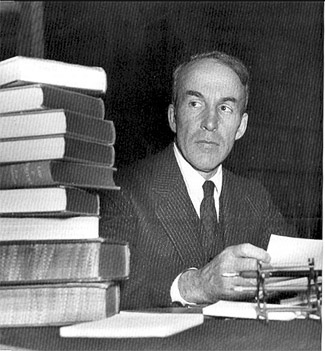
Archibald Macleish
Archibald Macleish (1892-1982) is a major modernist American poet and writer of the twentieth century, and I first discovered him through his critical writings, rather than through his poetry.  I have beside me as I write the first book I bought by him way back in 1978 when I was a mere twenty years of age.  That book is called Poetry and Experience (Harmondsworth: Penguin Books, 1961).  I remember being blown away by how easily he communicated to the reader his understanding of what poetry does and is.  In part one of that book, he discusses in a comprehensive way how poems work through sound, sign, image and metaphor.   In the second section of the book, Macleish treats of how what he has discussed in the first section functions in the works of Emily Dickinson, W.B. Yeats, Arthur Rimbaud and John Keats.  This book, consequently, would be a wonderful introduction to poetry appreciation for anyone wishing to learn more about how to read and enjoy it.

The Old Men in the Leaf Smoke

The old men rake the yards for winter
burning the autumn-fallen leaves.
They have no lives, the one or the other.
The leaves are dead, the old men live
Only a little, light as a leaf,
Left to themselves of all their loves:
Light in the head most often too.


Raking the leaves, raking the leaves,
Raking life and leaf together,
The old men smell of burning leaves,
But which is which they wonder – whether
Anyone tells the leaves and loves –
Anyone left, that is, who lives.

For me, it is the existential thrust of this poem that engages me as a reader.  I have already alluded to the psychiatrist Dr Irvin Yalom's listing humanity's awareness of its mortality as being one of the four great ultimate concerns in every human being's life.  Raking leaves is a perennial occupation for anyone with trees in their garden.  Growing up, it was one task I loved to do when I visited my country cousins and when I spent some three years as a would-be monk.  This poem uses the leaf as a symbol of the mortality of humanity and for the shortness and beauty of life.  I love the way Macleish speaks of "lives" and "loves" and "leaves" as they are, in effect, slight or partial rhymes as these words share the consonants "l," "v" and "s."  Such felicity of language enchants this reader, simple though this use of words is.

Repetition in the poem gives it a song-like sound.  As a country boy, I can almost smell the burning leaves as I have stood beside many a man burning dead vegetation in my time. Another riveting thing about this poem is its apparent simplicity that somehow draws us into the deeper mystery that life is.  It would seem that life is an amorphous mix of things in unity rather than a collection of random things.  When one rakes a garden one rakes many bits and pieces of vegetation and insect life and mud and clay together in a unity, and that unity in plurality suggests a mysticism at work in Macleish's sensitivity.  And this latter mystical sensibility is all too apparent to the perceptive and open reader.  Let's read the second stanza slowly and meditatively with the thoughts and sensitivities of this paragraph in mind:

Raking the leaves, raking the leaves,
Raking life and leaf together,
The old men smell of burning leaves,
But which is which they wonder – whether
Anyone tells the leaves and loves –
Anyone left, that is, who lives.


Mystically and linguistically leaves and lives and loves are all somehow magically one.  We are one with the poet raking them together as we live. On the one hand, then, this is a sad and depressing poem, and yet, on the other, this is a poem that suggests that we are part of the great cycle of nature, and we are ennobled by being part of it, never lessened, as, after all, we are the ones who do the raking.  We are the ones who do the maintenance on the garden.  We, in our turn, will become old men or old women, as the case may be, and we will surely smell of leaves and loves and lives.  Then, the beauty of the poem is that it does not state too much.  It connotes rather than denotes, and that is a wonderful device at the very heart of poetry.  Mystery, mystique, wonder and magic are always beyond capturing in prose.  They are more readily captured but never subdued or crushed in poetry.  That's why the last stanza defies paraphrase, which is surely anathema to anyone with a poetic sensibility.

Saturday, March 12, 2016

Thoughts on the Tao Te Ching 50

Poem 50


The Master gives himself up
to whatever the moment brings.
He knows that he is going to die,
and he has nothing left to hold on to:
no illusions in his mind,
no resistances in his body.
He doesn't think about his actions;
they flow from the core of his being.
He holds nothing back from life;
therefore he is ready for death,
as a man is ready for sleep
after a good day's work.

Commentary

One of the disputed quotes attributed to one of the mid-twentieth century Prime Ministers of Great Britain, Mr Harold Macmillan, who when asked what was most likely to throw any administration into crisis, is the famous one which goes, "events, dear boy, events!" Whatever about the accuracy or inaccuracy of its attribution, its wisdom is simple and so true.  Things happen either purposely or by chance, crises occur, accidents  take place and so on and so forth, and the wisdom we must learn to our definite cost is that we must weather these incidents with equanimity if we are to survive in this world in any sane sense.  This is the type of wisdom that our Taoist poet is alluding to in this poem above.  Once again, I hasten to point out that what he is recommending is no mere passivity in the face of random or caused occurrences, but rather an attitude of mind, a seemingly imperturbable spirit that will allow us peace of mind and sanity to deal with the human fall-out of those events no matter what the level or depth of their tragedy.

A weak flame tries to pierce the falling dusk: January 2016
Once again, at the heart of all spirituality is the contemplation of death and dying.  It has most rightly been pointed out by our inherited wisdom as a human race - in almost all spiritualities to a greater or lesser extent - that death is not the end of life - in fact, they maintain that it is part of the experience of living and central to life itself.  After all, individuality is but a little part of what life is.  We individuals are but mere specks of life who mostly subscribe to our own mythology of being so much more than we actually are: life is always greater than we small specks of it. However, when those close to us die, we are reminded in no small way what fragile vessels of life we are in actual fact.

In this regard, the Master lives by holding nothing back from life, by retaining nothing within his being that should not be spent on living and thereby adding to the sum total of life in the outer world.  He most naturally goes with the flow of life or the river of being.  As I type these fragile words on this virtual page in computer space, I realise how much more powerfully moving and existentially-loaded is the phrase "river of being" than the reductive, though solidly biological, "river of genes" of Richard Dawkins.  As humans, we are spiritual realities inhering so mysteriously and intricately in our temporary biological bodies. And so, as death and dying are inextricably part of all growth and of all life, the Master lives also by holding nothing back from the inevitability of life, not even his own death.  And so, dear friends, chance readers of these cyphers in virtual space, we could do worse than re-reading and pondering the above poem, which I repeat here for emphasis.  Namaste!


The Master gives himself up
to whatever the moment brings.
He knows that he is going to die,
and he has nothing left to hold on to:
no illusions in his mind,
no resistances in his body.
He doesn't think about his actions;
they flow from the core of his being.
He holds nothing back from life;
therefore he is ready for death,
as a man is ready for sleep
after a good day's work.


Sunday, August 23, 2015

Thoughts on the Tau Te Ching 6

Poem 6

The Tau is called the Great Mother
empty yet inexhaustible,
it gives birth to infinite worlds.

It is always present within you:
You can use it any way you want.


Commentary

The mother always has a central place in the life of all offspring, animal or human for obvious reasons.  Consequently, most cultures and religions have feminine gods as well as male ones. The act of physical birth is central to  life, and birthing also has its close psychological counterparts in the personality itself.  There is also a growing body of research that shows that babies in the womb feel, taste, learn, and have some level of consciousness.


The Blessed Virgin: an example of the Mother archetype

Chronic anxiety in the mother before birth can set the stage for a whole array of problems later: complications of birth, miscarriage, death, anxiety and/or depression in the child after birth and so on.  The opposite is also true, thankfully, and when a mother is feeling healthy and happy she produces the hormone oxytocin that is often called the molecule of belonging. The presence of this component creates feelings of bonding and strengthens the immunity in the baby. The message imprinted on the baby's brain through stimulated neurotransmitters communicates a sense of safety and peace, care and security. (See HERE)


Another example of the Mother Archetype
The famous psychiatrist Carl Gustav Jung invented the concept and term archetype.  In brief, an archetype may be defined as a representative model or universal example of something.  He saw them as essentially the basic elements or contents of what he termed the collective unconscious.  In essence, this means that they are symbols of abstract spiritual needs that are often projected onto other people to help individuals understand the world in which they live and grow and die.  The mother archetype that we often encounter in our dreams can be experienced as the archetypal nurturer or carer on the one hand or as a mother who abandons her child on the other - in which case the dreamer encounters an archetype with exaggerated flaws and complexes. This archetypal mother plays a dramatic part, consequently, in much storytelling, mythology and lore, and as a result also exercises an important role in psychology and psychotherapy.

Another important image associated with motherhood is that of womb which also exercises a central role in human psychological development.  It is interesting to note that the Latin word "matrix" originally meant "womb" and that it comes from the same Indo-European root that gives is the following words: "mother," and "mater" and other equivalents.  

Further, it is also interesting to note that a womb-tomb theme has been explored for instance in a recent archaeological book on the Newgrange Passage Tomb here in Ireland: Newgrange: Monument to Immortality (The Liffey Press by journalist, photographer and amateur astronomer Anthony Murphy.) In Irish archaeology we also find ancient carvings in stone called Síle na Gig (or Sheela na Gig or Sheila na Gig).  These ancient carvings are of women with exposed genitalia and are, interestingly and unusually, found in churches, usually near the doorway, and also in castles.  However, they are not erotic carvings as such as the women portrayed are old and are certainly not glamorous and some hold their genitals apart while others seem to be screaming.  Also, these Síle na Gigs are not unique to Ireland and they are also found throughout Britain, France and in some parts of Germany. One theory put forward for these carvings is that the Sheelas represent goddesses of birth and fertility and are pre-Christian artifacts in spite of their being found in churches which were in fact pre-Christian shrines or temples before they were Christianized.


Sile na Gig from Kilpeck Church (Hereford)  England


One way or another the archetype of the mother and the centrality of the image of the womb to civilization shoots through all cultures so it is not surprising to see them as being central to Taoism.  


I will finish these reflections here with a line that resonates with the above Taoist poem from the psalms of the Bible (also poems): "A prince from the day of your birth on the holy mountains; from the womb before the dawn I begot you." (Psalm 110).

Monday, June 8, 2015

Journal of a Soul 75

Of Living and Dying

"Live in the Now" - that's the lesson of Meditating on Death

“None of us gets out of life alive” is a quotation that remains in my mind.  I even remember the occasion of my first hearing it way back in the early 1990s.  I was listening to a radio programme by the Irish journalist Colm Keane on the subject of “Death Row” in some penitentiary in one of the southern states of the USA.  Our intrepid journalist interviewed a convicted murderer, who was placed behind a protective glass screen.  I remember that this man showed absolutely no remorse for the murders he had committed and saw life as being just a sort of game which one played; a game where it did not matter if one broke the rules as long as one got away with it.  In fact, the prison guards called him, “the animal.”  I remember the hair standing upright on my neck as I listened to this cold, unfeeling, rational, and obviously very intelligent man, express his thoughts and feelings on the crimes he had committed and on life in general. However, he expressed in eight short words the very heart of the human predicament – our temporality or our transitoriness on this minuscule planet that is a mere dot in the infinity of space. This state of affairs, when it hits home in the thinking and feeling and self-conscious human being, is exactly what we mean by the adjectives “existential” or “existentialist.” In short, our mortality lies at the heart of what essentially existentialism boils down to.

Freud used to say that the real repression in humankind was that of the base sexual desires that were deeply rooted in the dark pit of the unconscious.  However, Jung and others since have pointed out most wisely that the ultimate or real repression is that of death.  In one sense, this repression is a survival mechanism.  After all, the denial of death allows for egocentric humankind to push forward against all opposition – coming from either others or nature – to amass property, wealth and acquisitions of all kinds.  One might say, in quite a convincing sense, that all culture is created in the face of death – a sort of myth of significance and permanency in the teeth of the very impermanence and transitoriness of life itself.


Daffodil, Easter 2014

Here is where a philosophy of life comes in on the one hand and where the spiritual and religious traditions on the other have had some insightful things to say.  Admittedly religions in their more structural, authoritarian, hierarchical and indeed forbidding senses have been all too doctrinaire in their tenets and often murdered many who opposed them throughout the course of history.  However, here I am referring to a more devotional and spiritual model or aspect of such religions.  It is arguable that when religions lose vital contact with what the philosopher Eric Voegelin, called their “engendering experience” (or spiritual source or originating vision) they become monolithic, heartless and forbidding structures capable of dehumanising others.

The novelist, literary critic and professor of philosophy Umberto Eco opined that we read literature to learn how to die.  That notion is perhaps a bit one-sided.  I prefer to say that we read literature in order to learn how to live and die.  Living and dying are, in fact, the two sides of the one coin and are somehow paradoxically inextricably linked.  To be a living being is to be a dying being.  Essentially, death and dying are consequences of The Second Law of Thermodynamics or of the results of what’s called entropy.  A thorough understanding of this concept is beyond me as I have little background in Physics, but I can grasp some of its intentions and implications.  To my mind, Walter E. Requadt explains entropy very well for the ordinary person in the street in his wonderfully thought-provoking and stimulating blog called “The Happy Iconoclast” by invoking “Murphy’s Law”:

Unless we constantly insert new energy into a house by maintaining it, painting it, repairing it, the structure will eventually but inevitably be levelled to the ground. Its molecules will move from a lower level of randomization, from structure, to a higher level of randomization, towards unstructured debris.
Entropy is the reason why paint peels, why hot coffee turns cold. Furthermore, entropy is the reason why investments have a pre-ordained inclination to go sour -- unless we enhance success by inserting into the investment system additional energy in the form of strategy, work, calculated risk or other forms of energy. Entropy ensures that sugar, which becomes more randomized when it is dissolved in water, will not reconstitute itself in the crystalline form -- unless we apply heat energy from outside the system and evaporate the water.
Wherever we look, whatever we do, we must be acutely aware of the immutable laws of thermodynamics, especially the easily overlooked Second Law: Entropy. This fundamental law of physics ranks with other fundamental manifestations of the universe such as gravity, time and electromagnetism.
Anything that can go wrong not only will go wrong, it must go wrong, as decreed by the Second Law of Thermodynamics. (See here: The Happy Iconoclast)

To say that we humans die is to say that we like the entire flora and fauna of the earth are subject to the inevitability of the various laws of the universe, and most essentially to the law of entropy.

Along similar lines, Stephen Hawking told his biographers (Stephen Hawking: A Life in Science by John Gribbin and Michael White, 1992), who had once been Ph.D. students under his direction, that he had never succumbed to anger at life when he was stricken down with motor-neurone disease because essentially life was just chance anyway, and that it all boiled down to the randomness of nature – that is, to the chances involved or the probability of one’s parents meeting and then in the combinations of genes allocated by nature to your particular embryo.  These were, to say the least, random.


Professor Stephen Hawking


While Hawking likes to style himself an atheist, this stance is quite akin to that of a Buddhist spirituality (which some say is not religious anyway) that states that all suffering is caused by our attachment to things animate and inanimate.  All meditation practices and wisdom learnt therefrom and from study, and indeed from life in general, all help us to break free from such suffering by learning detachment. In other words, this is the implication of what is known as the Four Noble Truths of Buddhism that can be stated in simple terms as:

1.  Suffering exists: dukkha. (Life is unfair essentially, with much chance involved – Hawking’s position)
2.  Suffering arises from attachment to desires. (Wishing that things were different – that I shouldn’t get Motor Neurone disease and so on). It is called either samudaya or tanha in the various traditions and is the vain desire to have and control things. 
3.  Suffering ceases when attachment to desire ceases. (When I cease to be attached to unfulfillable desires or even fulfilled ones). The end to suffering is called nirodha. It is achieving Nirvana, which is the final liberation from suffering. The mind experiences complete freedom, liberation and non-attachment. It lets go of any desire or craving. It is an attaining of dispassion.
4.  Freedom from suffering is possible by practicing the Eightfold Path

It is important to note that in the Eastern religions, to meditate on dying and death is no mere negative action.  Nor is it a particularly morose one.  Only at first sight does it appear to be such.  Once one has meditated on either dying or death one comes from one’s sitting with a renewed commitment to living life more fully, and more especially living it more fully in the now.  To realise that truly life is fleeting and that we all end up either “six feet under” or being cremated is to deeply realise that the only answer is to live life more fully, more intensely by being aware of the sheer importance of living fully in the now.  After all, now is all we have.  In a sense, neither the past nor the future exists because the first has ceased to be and the second has not yet come.  In a deeper sense, all that exists is the present moment or the now.  In fact, conscious life is just that – an awareness of the abiding present or the passing now. (Or, as I look at these previous words anew, why not write "the abiding presence of the passing now"?


Picture of a Poppy I took April 2014

 Meditating on dying and death should never bring us down into the pits of despair because its real message is to deeply value and live in the enduring present.  Obviously, I don’t mean by this combination of words that everything stays the same or that nothing changes.  What I mean is that we only can really live in the now of time as it moves – that’s what I mean by the enduring present.

We read in the Tao Te Ching:

If you realise that all things change,
There is nothing you will try to hold on to.
If you aren’t afraid of dying,
There is nothing you can’t achieve.

Trying to control the future
Is like trying to take the master carpenter’s place.
When you handle the master carpenter’s tools,
Chances are that you’ll cut your hand.

(Tao Te Ching, verse 74, Lao Tzu, translated by Stephen Mitchell)

In summary, then, we have two choices and the choice recommended by all spiritualities worth their salt is to choose life not death everyday of our lives by practicing living in the now.

Tuesday, April 22, 2014

Journal of a Soul 51

To Travel or Not to Travel


To travel or not to travel, sometimes that is the question.  We are a restless species at base. The great St Augustine described himself as "a restless seeker."  In a sense, that fifth century saint summed up the human predicament nicely.  An acquaintance of mine who died over a year ago was not alone a "restless seeker," but he was also a restless traveller.  The way he dealt with his imminent demise was to take to travelling with an increased compulsion, if his previous obsession with it had not been intense enough.  Even to meet this man, you instinctively and intuitively picked up his restlessness.  He was always on the move, always going places, always living in the future, always making plans and more plans and more plans.  He was a deeply discontent person, and evidently unhappy in the moment. 

This road in Marley Park will eventually lead into the mountains
As I write these lines on the screen before me, I am at home in my attic study, having just finished one of Deepak Chopra & Oprah Winfrey's online meditation sessions.  Usually, I would be down in Isca Marina in Calabria for Easter, but this time I chose to stay at home while both my brothers travelled southward to the Mediterranean.  I have also just completed an eight week guided course on mindfulness in my local university -DCU.  Maybe that was one of the contributing reasons to why I did not wish to travel this Easter. However, there were also issues of getting my house into a more homely state to dwell in.  I have managed to get some long-standing jobs done about the house, and so not travelling did help.

However, for me as I live alone, I enjoy the peace and solitude of my Easter holidays.  I find that when I stay put alone I do a lot mental travelling - sometimes maybe too much. However, such internal journeying can be either stimulating or even disturbing.  Let me spell out what I am about here.  Restlessness can result in our desire to physically travel, but it can also see us staying put and travelling the equally hazardous roads of our own inner landscape.

And so as I sit here typing these words on the screen of my laptop I am travelling the roads of my own inner landscape.  Thankfully these are mostly interesting pathways leading me to a great extent along scenic routes to the discovery of a newer and deeper sense of Self. Moreover, I am also painfully aware that inner exploration for anyone of a depressive nature can be most disturbing, deeply unsettling and not a little scary.  I have written much over the years in various blogs about my suffering from clinical depression of the uni-polar variety.  Hence, I have known only too well the back-roads and side-roads of sadness and depression for a good number of years in my past life.  Thankfully, I have had no reason to travel those dreadful by-ways of the lonely depressed mind in the last sixteen years. Knowing them only too well, and my consequent awareness of what can pull me away from the more secure roadways and pathways to the real self and  into those dreadful by-ways of depression has led me to leading my life with a good map, both medical and therapeutic.

So journeying to the centre, or journeying to the Real Self, can and often is a painful one. However, as I have just stated, like any journey we set out on, we must make preparations, arm ourselves with the best maps, bring passports, visas, money and so on.  For the journey inward, we need the help of friends, spiritual guides, reading, discernment, patience, humility, openness and above all compassion for the Self.  All self-exploration, then, must be done with sound preparation and guidance, because as all spiritual teachers, guides, counsellors, therapists and any good, solid and well-trained facilitators of it will know, any form of deep meditation or mindfulness must be accompanied by solid sustenance for the journey. 

Flowers in Ardgillan Castle & Demesne, Skerries
In a nutshell, the difference between mindfulness and meditation is that the former is the secular face or incarnation of the latter.  Mindfulness is meditation divested of its religious garments, to use a metaphor.  However, in practice, to my mind at least, they are very much the same thing.  In short, I believe that mindfulness can be done at several levels.  The basic or foundational level is that of being mindful of the body and breathe.  The next is the level of being mindful of the thoughts, feelings and emotions.  A further and deeper level would be mindfulness of the Inner Self or the Real Self.  Again, more religious incarnations of mindfulness, would speak of a spiritual, if not a divine, experience associated with either meditation or prayer.  However, I do believe my nutshell explanation in the first sentence in this paragraph gets at the essence of the thing for the beginner. 

Yesterday and the day before I went out walking with my camera in hand, after I had done my period of meditation.  I found on both occasions that I had a new and more aware sense of the beauty of things than I usually would have if I had not done any mindfulness practice at all. Having said that, I was also somewhat overcome, too, by the fragility and beauty of life.  I had a sense of the destructiveness of the power of the more worldly pursuits of humankind, namely the despoiling and destruction of nature that is occurring at an alarming rate.  One would have to be living in a cocoon not to be aware of the environmental destruction we are subjecting our planet to literally on a minute by minute basis.  

Now, as an experienced meditator, I know myself only too well and realize that I cannot let myself dwell too much or too deeply on the flip-side or negative side of the "realization of the fragility and beauty of life" as such would bring morbid thoughts on.  Enough to go out into my garden, mow the lawn, and do my own little bit to nurture nature, and in so doing nurture my own soul.   Likewise, I recommend getting involved in one or other green campaign because so doing lessens the negativity that can be overwhelming when we contemplate how humankind threatens the very survival planet Earth.

More flowers, Ardgillan Park, Skerries
Recently, I was counselling a young boy who is suffering with depression.  He is also attending a psychologist. He was sent onto me by the school counsellor as she felt that my teaching him some meditation and visualization practices might help him.   Usually, I make a brief sketch of the client's state of mind on the whiteboard, with his help.  Needless to say, I work with all the good advice given by his psychologist and school counsellor, ensuring at all times that I do not contradict what they say, as working with others and on the same path is always crucial.  I sketched out what he was doing with his psychologist.  She was working with what made him Happy and what made him Sad.  We listed both these on the whiteboard.  What made him sad was that life was ultimately about loss, that everything and everyone grew old and died.  What made him happy was everything to do with living.  These were polar opposites as we sketched them out.  The birth of his little sister in more recent times has been a moment of singular happiness and joy for him. "Seek life", "go on living", "live in the now" were all messages we felt were good for living.  I recommended that he buy a present for his little sister and one for himself to celebrate the option for life.  When he returned the following week he had bought both presents and was a far happier boy.  As we were talking we spoke of the cycles of life and that often the life-death cycle can be a unity which we must respect as we are integral parts of it.  To get lost in either end of the cycle might not be the whole truth somehow.  Certainly getting lost in a cycle of depression, where we choose the dark and the negative and the deathly and death-ridden will lead us to despair.  Choosing sheer hedonism, a life of sensual pleasures may be choosing life as nothing but empty satisfaction after empty satisfaction.  Such a choice may, in fact, be very superficial.  Choosing to hold the hand of a sick or dying person, may paradoxically be choosing life, because those last moments of that person's life are so worthwhile.

Now, this is what I mean by travelling within.  Another metaphor could be "internal weather."  What's the weather like in your mind now? Stormy? Sunny? Cloudy? Grey? Dark? Dismal? Rainy? Windy? Night? Day? Sunset? Sunrise? and so on.  We do mindfulness and meditation and we travel ever deeper or ever higher (depending on your directional metaphor) into the Real Self, but that journey has many twists and turns, many obstacles, many hills and valleys, many rivers to be crossed, even seas and mountains at times - all of which means that we need to be well prepared and always look for help.  Going it alone is always dicey, to say the least.

To all the readers of this journal of a soul, I say "Buon viaggio!"

Saturday, February 8, 2014

Journal of a Soul 43

The Mess of Things


Winter scene of Dublin Bay from Clontarf
We learn lessons almost as soon as we are thrust forth from our mother's womb.  In the terms coined by the father of psychoanalysis the child learns early that there is a clash between the "pleasure principle" and the "reality principle," and it is somewhere in the clash of those two that the reality of life lies.* 

I can recall as a young boy when I first became aware that things broke, that plants decayed and that animals died, and finally that human beings also broke and died.  The lessons of mortality are soon learnt indeed by the growing child.  I vividly recall following a wind-up toy around the floor as a young boy and then my dismay when it ceased functioning consequent on my having wound it up too tightly.  Or when my father got sick when I was just three years of age - he lost the use of his right arm to polio and spent the rest of his life depending on his left arm only.  Or my grandmother Mary Phoebe Brophy laid out on her deathbed in the front room of the Crumlin home.  Life is messy and we learn to acknowledge its mess early. Admittedly, for some, life can be a whole lot more messy than for others.

Types of Mess

In the past few weeks I have dealt with various types of mess, mostly in the life of others, and I suppose any mess I might have experienced would be my ability or rather inability to be of help or my inability to deal with theirs at a personal level.  However, thankfully, I manage to forget about their mess as soon as work ends and I go home.  Otherwise, I would be no good to any of them. (When I was a very young teacher, I was not quite so good at doing that).  In those past few weeks I have dealt with one young lad who suffers from anger issues and shouts and roars at his dad mostly.  They have exchanged blows at times.  I have listened to another who told me that his mother (a recovering drug addict on metadone treatment) and her partner attacked him one morning and that he had rung the police. (We duly reported this to the social services, of course) I listened to another boy who is suffering from depression, and another who exhibited schizoid or schizophrenic traits and told me that the group he was founding was going to take over the world starting with Africa. Somewhere in the midst of all his outpourings he talked about exterminating those in the human race that were useless, and when he found me to be listening only and not reacting that perhaps he was playing mind games and how he didn't like anyone trying to get into his mind. (Some few Asperger boys exhibit symptoms of schizophrenia and that is a clinical fact)** I mention these instances here not to impress the reader with my psycho-therapeutic prowess or my empathy with others.  I do so to illustrate the various messes we humans find ourselves in.

Life is Unfair


I have always found that the simple statement "life is unfair" as the most basic of philosophical foundations on which to base one's life.  I remember reading it in a biography of Steven Hawking, a book co-authored by two of his postgraduate students about twenty years ago.  They had asked him whether he was angry with life for being confined to a wheelchair, indeed to be rendered speechless and motionless almost by Motor Neuron disease.  He replied in words akin to the following: "Why should I?  As a physicist I know that life is all about chance and luck -Evolution has nothing to do with fairness or justice." Obviously these are my words and are a mere paraphrase of what this world-renowned physicist said all those years ago and are rendered here through the mists of memory. However, they capture the substance of what Hawking said.

Acceptance and the Onward Thrust of Life


Sometimes the desire to understand things can frustrate us, especially our desire to understand and make sense of life.  I see this almost all the time with the Asperger boys with whom I work.  I teach them Mathematics, Life Skills, Communication Skills and Social Interaction.  One obstacle to tackling mathematical problems (in the less mathematical student) is their utter obsession with understanding everything and not being able to accept this or that method on trust to such an extent that they down tools in despair and say simply "I can't understand that!" I tell them that we are all simply finite beings.  We are not all superhuman, nor could we ever be.  There are many things which we should take on trust.  I tell them that I love technology, computers, iPads and cars and airplanes and so on.  I don't understand everything about my computer or the engine of my car but that I can drive both. The rest I can take on trust.

And so acceptance of our finitude means also accepting all the things we cannot understand and trusting others who understand some of those things.  Acceptance means going with the flow, swimming with and not against the current.  Now, I hasten to point out here that swimming with the current means just that - swimming, that is doing something, not just abandoning oneself to fate.  I stress again - acceptance is never blind fatalism.  Acceptance is an attitude that accepts things in a way somewhat similar to the following manner: "Okay, there is no use denying the obvious, I have high blood pressure, suffer from endogenous depression, am borderline obese and borderline type 2 diabetic.  Now I have the first two regulated by medication and meditation and by looking after my mental health.  I admit I must take more exercise and eat much more healthy foods so that I can control the type 2 diabetes that threatens by my diet.   I know this is possible with determination. Yes, this is something, I, Tim Quinlan must get on top of as a fifty six year old man."  Okay, all of the last several lines are true as they are an account of my medical condition.  I will do my very best to get down my weight over the next few months.  I need to drop 1 stone and I'll be fine apparently - well, as fine as any 56 year old can be.  I am a member of the local gym and do my best to take exercise and keep my weight under control.  All of that is the onward thrust of life, built on the acceptance of the reality of me and my state of health now in February 2014.

Shit Happens but Shit also Grows the Roses


The Autumn leaves in Fairview Park, Dublin, 3
We all need to accept the mess that life is or can be, and develop coping skills to guide us safely through that mess.  Life will throw many messes at us, and our task is to deal as best we can with the shit it throws at us.  That's why the Self-Help sections of bookshops and online book sellers are so well frequented.  That is also why complementary medicines and therapies are becoming so commonplace in these modern times.  Please notice I have said complementary, not alternative.  Listening to Professor Richard Kearney recently on the radio, I noticed that he spoke about dealing with his depression by the use of both medication (antidepressants) and psychotherapy and meditation, and that the treatment of mental illness needed a both/and approach, not an either/or.  As a sufferer from endogenous depression for the last twenty years I have believed this right from the start of my getting to grips with my illness, and more or less overcoming its severe debilitation. 

After coming to grips with my depression at forty years of age I have travelled more, written more - I wrote some four books, one of which I got published, done more courses, studied more, been involved in more voluntary organisations than I had ever done prior to forty.  In other words while shit happened to me, that same shit also helped grow roses which I never knew could have bloomed in my life.

The Mess of Things Revisited

As I look around me as I write I am aware of the small but significant mess of things about me.  I have a few thousand books I guess and I have spent about an hour trying to put some order on a few hundred of them.  When their authors wrote them, it is my contention that they were trying to put order on some messy ideas they had about life.  I was trying to separate my books into sections so that I'd more easily be able to access them. I also have a lot of washed clothing awaiting the pressing of my iron, some breakfast things that need to be washed and put away, documents that need to be sorted, bills that need to be paid, forms that need to be filled in and returned to this or that government department and finally, my own lack of inclination to engage with some if not all of this stuff is also part of the mess.  As I look around me I see this little mess that my life is now.  However, as I write these words I take great delight in the order that I am putting on the mess that is my existential being here and now in and through the task of making words and thoughts behave upon a page.  It is in the struggle for order, pattern and control versus the mess of disorder, lack of pattern and chaos that essentially the human (if not divine) dwells.


Endnotes

*Freud argued that the young baby realises early the importance of the pleasure principle. If the little child cries and is fed quite often when it does so it begins to realise that its needs can be met, its hunger and thirst satisfied and that such leads to real pleasure and gratification. Simply put, this is the “pleasure principle.” Now, it would be great if we lived in an "ideal world" where all our needs, wants and desires were satisfied. But such is not the real world. Instant gratification is not the way of life. Everything comes at a price. The child also learns very early on that sometimes when he/she cries their needs are not met immediately. In other words that child is beginning to learn that harsh reality is just that - harsh! It is almost superfluous to state that Freud called this meeting with harsh reality the "reality principle." The child now embarks upon a more balanced take on life – fine, it is well and good that one’s desires, needs and wants are met, but such does not happen all of the time. The young child quickly learns to balance the "pleasure principle" with the "reality principle."

** see this link for information about a possible link between Autism and Schizophrenia:  Here