Showing posts with label Gardens. Show all posts

Sunday, September 18, 2016

Poems I Journey With 10


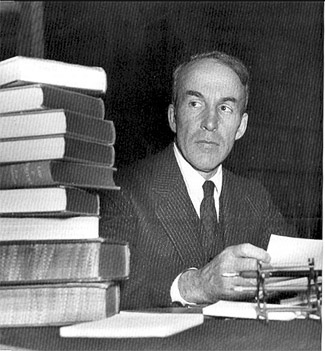
Archibald Macleish
Archibald Macleish (1892-1982) is a major modernist American poet and writer of the twentieth century, and I first discovered him through his critical writings, rather than through his poetry.  I have beside me as I write the first book I bought by him way back in 1978 when I was a mere twenty years of age.  That book is called Poetry and Experience (Harmondsworth: Penguin Books, 1961).  I remember being blown away by how easily he communicated to the reader his understanding of what poetry does and is.  In part one of that book, he discusses in a comprehensive way how poems work through sound, sign, image and metaphor.   In the second section of the book, Macleish treats of how what he has discussed in the first section functions in the works of Emily Dickinson, W.B. Yeats, Arthur Rimbaud and John Keats.  This book, consequently, would be a wonderful introduction to poetry appreciation for anyone wishing to learn more about how to read and enjoy it.

The Old Men in the Leaf Smoke

The old men rake the yards for winter
burning the autumn-fallen leaves.
They have no lives, the one or the other.
The leaves are dead, the old men live
Only a little, light as a leaf,
Left to themselves of all their loves:
Light in the head most often too.


Raking the leaves, raking the leaves,
Raking life and leaf together,
The old men smell of burning leaves,
But which is which they wonder – whether
Anyone tells the leaves and loves –
Anyone left, that is, who lives.

For me, it is the existential thrust of this poem that engages me as a reader.  I have already alluded to the psychiatrist Dr Irvin Yalom's listing humanity's awareness of its mortality as being one of the four great ultimate concerns in every human being's life.  Raking leaves is a perennial occupation for anyone with trees in their garden.  Growing up, it was one task I loved to do when I visited my country cousins and when I spent some three years as a would-be monk.  This poem uses the leaf as a symbol of the mortality of humanity and for the shortness and beauty of life.  I love the way Macleish speaks of "lives" and "loves" and "leaves" as they are, in effect, slight or partial rhymes as these words share the consonants "l," "v" and "s."  Such felicity of language enchants this reader, simple though this use of words is.

Repetition in the poem gives it a song-like sound.  As a country boy, I can almost smell the burning leaves as I have stood beside many a man burning dead vegetation in my time. Another riveting thing about this poem is its apparent simplicity that somehow draws us into the deeper mystery that life is.  It would seem that life is an amorphous mix of things in unity rather than a collection of random things.  When one rakes a garden one rakes many bits and pieces of vegetation and insect life and mud and clay together in a unity, and that unity in plurality suggests a mysticism at work in Macleish's sensitivity.  And this latter mystical sensibility is all too apparent to the perceptive and open reader.  Let's read the second stanza slowly and meditatively with the thoughts and sensitivities of this paragraph in mind:

Raking the leaves, raking the leaves,
Raking life and leaf together,
The old men smell of burning leaves,
But which is which they wonder – whether
Anyone tells the leaves and loves –
Anyone left, that is, who lives.


Mystically and linguistically leaves and lives and loves are all somehow magically one.  We are one with the poet raking them together as we live. On the one hand, then, this is a sad and depressing poem, and yet, on the other, this is a poem that suggests that we are part of the great cycle of nature, and we are ennobled by being part of it, never lessened, as, after all, we are the ones who do the raking.  We are the ones who do the maintenance on the garden.  We, in our turn, will become old men or old women, as the case may be, and we will surely smell of leaves and loves and lives.  Then, the beauty of the poem is that it does not state too much.  It connotes rather than denotes, and that is a wonderful device at the very heart of poetry.  Mystery, mystique, wonder and magic are always beyond capturing in prose.  They are more readily captured but never subdued or crushed in poetry.  That's why the last stanza defies paraphrase, which is surely anathema to anyone with a poetic sensibility.

Thursday, August 18, 2016

Thoughts on the Tao Te Ching 80

Poem 80

If a country is governed wisely,
its inhabitants will be content.
They enjoy the labor of their hands
and don't waste time inventing
labor-saving machines.
Since they dearly love their homes,
they aren't interested in travel.
There may be a few wagons and boats,
but these don't go anywhere.
There may be an arsenal of weapons,
but nobody ever uses them.
People enjoy their food,
take pleasure in being with their families,
spend weekends working in their gardens,
delight in the doings of the neighborhood.
And even though the next country is so close
that people can hear its roosters crowing and its dogs barking,
they are content to die of old age
without ever having gone to see it.


Commentary

This poem is certainly one we moderns would not understand as we live in a global village where the whole world has become our home. We can travel anywhere, now that air travel has become relatively cheap and within almost everyone's capacity.  Very few of us in the Western world do not go abroad for holidays or business or whatever.  Indeed, should we not wish to travel somewhere physically we can even journey there virtually by way of cinema or the Internet, both of which can bring us anywhere we wish imaginatively.  And the imagination and reality are next-door neighbours in a sense. 

As a man of 58 years who was born in a small rural Irish town in 1958 and who experienced at least for a few years pre-television era in that country setting, I would have an inkling of what the poet in the above poem is getting at.  I well remember a young friend's parents having bought their first tv set as RTE, the Irish public broadcaster began life on the 31st of December 1961.  They must have bought it soon enough thereafter, so I would have been about 4 years of age at the time. The TV ushered in the New Ireland, as from then on the global visited in a virtual and imaginative sense the sitting rooms of all the homes in Ireland. Therefore, I can slightly understand the above poem.  Now, we must remember that the Tao Te Ching was written roughly around the sixth century BCE in a very rural and primitive setting so the values of a small community would have been the prevailing ones: working in the fields, ploughing, planting seeds, watering the crops, going to the market, harvesting, participating in  the local gatherings, chatting and conversing.  Everything would have revolved around the extended family or clan, and then around the local tribe or community. The home and the community and the values asssociated with both would have been the origins of the only values known to anyone.  Therefore, it is against this background that we have to understand the above poem.

The above poem presents us with the ideal, indeed with the idyll.  It is purely romantic and is filled with Utopian sentiments.  No such place on earth could possible exist.  However, when we remember that it is a poem, that it was written so long ago and that as a poem it should not be taken literally. Bearing all this is mind, we may then read it and meditate upon it and see what wisdom we might learn from it.

One lesson is that of valuing our lives, valuing our experiences of life in the now, valuing simply being.  We are all so busy rushing to succeed, make more money, get a better job, travel to more countries, gain more wealth, acquire X, Y or Z new item that we often forget that it is the simple things in life that really make us happy like those mentioned in the poem: (i) enjoying our workaday life, (ii) getting in touch with nature, (iii) gardening, (iv) building up and enjoying our homes, (v) enjoying simple but good meals with our families and friends, (vi) supporting all the events that take place in the community, and (vii) happily growing old listening to the sounds of what naturally occurs in nature.

These are obviously extremely romantic and Utopian ideas, but the poem hints that we may experience an intimation of that blessed state by being more mindful and attuned to living in the now.

Namaste, friends. 


Wednesday, April 3, 2013

Journal of a Soul 11

The Makers of Meaning
A book I am currently reading.


We are makers of meaning.  Without meaning, life is shallow and hollow. Without it, we become heartless and soulless automata.  Eventually, we literally dry up, wilt and die like an uncared for plant.  Immediately here, we have the makings of a good metaphor – living a good life is, in a certain sense, gardening for the soul.  This is a metaphor suggested by Carl Ransom Rogers in his Person-Centred Therapy (PCT).

In a major sense, too, our opening metaphor here, namely gardening for the soul, suggests a firm connection with nature.   And, further, this is one of modern and post-modern humanity’s greatest faults.  Not alone do we lack a real connection or relationship with the earth and its goods, but we destroy them with impunity.  Even worse, the acquisitive and capitalist cultures we are born into allow us to be virtually indifferent to the earth and its bounty.  Sadly, we meet many people who are unaware of the destruction we are doing to the bountiful planet on which we live. 

Maybe at this juncture in the history of humankind, when we are in the midst of the worst economic crisis we have ever witnessed, we are ready for a wake-up call.  Perhaps, greed and rapacity have shown us their worst results – corruption, bankruptcy, selfishness, and a sheer lack of appreciation for things of the spirit or the soul, for values other than those linked to financial profit at all costs.

But, any of us who are idealists, who believe that something else is needed over and above rapacious capitalism for the redemption of humankind, are often left totally disillusioned.  In this side of the developed world – Europe – it would seem to this economically ignorant commentator that the powers that be, namely Germany and France don’t really want to help the rest of Europe in solidarity.  Rather, they prefer to self-righteously preach about unfettered over-spending by smaller countries and lack of regulation, and not a word about their own unfettered over-lending.  There is not much solidarity in squeezing the last penny from some of the poorest nations who in turn are squeezing their own poorest citizens.

This is no political qua political post, dear reader.  It is, perhaps, political qua spiritual, as all spiritual stances have political and financial consequences.  Humankind has lost its way as all spiritual values are being lessened and eroded in the name of the mighty euro or indeed the mighty dollar or whatever the ascendant currency might be. What, then, are these values, the decrease of which, I lament here?  Let me try to list them in no specific order:

  1. Connection with the earth.  Call her Mother Earth or Gaia – see James Lovelock’s notion of Earth as one great organism.  Notice the connection of all simple religions and spiritualities with the Earth as Mother or provider.  In this regard reading the spirituality of the American Native Indians is very enriching.  (Note to self: I must read more here.)
  2. Fostering creativity in all its incarnations: drawing, painting, writing, sculpting, composing music, singing, dancing, acting and so on and so forth.  What do they tell us about humanity?
  3. The moral call – the call to fight for justice on our own doorstep as well as further afield.
  4. Asking questions like: Where does this moral call come from?  Why behave in a just way? Where or who is the source of this moral call?  Is there a source of Good, i.e., God?  The present writer believes this is a very important question to discuss, though he is agnostic about the answer.  He certainly has very few answers.  But in the tradition of Socrates all questions, especially the hard ones must be put.
  5. What is friendship? What is love?  Or again, in reference to the current financial crisis: What is SOLIDARITY? What is the common goal of humanity?  In how far am I my brother’s keeper?
  6. What lessons have we learnt from the current worldwide DEPRESSION?
  7. What, essentially, have the traditions of the great world religions to teach us about our values as humans?


If we as humans are the makers of meaning, and the makers of values, then we had best be up and at it, and not leave the way clear for the empty philosophies of bureaucrats and capitalists, who, in the words of the great Irish litterateur Oscar Wilde, “know the price of everything and the value of nothing.”

Monday, June 25, 2012

Journal of a Soul 8

Badolato Marina Beach, June 2012
The fleeting nature of time has long been a topic in philosophy.  Things are so much in flux that the ancient pre-Socratic philosopher Heraclitus declared so insightfully that we cannot step into the same river twice.  Our grand-parents, now long since passed away, used to opine, also rather wisely, “that much water has passed under the bridge” since X, Y or Z happened.  They intuitively had grasped exactly what Heraclitus meant.
As a small boy I used hate travelling with my parents to my father’s home town, called Roscrea, in the County of Tipperary in the Southern midlands of Ireland.  He would inevitably end up in this or that erstwhile neighbour’s house or in this or that local hostelry reminiscing on his youth, on how quickly the years had passed, on where A or B had lived, on whether C or D were still in England or America and how sad it was that E and F were now no more. It used to drive us children mad as we just wanted to be outside playing.  We simply did not wish to be sitting indoors while the older people went back in time in their minds.  And yet we were often bemused that my father could remember decades before the then present time.
As I age it has now become quite interesting that I can now appreciate what made my father misty eyed as he reminisced about the so-called “good old days” which were not that good at all at all.  At 54 years of age I can recall clearly when I was three years old playing with a toy lorry in the lane at the back of our house in Roscrea.  Now that’s 51 years ago or just slightly over five decades in the past.  That time has passed so quickly is at once frightening and somewhat consoling too.  If everything were to stay the same there simply would be no being or becoming at all, no ageing and consequently no death.  Indeed, if everything were to remain the same would there even be birth?  Without change there would be no life at all.  Then, paradoxically, one could say that without death there would be no life at all. 
To be is to become; to become is to grow old; to grow old is to die.  St Augustine once defined time as “the measure of change.”  For a fourth century intellectual that was not a bad definition of time at all.  To grow is to change.  To live is to grow and change, and indeed, eventually to die.
Modernity has a lot going for it.  Health of humans and indeed animals has improved remarkably in the last, say, one hundred years.  People are now living longer; women into their late eighties and men into their late seventies and early eighties.  I’m taking these figures from my own experience here in Ireland, and have not checked them out, but they are roughly accurate.  Modernity has brought comfort with it also, with so many pieces of modern technology to help us in our every daily task.  And so living has become less of a struggle.  We are also so much better educated.  Added to that, we can practically travel anywhere we want in the modern world, again with greater ease and with so much less cost than one hundred years ago.  Within reason we have more control over our lives than our forefathers.  And yet, this control over our lives has a downside to it.
Modernity, and indeed post-modernity if that is the way to describe our time in the early 21st century, have hoodwinked us into believing almost the impossible at times.  We, in the Northern hemisphere certainly, believe that we are entitled to all the benefits that a modern state can give; believe almost at times that the world (or State) owes us a living; believe that we can conquer the impossible; live longer and ever longer; look to our selfish rights without adequately considering our due responsibilities.  And this is where we have lost some of the extraordinary advantages of less modern times.
Another view of Badolato Beach
Those advantages were more of a “soul-making nature.”  John Keats, the great poet of the English Romantic period, who lived to be barely 25 years of age used to call this world the “vale of soul-making.”  The poor man died very young from Tuberculosis.  Even travelling to the wonderfully warm climes of Rome failed to stop the inevitable.  In other words, from our sufferings we can learn.  Now, here I am not necessarily talking about suffering and dying per se, or about learning their profound if bitter lessons.  No, I am referring to the fact that we can learn to slow down; learn to take stock of life; learn to prioritize things in our lives; learn to listen to our own Heart or Soul; learn to listen to the Heart or Soul of an Other; learn to be in tune with the rhythms of life; learn really to be at one with the natural sequences of the seasons.
And so to finish this post, I have learned to slow down firstly the hard way by enduring a bad mental breakdown occasioned by too much stress when I was forty.  But I knew that I had to do more.  I then began to do many creative soul-making things like Meditation, taking more time out, learning to say NO, learning to do new things, to holiday more, to write more, to reflect more, to go to more personal development conferences, to get to know positive people and to spend more time with such people, to cultivate friendships because truly relationships are like plants, they will wither and die if not cared for.  Even in the concrete jungles of modern cities each of us can at least cultivate a small garden on our balconies.  I have seen many of them in the biggest and most alienating of cities.  I have also been privileged to have been welcomed into the smallest and most homely and soul-full of homes in the biggest of cities.  In other words, with practice we can learn to grow our own Souls with care.  We can also learn in the most alien of places to put down roots of Self.  By doing so we will become attuned once again, like our forebears to the rhythms and cycles of the seasons where it is just as natural for the ripe fruit to drop from the bough as it is just as natural for the seed to die and give forth the life of a new young shoot.  Being in tune with the rhythms and cycles of the seasons, with the circular nature of time, readies us to face our own necessary part in those same cycles and rhythms, of which our dying and death are just such a little part.