Showing posts with label Hope. Show all posts

Sunday, September 25, 2016

Poems I Journey With 14

Emily Dickinson
After Gerard Manley Hopkins, I turn most often to the wonderful and wondrous rhythms of the poems of Emily Dickinson, another spiritual and mystical poet who also loved her periods of isolation and aloneness and even ascetic living like the Victorian Jesuit priest and convert. Dickinson was born in 1830 (fourteen years before Hopkins was born) and died at the age of 56 in 1886 when Hopkins was 42.  While their lives overlapped then for some 42 years in terms of linear time neither would obviously have been aware of the writings of the other given their personal and indeed the social circumstances of the day and indeed the fact that neither sought publication of their work.  But, I personally get a lot of spiritual sustenance from the poems of both great poets. Both were also most unusual is that they both broke away from the then conservative conventions of what poetry was deemed to be. While both are spiritual and mystical poets their work is correspondingly completely "sui generis," unique and authentic to the very syllable of their output.  As her poems are so short I will offer three short favourite poems from Dickinson's pen here below:

1. Hope is a thing with feathers

Hope is a thing with feathers—
That perches in the soul—
And sings the tune without the words—
And never stops—at all—

And sweetest—in the Gale—is heard—
And sore must be the storm—
That could abash the little Bird
That kept so many warm—

I've heard it in the chillest land—
And on the strangest Sea—
Yet, never, in Extremity,
It asked a crumb—of Me.

2.  Heaven

"Heaven"—is what I cannot reach!
The Apple on the Tree—
Provided it do hopeless—hang—
That—"Heaven" is—to Me!

The Color, on the Cruising Cloud—
The interdicted Land—
Behind the Hill—the House behind—
There—Paradise—is found!

Her teasing Purples—Afternoons—
The credulous—decoy—
Enamored—of the Conjuror—
That spurned us—Yesterday! 


A somewhat younger Emily Dickinson


3. My cocoon tightens, colors tease

MY cocoon tightens, colors tease, 
I 'm feeling for the air; 
A dim capacity for wings 
Degrades the dress I wear. 

A power of butterfly must be 
The aptitude to fly, 
Meadows of majesty concedes 
And easy sweeps of sky. 

So I must baffle at the hint 
And cipher at the sign, 
And make much blunder, if at last 
I take the clew divine. 

The Briefest of Commentaries:
I love Emily Dickinson's poems because they invariably give me a spiritual lift and a deep insight into the depths that simple things can have. I also like her unique writing style with dashes, which is completely unique to her and revolutionary, indeed, at the time she was writing.  She is simply unique, "sui generis" and so authentic. Who could not be moved by the image of a little bird?  It is at once so fragile and yet can fly to such heights and gain an overall view of things we humans are not privy to. Then the equating of hope - a complete abstraction - with that little physical image of a bird is simply mindblowingly powerful.  That equation or juxtaposition of two utterly different "objects" is so wonderful and wondrous that it strikes us immediately as being insightful. Hope, which we all need to keep going, is often as fragile as a little bird which we often doubt will be able to weather the storms of life. Where does that little bird of hope perch? Yes, in the very cage of our souls!  It sings a tune without words, the delicate and fragile tune of hope.  And that strange little fragile creature, that brittle bird of hope, never asked a single crumb of sustenance from its jailer, that is, ME and YOU and US!!

The second poem is about Heaven. However, no mystic will ever offer a cheap or cheapened image of that place or state or whatever we call Heaven.  Dickinson presents that reality as somewhat unattainable like the apple on the highest bough while we are mere children playing about the trunk of that great tree. There are hints also of Moses not being granted his wish to the Promised Land which has traditionally also been linked with whatever Heaven is, may be or could be. In fact, I like this poem also, and have placed it under the poem on Hope as Dickinson talks about the reaching of the apple being absolutely hopeless.  In that regard let me repeat its opening stanza for our contemplation here:

"Heaven"—is what I cannot reach!
The Apple on the Tree—
Provided it do hopeless—hang—
That—"Heaven" is—to Me!

The third poem reminds me of the sage advice, or at least the wise comment of Anais Nin (1903 - 1977) that the day will come for all of us "when the risk to remain tight in the bud is more painful than the risk it takes to blossom."  These words resonate with those of the entire poem and especially those of the first stanza. The growth of the little seed in the bud to full flower and blossom parallels the formation of the butterfly from egg to larva (caterpillar) to pupa (chrysalis) to adult butterfly:

MY cocoon tightens, colors tease, 
I 'm feeling for the air; 
A dim capacity for wings 
Degrades the dress I wear. 

Monday, August 31, 2015

Thoughts on the Tao Te Ching 13

Poem 13

Success is as dangerous as failure.
Hope is as hollow as fear.

What does it mean that success is as dangerous as failure?
Whether you go up the ladder or down it,
your position is shaky.
When you stand with your two feet on the ground,
you will always keep your balance.

What does it mean that hope is as hollow as fear?
Hope and fear are both phantoms
that arise from thinking of the self.
When we don't see the self as self,
what do we have to fear?

See the world as your self.
Have faith in the way things are.
Love the world as your self;
then you can care for all things.


Reflections


These poems from the Tao Te Ching are designed to make the reader or indeed listener (as in those ancient times when these lines were written oral cultures abounded, as only the very rich or people of status were able to read) think; to snap the person into a state of wakefulness or awareness.  Koans, which can be in the form of a story, a question, a statement or even a dialogue, were traditionally used in Zen Buddhism to provoke the disciple into a deeper awareness or a keener sense of wakefulness than heretofore.  In this way, the student's progress in Zen practice was tested. To my mind, the poems in the Tao Te Ching share in that purpose, namely to test and to deepen the student's progress in wisdom. The above poem is quite koanic (if this word exists) or koan-like  in this regard. 


Objectivity

All meditative practices allow us to withdraw a considerable distance from our own ego or from our obsession with self, from our egocentricity.  If we can arrive at this stage of personal or spiritual development, we have become more objective about ourselves and are less likely on the one hand to swell up with pride when we are praised by another or on the other hand retreat in failure into gloomy despair when criticized.   In that sense we can meet success and failure in our stride and not be too overcome in either an overly positive or overly negative sense.  Another way of stating these objective sentiments would be by making the paradoxical or koanic statement that "success is a dangerous as failure."  Once again, it's a question of not clinging onto or obsessively desiring those allurements or charms of the ego.  In that sense, success can be dangerous to our discovering real happiness, which lies in discovering the real or true self that is hidden behind all the empty promises of our ego-ridden society.  Failure can be crippling to the ego and reduce it to a state of not being able to do this or that.  We want to keep the ego in a healthy place in our psyche, and we certainly don't want to cripple it.  In fact, when we learn to give it its proper place in the psyche, balanced well astride the super-ego and id, then we can function confidently in life.  We have to learn to be ruthlessly objective and never allow our failures to have any negative effect on our real and true selves.  This takes some work in both personal development and on-going meditative practice to achieve. 

Our Taoist poet tells us also that "hope can be as hollow as fear."  In other words, the poet is telling us that unfounded fear or anxiety can reduce a person to an ineffective and passive on-looker rather than an active participant in society.  Unfounded hope can be mere wishful thinking and lead us into despair.   

Stanza three is pure koan and will only yield up a little of its wisdom after meditating upon it many times.  Therefore, I am offering no explanation here, or attempted explanation even, as I have to humbly, like Socrates, admit my ignorance.  What I will do is meditate and pray on it and leave it to the great Unconscious (or God, or Meaningfulness, or the spirit of life or whatever you wish to call it) to offer up some suggestive answer.

It is also my opinion that the Taoist poet uses the "self" in two differing ways in this poem. Stanza three seems to suggest that when we go beyond the self, or beyond being preoccupied or even concerned with self that it is only then that we have nothing to fear.  Stanza four recommends, in a rather contradictory sense, that we must see all things in the world from the perspective of the self that it is only then that we can really love everything and everyone. This last stanza, then, is in the tradition of Jesus' famous command to his disciples to love their neighbour as themselves.

John Keats: 1795 - 1821


However, as we all know by now, it is in the tradition of Taoist wisdom, as it is in that of Zen Buddhism, to hold the two opposites in a polar tension or union.  Therefore, as readers of this beautiful Taoist poem, we are happy to remain in a state of what the famous ill-fated wonderful Romantic poet John Keats called "negative capability," a term he coined himself for the learnt ability in the human mind to balance opposites and hold them thus "without any irritable reaching after fact and reason." (see Negative Capability)

Conclusion:

One again, by way of conclusion, I invite the reader to read reflectively through the above Taoist lines and let a word or phrase spark a mantra for a five or ten minute meditation.


Monday, May 26, 2014

Journal of a Soul 55

Embracing the Magic of Hope


When I use the word "magic" here, I am in no way using it in its restricted, perhaps more correct, understanding of actions connected with manipulating normal things or forces by paranormal methods.  I am, of course, using it in its broadest sense to suggest everything that evokes wonder, beauty, mystery and love in the human soul.  In a world where destruction is more often than not the hallmark of human interaction, we need the magic of hope more than ever.  One would want to be a strong individual not to grow depressed when one even cursorily views the history of humankind where wars and crimes against humanity so obviously abound.  One would want to be equally courageous in viewing the international news which is virtually filled with accounts of the destruction of humans by other humans: from Afghanistan, Somalia, Nigeria, Pakistan, Egypt, Syria, Iraq, Central African Republic and South Sudan where there are 1000+ deaths per country per year (See Here and Here)  to the destruction of our very own worldly home, namely Mother Earth, our lovely Blue Planet.

Ring-tailed lemur, Dublin Zoo, May 2014
The longer I live the more passionate I am becoming about the need to inspire hope in others.  There are too few great leaders who are doing so today in the political world.  The two most outstanding leaders to my mind, in a more spiritual context, who are attempting to cast the magical spell of hope over a very destructive, greedy and hateful world are such wonderful leaders as Pope Francis I and the Dalai Lama.  Other leaders who impress me from the political world are Aung San Suu Kyi of Myanmar, Desmond Tutu of South Africa and Kofi Annan.  For the life of me, I cannot think of very many more.  President Clinton still impresses me with his commitment to world peace and peace in Northern Ireland, as does the wonderful President Jimmy Carter who is constantly working for peace all around the globe. These are all leaders who inspire hope. Another group of committed "retired" leaders that much encourages the present writer are The Elders and you can read all about their wonderful work for peace here

As a teacher, I find that often many of our youngsters are lacking in hope.  In the wake of the downfall of the infamous Celtic Tiger, a growing number of people are mired in negativity that can all to often descend into the lower reaches of desolation and despair. Many pupils who attend our inner city working class school cannot see very much in the way of promise for their future lives. In Ireland as I write, there have been so many cutbacks, so much austerity that the presence of the Labour Party - who are partners in a Coalition Government with a centre-right party called Fine Gael - has been virtually wiped out on town councils all around Ireland.  The Labour Party has been adjudged by the electorate to have so much compromised, or indeed sold out on, their socialist principles that the voters virtually ignored voting for any of their candidates.  A very disillusioned and dejected voting public opted instead for independents and candidates from other parties, most especially Sinn Féin.

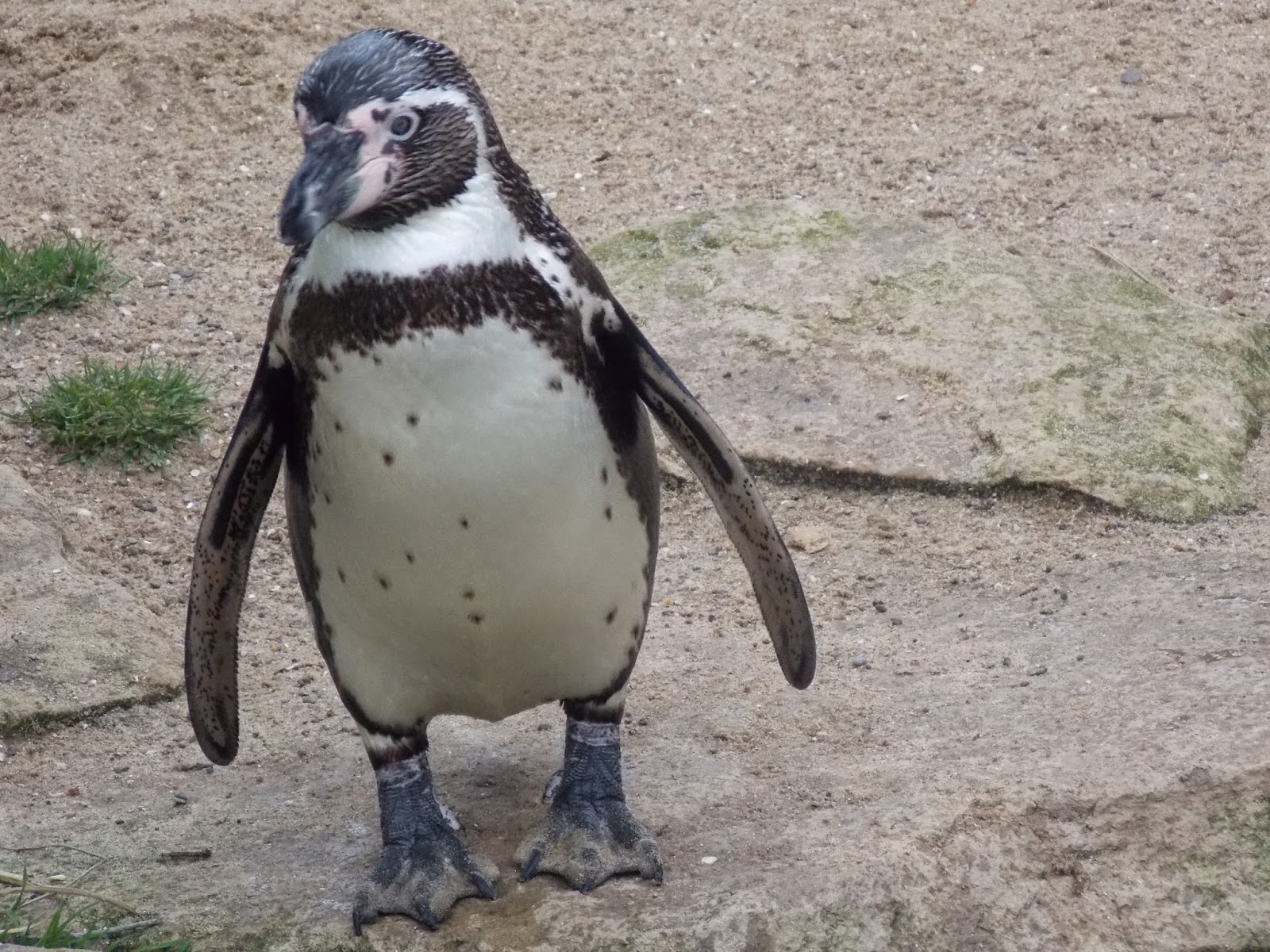
"Pp...pp. pick up a penguin," at Dublin Zoo, May 2014
One boy who comes to me for counselling suffers from a sort of low-grade depression for which he is taking sessions from a qualified psychologist in a local hospital.  I work with him once a week.  He is representative of a growing number of young people who seem to be somewhat bereft of hope.  In our sessions, we constantly talk about choosing life and hope, not despair and death.  Recently a young female contact (I never like the use of the word "friends" for "contacts" on this social network as it is a definite misnomer that can cause some young people an amount of anguish if they are deleted or blocked or even bullied by another so called "friend.") on Facebook put up a rather depressing status including the symbol of the skull: "It's mad knowing the only thing we actually are promised in life, is death I do have meself (sic) freaked to bits thinking about it!" Indeed, I notice that FB has become a sort of diary for many of our young people where they reveal their hearts to an oftentimes disinterested public.  As I say, I have my doubts about how helpful FB can be in mental health matters, but that is a debate for another post.

Attracted to the Light

It is indeed a truism to say that we are attracted to the light and repulsed by the dark. For the most part, we are all intuitively attracted by the light in good people.  Generally, it has been my experience that really good people are innately attractive, e.g., Martin Luther King, Mother Teresa, Pope John XXIII, Pope John-Paul II and in more recent times Pope Francis I.  I have named many others above in my opening paragraph.  I leave it to you, all you good loyal readers out there, to name your own attractive world political and spiritual leaders.  Essentially, such leaders share much with the historical Jesus and the equally historical Siddhartha Gautama (the Buddha), St Francis and all the present day great spiritual leaders (as distinct from Religious Leaders.  I will be contentious here by stating that I believe that Pope Benedict XVI was a Religious Leader while Pope Francis is a Spiritual Leader). I believe that the great contemporary religious writer and theologian Karen Armstrong is also an attractive spiritual leader.  Her books are widely read and she has been universally honoured for them.*

We must radiate the light of hope in our lives, especially if we are in any position of leadership.  Leadership requires those who exercise it to be real, authentic human beings, aware both of their strengths and weaknesses, to be open to encouraging those whom it is both their task and privilege of leading, being so self-assured in themselves that no one on the staff is ever a threat to their sense of authority.  They must be motivators who notice and affirm the innate talents in each and everyone of their colleagues and employees.  This may be a tall order, but after all that is why we put such people into leadership roles and pay them oftentimes extravagant salaries.

If we know that in the end, in a very real and actual way, every individual life is a physical
Chimp with orange, Dublin Zoo, May 2014
failure in the sense that we all end up in the grave, why then should we keep going on?  If, in the end, all the knowledge we have learnt in our individual brains decays into nothing with our bodies, why do we desire to learn?  A very intelligent student asked me that the other day when we attended the presentation of Green Flags for schools that had made serious efforts to cut down on waste of energy and water. We were discussing the dreadful ecological state we have got our lovely Blue Planet into in these more modern times when he asked the question.  If in the end we are all going to perish, given the horrific mess we have made of our planet, why not give up? I replied that one reason we bothered is that we did not ever wish to become victims, that we had a desire, in-built in us, for order and meaning, and that to give up hope was to admit defeat. As we continued our discussion we spoke of humankind being co-creators with the Creator of the Universe, of our being called to build up as many lovely things as we could for the sake of others, for the sake of all humankind and for the sake of all creaturely and inanimate life.

The lovely cuddly red panda at Dublin Zoo, May 2014

When we write a poem, sing a song, compose a new piece of music, protect animals, build a new building, nurse another sick human being or animal, discover a new piece of knowledge to add to the jigsaw of wonder which this life essentially is, we are lighting candles of hope. When we put out our hand to help another, when we join a cause for the betterment of someone or something or even smile in acceptance of another, we are engaged in spreading the light of hope.  When we shake hands, when we hug another, when we truly listen in acceptance, when we are truly compassionate towards all sentient things, as the Dalai Lama is wont to put it, then and only then are we a true and authentic people of hope.  All our most profound religious and spiritual traditions speak of the light of hope conquering the darkness of despair.  It is no wonder that we often turn to their wisdom traditions in times of disillusionment and despair for words of comfort like: "better to light one candle than to scorn the dark," or "every journey, no matter how long, begins with one little step."  Even if you only smiled at someone today, you are engaged in the apostleship of hope.  I have long loved the short saying of the late Medieval Catholic mystic Meister Eckhart that runs: “If the only prayer you said was thank you, that would be enough.”  If each and everyone of us said this prayer as often as we can on a daily basis we would be truly embracing the magic of hope. 


Footnote:

* In May 2008 Armstrong was awarded the Freedom of Worship Award by the Roosevelt Institute, one of four medals presented each year to men and women whose achievements have demonstrated a commitment to the Four Freedoms proclaimed by President Franklin D. Roosevelt in 1941 as essential to democracy: freedom of speech and of worship, freedom from want and from fear. The institute stated that Armstrong had become "a significant voice, seeking mutual understanding in times of turbulence, confrontation and violence among religious groups." It cited "her personal dedication to the ideal that peace can be found in religious understanding, for her teachings on compassion, and her appreciation for the positive sources of spirituality."