Showing posts with label Wonder. Show all posts

Sunday, June 19, 2016

Thoughts on the Tao Te Ching 72

Poem 72


When they lose their sense of awe,
people turn to religion.
When they no longer trust themselves,
they begin to depend upon authority.

Therefore the Master steps back
so that people won't be confused.
He teaches without a teaching,
so that people will have nothing to learn.


Commentary

Aristotle, following his teacher Plato's insight, believed that philosophy begins in wonder. The American philosopher Garreth Matthews (1929 - 2011) describes what Aristotle and Plato before him believed wonder to be: The wonder Aristotle has in mind is, he argues, "astonishment over basic puzzles or perplexities (aporia)." The actual word in Greek is "thaumazein" (wonder).  Aristotle talks about a man who is constantly wondering, namely constantly puzzled about the nature of people and things in this world.  So, it is so much more than simply having a question.  For Aristotle wonder is about the puzzlement we experience when contemplating the beauty of numbers - say the irrationality of root 2, the motion/path of the planets and so on and so forth. Basically, then, it's a "ah" moment rather than a "ha" or "aha" moment.

It is more than interesting, and not a little surprising that our Taoist poet sees religions as lacking in the sense of awe and wonder.  In other words, then, for our Taoist writer, religions attempt to domesticate wonder, capture it in neat phrases, doctrines, dogmas and formularies.  In so doing, our poet is arguing that they kill mystery and awe.

When people, he further argues, stop trusting their own native instincts and intuitions they begin to become dependent on the advice and on the recommendations of those in authority.  They become, consequently, overly dependent on external approval and begin to lack inner responsibility for themselves, their thoughts and their decisions.

In the final stanza, once again, our Taoist author takes refuge in paradox for the sake of making us flounder in a sea of confusion, that is, lest we become too complacent with our newly found insights into the awe and mystery of the Tao.  What he or she is saying is that we will, of necessity, be awe-struck and wonder-enraptured when we come to pondering the depths or heights of the mystery of life.

Tuesday, January 5, 2016

Thoughts on the Tao Te Ching 35

Poem 35


She who is centered in the Tao
can go where she wishes, without danger.
She perceives the universal harmony,
even amid great pain,
because she has found peace in her heart.

Music or the smell of good cooking
may make people stop and enjoy.
But words that point to the Tao
seem monotonous and without flavor.
When you look for it, there is nothing to see.
When you listen for it, there is nothing to hear.
When you use it, it is inexhaustible.


Commentary

The persistence of life - wild butterfly bush at Dollymount, 2006
Balance is both a physical and a mental necessity if we are to live a life characterised by well-being. Indeed, one is more than a little likely to connect balance to the old Greek philosophical idea of moderation in all things or what Aristotle termed the "Golden Mean," namely the desirable middle or balancing point between any two polar extremes. For example, Aristotle saw courage as that virtue which was the mean or balancing point between recklessness on the one hand and cowardice on the other.  In these pluralistic times, it is interesting to point out that such a teaching of moral balance is also found in the ancient Chinese teaching of Confucius who lived approximately from 550 to 480 B.C.  He called his teaching "the doctrine of the mean" while Buddhist philosophers spoke of the concept of "The Middle Way" which basically is a summary of the essence of the Nobel Eightfold Path.

One could, of course, argue that much of Jesus Christ's teaching could be boiled down to a similar ethic of balance summarised in "love your neighbour as yourself."  However, let me return here to our Taoist poem which recommends such balance, not alone in the above quoted stanza, but in the whole work we call the Tao Te Ching. Balance essentially is at the very heart of Taoism as is witnessed in its major symbol, that is, the Yin-Yang emblem.

Spanish Chestnut Tree - Dalgan Park, November 2006
Our translator, Stephen Mitchell, who is steeped in his subject, often uses the feminine and masculine pronouns interchangeably as the Tao is both, more indeed, beyond all gender and in that sense is very much transgender, not in a sexual sense, but in a philosophical sense.  If we are creatures or beings of balance we will have no fears at all as we are centered in the Tao and this means that we are "at home" with ourselves always and we never fear going anywhere.  This is the meaning of the opening lines of our first stanza above.  The word "Tao" means the "way," also a word must loved in all spiritual traditions, e.g., Jesus proclaimed himself to be "the way, the truth and the life."  Now the Tao or Jesus or any other spiritual leader very seldom, if ever, promise an easy way or an easy path to our destination.  Indeed they sometimes explicitly, and mostly implicitly, say that the "way" or "path" is the destination. Pain and suffering are parts of the human lot as we all know.  I shan't rehearse here my personal woes as I have outlined and pointed to them at various times in this blog and in others.  Anyway, those personal incidents are only tangentially of importance here.  The Tao will help us keep our balance when the "storms of life" rock our fragile "ship of self."  Again, all spiritualities offer the same advice and the same sustenance basically when everything is boiled down to the essentials.

German Philosopher M. Heidegger
In our present sufferings, we are invited to see beyond the superficial flavours and smells of food to the "real food" or "invisible food" or if you like raise our hearts to a spiritual realm. This is so hard to do, so I cannot do more than repeat what the Taoist poet so well expresses above.  I often feel that those who attend AA or Narcotics Anonymous or Weight Watchers or any of the many other self-help groups are reaching out to a help or a power that is somehow greater than them, some trans-temporal power, some power that at one level can be evoked by the group but yet they can experience it as a power from another dimension reaching down and into them.  This is very hard to explain unless you know the experience of being grasped by something greater than oneself.  On one level, the rationalist in me will explain this by saying it is mere parapsychology, mere emotions and/or spiritual experiences whipped up by the enthusiasm of the group.  On another deeper level, I definitely experience this quite often as a divine or spiritual element from outside me or from outside the group reaching down or reaching in. It helps to call to mind that we are not just computer-like brains that are cortical only. There are many other intelligences - Multiple Intelligences - as Howard Gardner has pointed out. It also heartens me to realise that there is more to life than is dreamt of in my little intelligence.  Furthermore, the sheer wonder of life and both the exhilaration and trials of that same life lead me often to figuratively fall down in awe at its very mystery bringing me back to that wonderfully powerful question posed by the philosopher Heidegger of all thinking beings, "Why is there something rather than nothing?" That is a big metaphysical question that all cultures attempt to answer.  Indeed, one might contend that cultures are indeed humankind's attempts to answer that thorny but crucially important question.

Viktor Frankl, founder of logotherapy
Let me finish with a quotation from the great psychiatrist Viktor Frankl, amazing survivor of Auschwitz, who founded the existentialist therapy called "logotherapy" on the basis of his experiences in that death-camp, that hell of hells:  "Those who have a 'why' to live can bear almost any 'how'." (from Man's Search for Meaning.)  All spiritualities worth their salt are about offering their followers a "why" to go on with the prospect of living.  The Taoist poet is offering us one way or one "why" to keep on going.

Happy New Year, friends.  For a few minutes now, I invite the reader to reflect on what are his/her motives or his/her main "why" in their life journey. This is a small but paradoxically great exercise to do!

Wednesday, April 29, 2015

Journal of a Soul 74

Nothing New Under the Sun


The Kerry Cliffs, February 2015
In Ecclesiastes 1:9, the writer tells us in succinct words: "What has been will be again, what has been done will be done again; there is nothing new under the sun." (NIV).  I often ponder these words whenever I might possibly think that I may have come up with a startlingly new insight into anything.  Indeed, I suppose, one of the few people for whom the thought is new is indeed I, the thinker of the thought. Often, I struggle to come up with something new for this particular blog because it is the most personal of any of the blogs I author or contribute to.  "How far have I progressed in self-knowledge?" has always been a constant question in my life since I was a young man.  Many years ago as a young novice I was a student in religious life for three years and for the duration of that time I would have attended a spiritual director/counsellor on a regular basis.  Hence, that question was to become and to remain an important one by which I measure my existence on this planet.  

At an an in-service programme I attended as a new Resource/Special Education teacher I remember the instructor telling us that many autistic children make progress in millimeters. I loved her analogy, and I suppose, in answer to my above question of myself, I could respond in like manner.  Along with the spiritual classics and the scriptures, I have always found reading every and any poem I can get my hands on thoroughly rewarding.  Poems in general contain a distilled wisdom in shape and sound that resonate in my heart.  Readers of this blog will know that I have a particular liking for the poems of T.S. Eliot and that I am wont to quote him often.  Once when accused of repeating himself a tad too often in his poetry, he replied in some such words as: "Ah, but I always said it in a new way each time." In other words, by implication, we can look at a problem or indeed the mystery of life itself from many different angles, from many different perspectives.

Nothingness and Emptiness

Portrane, February 2015
In The Myth of Sisyphus, that basic seminal text of absurdism, Albert Camus tells us that the thought about the sheer absurdity of life can strike us at any time and may occur as simply as when we might enter or exit a building through a revolving door.  Heidegger and the other philosophers of that amorphous and rather untidy group of writers/thinkers called existentialists stress that philosophy begins in this very experience of the nothingness and emptiness of life.  Now and again I hear friends and acquaintances ask the rather  common but exasperatingly desperate question of life, viz., "What's it all about, anyway?"  Richard Kearney reminds us that "through the experience of nothing, something emerges as important." (Life Lessons, ed. Rita de Brún, Dublin: New Island, 2014, p. 252)

Again, I was always taken by the question that Heidegger argued was the most important one that anyone could ever ask in philosophy since I first heard it, viz., "Why is there something rather than nothing?"  I first heard that question when it was addressed to us by Fr Patrick Carmody, our wonderful philosophy lecturer, way back in the 1970s.  Indeed, it is a question well worth pondering and indeed meditating on as a mantra in prayer.  Further, if you do so, as I have done from time to time, you will then understand what Wittgenstein meant when he declared "(T)hat this world is; that is the mystical."

The Power of Wonder

Cemetery, Portrane, Summer 2013
In other words, a sense of the mystical is experienced in our being driven to wondering what life is all about in the first place.  No wonder Socrates opined that "philosophy begins in wonder." [Plato puts those words in the mouth of Socrates in the Theaetetus 155 d (tr. Benjamin Jowett)] Or again, I am often reminded of an old Peanuts cartoon by Charles Schultz from my college years which featured Snoopy the dog and had the following caption underneath it: "Sometimes I sits and I thinks. Sometimes I just sits." (The dog in the said cartoon happened to be sitting on either a potty or a toilet bowl, I cannot remember which at this distance in time.)  These moments of wonder or even bewilderment - often expressed through tears, laughter, screams of joy, mania or even pain - represent the beginning of the philosophical quest.  We are figuratively thrown outside ourselves, or made to sit or stand "beside" ourselves and in doing so we put ourselves, others and everything in our world into question.  This is what the theologian Karl Rahner means when he says that "man is himself the question."  It is further most interesting to note that this brilliant theologian was long a philosophical disciple of the equally brilliant philosopher Heidegger who said that the human being is the only creature whose being is an issue for it.  

The Elusive Now


As far back as the early 1700s the Jesuit priest (and mystic in my opinion) Jean Pierre de Caussade S.J. (1675 – 1751) was encouraging those in his spiritual care to live in the present moment or in the "now" of experience. He was telling them that the present moment is a sacrament from God and that self-abandonment to it and its needs is a holy state.  And we think that Eckhart Tolle's teaching is new!   Indeed, many spiritual scholars have found Caussade's writings very similar to those of both Mahayana and Zen Buddhism. Again, our minds are rarely in the now because many of us may neurotically live in the past - regretting this, that or the other action or occurrence - or in the future - desiring or indeed fearing this, that or the other state or this, that or the other material thing.  Bringing the mind into the immediacy of the now of present experience is no easy task.  At a recent mindfulness retreat, the director reminded us that our bodies were always in the "now" and that this is why when we meditate we first return to mindfulness of our bodies, most especially to our breath, as a way of stilling the mind.  Meditation brings us back from that "standing beside ourselves" or outside ourselves that we have said is the beginning of philosophy.  Richard Kearney opines that "(i)n many respects, prayer, yoga, being one with nature, alcohol and food can be different ways of responding to the gap, of bringing us back to a certain kind of presence." (Op. cit., pp. 254 - 255)

Now, quite obviously the animal does not exist (from the Latin "ex-istere" which means "to stand out or apart from") in the same way as we humans do.  They can never stand out or apart from themselves a s we do.  Indeed, inanimate objects can certainly never exist in such a fashion at all.  Kearney again reminds us that for these reasons we are most likely ".... to relax with animals: they calm us and bring us back to earth, to basics and peace and quiet. Think of a purring cat or a sleeping dog." (Op.cit., p. 255)

From Esoteric Dreams to Concrete and Dirt

It is good to get stopped in our tracks, held up, brought to our knees, even onto all fours from time to time.  Some six weeks back I was walking all too quickly and blithely across our school yard lost in reverie, and indeed lost to the world.  As my late mother would have put it, I was "away with the fairies."  Then suddenly, crash, bang and wallop.  I had run into a huge garden planter that has been in the school yard for many years.  I cut both knees and both shins in my collision.  As I was doctoring myself with some medications from the  First Aid Kit some moments later I began to laugh at how ridiculous this whole existence is; how stupidly serious we actually take ourselves in our nothingness and emptiness and how desperately and sillily we want to fill that emptiness with our pipe dreams. Meditating some hour or two later, I realized that my collision with the garden planter was serendipitous as it was calling me back to an awareness of my body, or re-calling me to the now-ness and immediacy of the present, to be really and truly present to myself in the here and now.  This is essentially what all meditation, what all mysticism is about.  Further, some clay spilled out of the planter and it reminded me that as the Bible said we were made of such and to such we would return.  It also reacquainted me with the fundamental meaning of being "human" which is etymologically linked with the Latin word "humus" which simply means clay or earth.  

Why is there something rather than nothing? Why does the planter exist in the first place? Why do I exist?  These are questions we will never get a final answer to, but that is not what life is about at all, is it, dear reader?  It's the wonder and mystery of all those questions that keeps us going; that pushes us on to ever new horizons; that inspires us to strike out for the next hill or valley, to set off to foreign lands, to explore the mysteries of space and to wonder at our own littleness and brittleness against such vastness.  We were made to wonder.  We were created to be philosophical and spiritual beings.  May we never stop wondering and may we never stop asking those big questions of ourselves.  

Friday, June 20, 2014

Journal of a Soul 58

So Many Colours in the Rainbow

Who can forget the lyrics of  the chorus of the late great Harry Chapin's song "Flowers are Red"?  Let me remind you of them:

But the little boy said
"There are so many colors in the rainbow
So many colors in the morning sun
So many colors in the flower and I see every one."

Howth Harbour by night, three days ago 
The song is a good one as its message is perennial, namely, that it reminds us that "variety is the spice of life," that differences are not alone to be acknowledges but to be celebrated. It is a timely reminder not alone for politicians, law makers and legislators but also for academics, teachers, and indeed preachers.  Who wants to live in a monochrome world where everything is boringly staid, monolithic and grey? These reflections were occasioned by reading about how changes are occurring for the better in certain churches in the world: "US Presbyterian Church Votes to Allow Same-Sex Marriages," see Here.

Many Narratives

Bronze statue, UCD
Another phrase that stays in my mind is one I heard just last week used by our former President (Uachtarán na hÉireann), Mary McAleece, viz., "there is not just one narrative, you know," in response to a question on the centralized power structures of the Church. In other words, why is there just one monolithic approach to every moral and dogmatic question?  Surely, there are many approaches to and many perspectives on one or other truth.  Is there one monolithic Truth with a capital 'T'? Oh for a broad-Church mentality, not a narrow straitjacket approach where the take of a certain period in history is petrified or set in stone for millennia?  

Likewise, we tire from the same old rants by the tabloids that sell through sensationalist stories, many often blown totally out of proportion.  The narratives they proclaim and sell are all of a certain unseemly nature.  Many years ago my now deceased mother used always say: "good news never sells: bad news does!"  It is so easy to sell certain narratives only.  There are so many other stories, and many of them good, that could be given more public space and acknowledgement.  One further thing that does annoy me considerably is the almost deliberate avoidance of good journalistic practices of investigation before going to print with the publication of the latest  exposure of X, Y or Z.  

I Fear the Man of One Book

An old friend of mine used always quote the Latin phrase (he was a teacher of a certain era) from the pen of St. Thomas Aquinas, viz., "hominem unius libri timeo" which means "I fear the man who quotes one book (all the time)." As an academic of many years standing, I have never read or written a paper that did not make allusions to and citations from as many learned sources as possible.  In that way, academics attempt to bring out as many sides of the truth as possible.  After all, there are many ways of approaching every problem.  Let's take the field of geometry within the subject area of mathematics.  When I was at school, it was thought that Euclid was the final word on geometry, but when I got to college I learned about many other geometries: analytical geometry, algebraic geometry, descriptive geometry, differential geometry, projective geometry and so on.

Colloquialisms and Old Sayings

How often have we all heard that old chestnut: "There is more than one way to skin a cat"? This is a dreadful thought, and as to why one might want to skin a cat, I'll never know. I could understand it better if instead of the word "cat" one substituted that of "rabbit" as the latter provided much needed food to many of our forebears in less fortunate times.  The following is an interesting and learned conjecture as to its provenance: 

To a lexicographer, all phrases are interesting, it’s just that some of them are more interesting than others ... There are many versions of this proverb, which suggests there are always several ways to do something. Charles Kingsley used one old British form in Westward Ho! in 1855: “there are more ways of killing a cat than choking it with cream”. Other versions include “there are more ways of killing a cat than by choking it with butter”, and “there are more ways of killing a dog than choking him with pudding”. The earliest version appears as far back as 1678, in the second edition of John Ray’s collection of English proverbs, in which he gives it as “there are more ways to kill a dog than hanging”. (see Here )
Celebrating Difference


Marley Park, April, 2014
Surely the celebration of difference is one of our greatest possibilities as educated and progressive humans?  You don't need to be a zoologist or a botanist to celebrate the wonderful variety which the flora and fauna of the world present us with on a daily basis or a physicist or a chemist to celebrate the mystery of the microscopic world and even the submicroscopic world of atomic structure.  Neither do we need to be astronomers to appreciate the vastness and mystery of our universe.  Nor do we need to be college professors to marvel at the sheer exponential growth of knowledge.  All of this adds to the wonder of difference and the importance of celebrating this variety that seems to have one underlying thrust that biologists and physicists chase after in their desire for one overall comprehensive theory of the universe.  Perhaps, even if we are believers, we might see this as a quest for the Creator God?

The Wonder of Children

As a little primary school boy I was fascinated with the following quotation from the great English scientist Isaac Newton that our teacher Mr. Murray made us learn off by heart.  I remember it to this day: “I was like a boy playing on the sea-shore, and diverting myself now and then finding a smoother pebble or a prettier shell than ordinary, whilst the great ocean of truth lay all undiscovered before me.” This childlike wonder at mystery and truth celebrates life in its great diversity.  It was the same wonder and innocence that Jesus meant when he said to all the adults around him:And he said: "Truly I tell you, unless you change and become like little children, you will never enter the kingdom of heaven." ' (Mat 18:13)

Wednesday, June 4, 2014

Journal of a Soul 56

Body and Soul


A walk in Marley Park, Dublin, April 2014
"Body" and "Soul" are categories with which we are all too familiar.  Certainly, within the Roman Catholic dispensation. Building on Greek philosophy (most especially the work of Plato and Aristotle), the early Christians and the somewhat later Church Fathers promulgated a strong philosophy and theology, or if you like a philosophical theology*, that differentiated very strongly between the two categories. The soul, which is by nature good, inhabits the body, which according to St Paul, whom some scholars see as being as much the founder of the church as Jesus himself, is "the Temple of the Holy Spirit."  Building on the theology of St Paul, St. Augustine would adjudge the body as being simply the root of all evil.  And so over centuries there emerged a philosophy and theology that demonized the body and sanctified the soul.  

This rather radical disjunction of body and soul was accepted right down through the ages and is still central to both orthodox and unorthodox Christian belief, indeed to mainline theist belief.  The body dies and the soul lives on in another spiritual world, another realm. Now, needless to say, I am not arguing strongly on one side or another here.  I am merely stating the facts as they are, facts which hopefully I will build my reflections on somewhat later in this post, and perhaps in further posts.  My preferred method of reflection in things spiritual is always phenomenological, never reductionist or positivist, as anyone who has been a reader of my posts will know.  It's just that I like to get the basic facts straight first before proceeding. 

When René Descartes came along in the early seventeenth century, his "cogito ergo sum," a philosophical position worked out painstakingly through the crucible of intellectual doubt, argued that the mind (the mental) was radically different to the material (the body) and that they somehow interacted through the strange workings of the Pineal gland.**  Now, needless to say, this is a philosophical position compatible with most theologies that claim that immortal souls occupy an independent "realm" of existence distinct from that of the physical world.

That is a very brief outline of the historical background.  Whatever we human beings are in our full humanity we are certainly both mental (spiritual) and material (body).  Modern thinking would argue for a holistic approach where both mental and bodily aspects of who we are are inextricably linked.  While they can be differentiated to enable reflection on the mystery that is the human being in his/her totality, they simply cannot be radically separated as in either mainline Christian theology or in radical Cartesian dualism.

More Questions than Answers: Mind, Soul and Self


I like to describe myself as a spiritual person with a deep interest in Christ and the Buddha, who believes that there is a spiritual aspect to the life of the planet and to all sentient life, and most especially to human life. Indeed, phenomenologically I experience life as miraculous in the sense in which the transcendentalist/realist poet Walt Whitman put it in his eponymous long poem:
To me, every hour of the light and dark is a miracle,
Every cubic inch of space is a miracle,
Every square yard of the surface of the earth is spread with the same,
Every foot of the interior swarms with the same;
Every spear of grass–the frames, limbs, organs, of men and women, and all that concerns them,
All these to me are unspeakably perfect miracles.

Marley Park, April, 2014
In other words, what I am arguing for here is the sheer mystery or wonder or magic with which the experience of living presents the conscious mind.  To offer simplistic, and especially reductive, answers to the meaning of life is to my mind the height or depth of arrogance and hubris. While no easy answers exist to the following questions in a clear rational sense, nonetheless these questions are valid for every thinking and feeling human being.  Let me pose the questions here - questions that are existential in tenor, questions which invite the listener to listen, reflect, ponder, wonder, expand his/her thought, stretch or flex their cognitive powers or simply invite the questioner to listen in silence and meditate on the experience.

  • Is the Mind the same as the Soul?
  • Is the Mind the same as the Self?
  • Is the Self the Soul?
  • What is the Mind?
  • What is the Self?
  • What is the Soul?
  • Where does Personality fit into all of this?
  • Is the Self the same as our Identity?
  • Who or what defines Who we are?
  • Is Identity a psychological phenomenon solely?
  • Is Identity a sociological phenomenon solely?
  • Is Identity a psychosocial phenomenon more correctly, then?
  • Has Identity got a Spiritual dimension?
  • Has Identity got a Religious dimension?
  • What is the difference between Religion and Spirituality?
  • Have the Natural Sciences anything to say about our Identity or about any of the above questions?
  • What is the difference between the Natural Sciences and the Human Sciences?
  • Where does the Truth lie? In the Natural Sciences or in the Human Sciences?
  • Or more correctly, does it not lie in dialogue between both areas of exploration?
  • Is Truth singular, i.e., "The One Truth" (Ultimate and Objective)?
  • Is the Truth plural, i.e., "The many truths of knowledge" (Relative and often Subjective)?
  • Can/does the Soul live on after Death?
  • Can/does the Mind live on after Death?
  • Can/does the Self live on after Death?
  • Why are these questions so important for humankind?
  • There are billions of people who believe that these questions are important.  Why?
  • Does an animal have a Mind?
  • If the Mind = the Soul, then could not an animal be said to have a Soul?
  • Why couldn't an animal live on after death so?
  • Do animals have a Personality or a Self or an Identity?
  • Is a self-conscious Self a Soul?
  • Is a non-self-conscious Self, i.e., an animal a Soul?
Obviously, if we wish to explore the above questions systematically we will have to do some pains-taking work of research into the origins of each term, their historical usages from culture to culture and then go on to offer a descriptive definition of each.  Once that's done we should then have to discuss and debate each question in a systematic way. Obviously, one could never tackle all such questions in one post, one chapter or even one book.  However, what I am about in this post is to give the reader a flavour of the breadth, depth and height of the questions posed by any worthwhile philosophical anthropology.

Analytical or positivist philosophers like A.J. Ayer would say that these questions are practically all invalid as they ask questions about things that are mere hypotheses and absolutely strange ones at that.  They are in no way verifiable or falsifiable and hence completely meaningless and therefore redundant questions. Those questions, he argues, simply make no sense at all as they refer to the mere idle speculation of of less rigorous philosophers.  Bertrand Russell says somewhere that to ask such metaphysical questions as I have done above is as ludicrous as asking is there a tea-pot orbiting the sun or any sun out there in space?***

Flowers, Marley Park, April, 2014
Of course, we are perfectly well within our rights to counter Russell, and indeed Ayer who was one of his early students and followers, by stating that in an existential and in a phenomenological sense human beings find that they actually do ask these questions. Indeed, I would argue that there is something within us driving us to ask these questions. In a sense, I believe that our two analytical philosophers are in fact being somewhat disingenuous because they are treating human beings as mere cognitive entities, or as entities that can only ask certain linguistically logical questions, that somehow human beings are not allowed to engage in a meta-linguistics or in a meta-meta-linguistics and further even in a metaphysics. Why not?  In this regard, I have always been inspired by that great metaphysical question asked by Heidegger, "Why is there something rather than nothing?" ****

The Scottish empiricist David Hume was an early atheist who not alone denied the existence of the soul but also of the very notion of a self, an entity that he defined as a mere "bundle of perceptions."  This is alright in theory or in logically worked out clinical thought, but humanity is more than logic or rationality.  Humanity also entails feelings, affectivity, moral and ethical impulses, and indeed much that is non-rational, even irrational.  One might counter Hume and his followers phenomenologically with a statement such as the following: "No client attends a psychotherapist, analyst or counsellor and says 'I am suffering from a bundle of perceptions crisis.'  S/he implicitly, if not  at times explicitly, believes that someone called the Self actually exists."  In other words both client and counsellor know that the self as a phenomenon exists because of their experience.  In all of this, I sometimes take heart that the great Victorian theologian and philosopher John Henry Cardinal Newman***** wrote somewhere that the human being "knows more than he is aware of," and that while he never used the term "the unconscious," he certainly would have been most aware of intuition, feelings and so on, much of which was not accessible to clinical reasoning, though it could always be reflected upon and thought about "after the fact."  Newman saw spirituality and the world of religious experience as being very much part of our overall human experience, though once again only amenable to reason "a posteriori." 

Indeed, if we were to take the Analytical and Positivist philosophers literally we would simply have no literature at all, and indeed I believe there would be no place in such a literal world for Arts of any kind.

Marlay House, once owned by David La Touche, M.P. and first governor of Bank of Ireland
The human being is way more complex than some scholars might allow.  That's why we need a philosophy like that of Socrates, a philosophy that always asks the hard and searching questions, that always asks "why" of everything and keeps asking even at seemingly inappropriate times.

I have spoken before that what is important for our study of the nature of humanity is a philosophical anthropology that looks at that nature from as wide a perspective as possible, that seeks the truth from every possible area of knowledge and does not arrogantly arrogate all truth to its own narrow province like the logical positivists and analytical philosophers do.  Phenomenologically and sociologically, Religion even has something to say about human nature. Perennial philosophy as well as all the other approaches in philosophy, and all the various theologies have much to contribute, too.  The Natural Sciences must always be tempered and balanced by the Human Sciences so as to do justice to "the phenomenon of man," in all  his/her complexity, that is the complete and essential nature of the human person.

In this sense, dear reader, what our anthropology must explore is the "more" that is in humanity rather than the "less."  The easy way out of deep thinking and reflection is often the lazy way of seeking to reduce humankind to the least it can be.  


Endnotes 

*Now the very early Christians would have had very little learned theology.  After all, theology emerged as a reflection on their lived faith experience over the ensuing centuries after Jesus' death and resurrection.  The great Greek and Roman Fathers of the Church and the early Church Councils like Nicea and Chalcedon all co-operated to promulgate various learned theologies (note the plural here, in later centuries a rather solidified central core of orthodoxy emerged, and some even subscribed to one theology or way of looking at things spiritual and religious) built upon the foundations of Greek philosophy mainly.  I have mentioned "philosophical theology" in my text above as it is an area where the two overlap rather foundationally, and obviously I am using this twentieth century term rather anachronistically here.

** "Substance dualism is a type of dualism most famously defended by René Descartes, which states that there are two fundamental kinds of substance: mental and material. According to his philosophy, which is specifically called Cartesian dualism, the mental does not have extension in space, and the material cannot think.  Substance dualism is important historically for having given rise to much thought regarding the famous mind–body problem. Substance dualism is a philosophical position compatible with most theologies which claim that immortal souls occupy an independent "realm" of existence distinct from that of the physical world." See article on Dualism in the WIKI here.

 ***The WIKI describes Bertrand Russell's argumentation on this matter thus: "Russell's teapot, sometimes called the celestial teapot, is an analogy first coined by the philosopher Bertrand Russell (1872–1970) to illustrate that the philosophic burden of proof lies upon a person making scientifically unfalsifiable claims rather than shifting the burden of proof to others, specifically in the case of religion. Russell wrote that if he claims that a teapot orbits the Sun somewhere in space between the Earth and Mars, it is nonsensical for him to expect others to believe him on the grounds that they cannot prove him wrong. Russell's teapot is still referred to in discussions concerning the existence of God" See here.


**** I have discussed Heidegger's famous question in many posts in various blogs I have written over the years.  Here is a review I wrote of a book with this very title by Leslek Kołakowski: here.


*****The great Victorian scholar, theologian and philosopher John Henry Cardinal Newman (1801-1090) was perhaps one of the greatest prose stylist of his era.  Much of his prose writings appeared on various curricula in English literature around the world for decades because of its sheer precision and essential beauty.  He was an original thinker, steeped in ancient history, the classical languages of Greek and Latin, the writings of the Fathers of the Church, Church history and contemporary issues in science and philosophy and much else besides.  Indeed, he had one of the subtlest of minds of his time, well able to dialogue with, as well as argue with the Darwinians of his day.  He was also a founder of a University, named the Catholic University of Ireland, which preceded UCD and wrote a classic on the philosophy of education called The Idea of a University.  His most erudite book and the subtlest of his philosophical/theological works is undoubtedly his Grammar of Assent which shows a most amazing insight into not alone why it is reasonable for humans to believe in God, but also shows a profound understanding as to how a human believes at all.  In short, after Rev Professor Jan Walgrave, O.P., I have argued in a paper I wrote some twenty years ago that Newman's approach to belief was one of "phenomenological investigation."  In other words, Newman was very much ahead of his time in describing the complexity of the phenomenon of humanity.  However, Newman's majestic Oxford University Sermons, written in his late thirties to early forties before his conversion to Catholicism, remains my favourite book from the great Victorian scholar for its beauty and simplicity of language and most essentially for its sheer authenticity.

Monday, May 26, 2014

Journal of a Soul 55

Embracing the Magic of Hope


When I use the word "magic" here, I am in no way using it in its restricted, perhaps more correct, understanding of actions connected with manipulating normal things or forces by paranormal methods.  I am, of course, using it in its broadest sense to suggest everything that evokes wonder, beauty, mystery and love in the human soul.  In a world where destruction is more often than not the hallmark of human interaction, we need the magic of hope more than ever.  One would want to be a strong individual not to grow depressed when one even cursorily views the history of humankind where wars and crimes against humanity so obviously abound.  One would want to be equally courageous in viewing the international news which is virtually filled with accounts of the destruction of humans by other humans: from Afghanistan, Somalia, Nigeria, Pakistan, Egypt, Syria, Iraq, Central African Republic and South Sudan where there are 1000+ deaths per country per year (See Here and Here)  to the destruction of our very own worldly home, namely Mother Earth, our lovely Blue Planet.

Ring-tailed lemur, Dublin Zoo, May 2014
The longer I live the more passionate I am becoming about the need to inspire hope in others.  There are too few great leaders who are doing so today in the political world.  The two most outstanding leaders to my mind, in a more spiritual context, who are attempting to cast the magical spell of hope over a very destructive, greedy and hateful world are such wonderful leaders as Pope Francis I and the Dalai Lama.  Other leaders who impress me from the political world are Aung San Suu Kyi of Myanmar, Desmond Tutu of South Africa and Kofi Annan.  For the life of me, I cannot think of very many more.  President Clinton still impresses me with his commitment to world peace and peace in Northern Ireland, as does the wonderful President Jimmy Carter who is constantly working for peace all around the globe. These are all leaders who inspire hope. Another group of committed "retired" leaders that much encourages the present writer are The Elders and you can read all about their wonderful work for peace here

As a teacher, I find that often many of our youngsters are lacking in hope.  In the wake of the downfall of the infamous Celtic Tiger, a growing number of people are mired in negativity that can all to often descend into the lower reaches of desolation and despair. Many pupils who attend our inner city working class school cannot see very much in the way of promise for their future lives. In Ireland as I write, there have been so many cutbacks, so much austerity that the presence of the Labour Party - who are partners in a Coalition Government with a centre-right party called Fine Gael - has been virtually wiped out on town councils all around Ireland.  The Labour Party has been adjudged by the electorate to have so much compromised, or indeed sold out on, their socialist principles that the voters virtually ignored voting for any of their candidates.  A very disillusioned and dejected voting public opted instead for independents and candidates from other parties, most especially Sinn Féin.

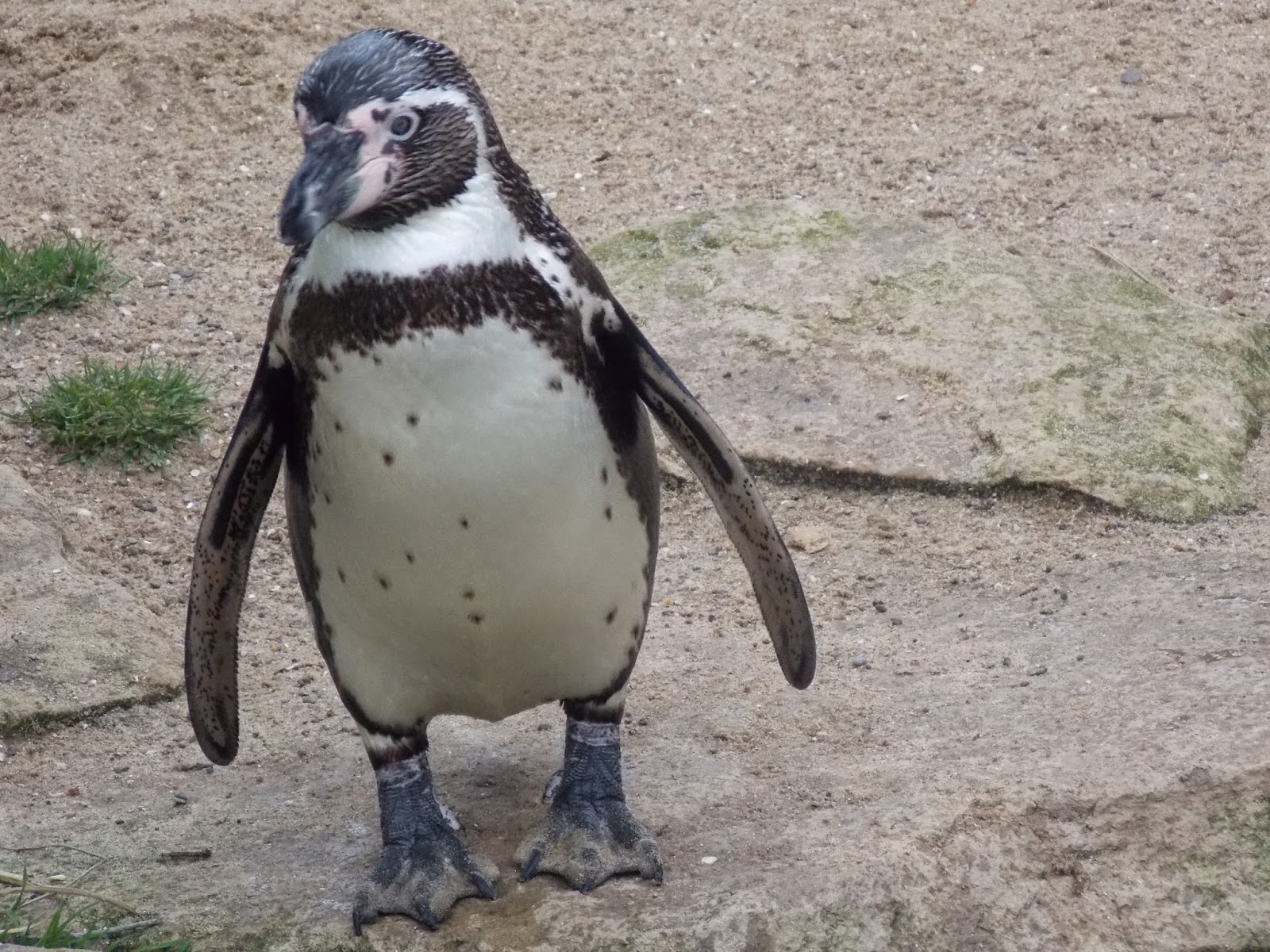
"Pp...pp. pick up a penguin," at Dublin Zoo, May 2014
One boy who comes to me for counselling suffers from a sort of low-grade depression for which he is taking sessions from a qualified psychologist in a local hospital.  I work with him once a week.  He is representative of a growing number of young people who seem to be somewhat bereft of hope.  In our sessions, we constantly talk about choosing life and hope, not despair and death.  Recently a young female contact (I never like the use of the word "friends" for "contacts" on this social network as it is a definite misnomer that can cause some young people an amount of anguish if they are deleted or blocked or even bullied by another so called "friend.") on Facebook put up a rather depressing status including the symbol of the skull: "It's mad knowing the only thing we actually are promised in life, is death I do have meself (sic) freaked to bits thinking about it!" Indeed, I notice that FB has become a sort of diary for many of our young people where they reveal their hearts to an oftentimes disinterested public.  As I say, I have my doubts about how helpful FB can be in mental health matters, but that is a debate for another post.

Attracted to the Light

It is indeed a truism to say that we are attracted to the light and repulsed by the dark. For the most part, we are all intuitively attracted by the light in good people.  Generally, it has been my experience that really good people are innately attractive, e.g., Martin Luther King, Mother Teresa, Pope John XXIII, Pope John-Paul II and in more recent times Pope Francis I.  I have named many others above in my opening paragraph.  I leave it to you, all you good loyal readers out there, to name your own attractive world political and spiritual leaders.  Essentially, such leaders share much with the historical Jesus and the equally historical Siddhartha Gautama (the Buddha), St Francis and all the present day great spiritual leaders (as distinct from Religious Leaders.  I will be contentious here by stating that I believe that Pope Benedict XVI was a Religious Leader while Pope Francis is a Spiritual Leader). I believe that the great contemporary religious writer and theologian Karen Armstrong is also an attractive spiritual leader.  Her books are widely read and she has been universally honoured for them.*

We must radiate the light of hope in our lives, especially if we are in any position of leadership.  Leadership requires those who exercise it to be real, authentic human beings, aware both of their strengths and weaknesses, to be open to encouraging those whom it is both their task and privilege of leading, being so self-assured in themselves that no one on the staff is ever a threat to their sense of authority.  They must be motivators who notice and affirm the innate talents in each and everyone of their colleagues and employees.  This may be a tall order, but after all that is why we put such people into leadership roles and pay them oftentimes extravagant salaries.

If we know that in the end, in a very real and actual way, every individual life is a physical
Chimp with orange, Dublin Zoo, May 2014
failure in the sense that we all end up in the grave, why then should we keep going on?  If, in the end, all the knowledge we have learnt in our individual brains decays into nothing with our bodies, why do we desire to learn?  A very intelligent student asked me that the other day when we attended the presentation of Green Flags for schools that had made serious efforts to cut down on waste of energy and water. We were discussing the dreadful ecological state we have got our lovely Blue Planet into in these more modern times when he asked the question.  If in the end we are all going to perish, given the horrific mess we have made of our planet, why not give up? I replied that one reason we bothered is that we did not ever wish to become victims, that we had a desire, in-built in us, for order and meaning, and that to give up hope was to admit defeat. As we continued our discussion we spoke of humankind being co-creators with the Creator of the Universe, of our being called to build up as many lovely things as we could for the sake of others, for the sake of all humankind and for the sake of all creaturely and inanimate life.

The lovely cuddly red panda at Dublin Zoo, May 2014

When we write a poem, sing a song, compose a new piece of music, protect animals, build a new building, nurse another sick human being or animal, discover a new piece of knowledge to add to the jigsaw of wonder which this life essentially is, we are lighting candles of hope. When we put out our hand to help another, when we join a cause for the betterment of someone or something or even smile in acceptance of another, we are engaged in spreading the light of hope.  When we shake hands, when we hug another, when we truly listen in acceptance, when we are truly compassionate towards all sentient things, as the Dalai Lama is wont to put it, then and only then are we a true and authentic people of hope.  All our most profound religious and spiritual traditions speak of the light of hope conquering the darkness of despair.  It is no wonder that we often turn to their wisdom traditions in times of disillusionment and despair for words of comfort like: "better to light one candle than to scorn the dark," or "every journey, no matter how long, begins with one little step."  Even if you only smiled at someone today, you are engaged in the apostleship of hope.  I have long loved the short saying of the late Medieval Catholic mystic Meister Eckhart that runs: “If the only prayer you said was thank you, that would be enough.”  If each and everyone of us said this prayer as often as we can on a daily basis we would be truly embracing the magic of hope. 


Footnote:

* In May 2008 Armstrong was awarded the Freedom of Worship Award by the Roosevelt Institute, one of four medals presented each year to men and women whose achievements have demonstrated a commitment to the Four Freedoms proclaimed by President Franklin D. Roosevelt in 1941 as essential to democracy: freedom of speech and of worship, freedom from want and from fear. The institute stated that Armstrong had become "a significant voice, seeking mutual understanding in times of turbulence, confrontation and violence among religious groups." It cited "her personal dedication to the ideal that peace can be found in religious understanding, for her teachings on compassion, and her appreciation for the positive sources of spirituality."