Showing posts with label Ego. Show all posts

Sunday, June 19, 2016

Thoughts on the Tao Te Ching 71

Poem 71


Not-knowing is true knowledge.
Presuming to know is a disease.
First realize that you are sick;
then you can move toward health.

The Master is her own physician.
She has healed herself of all knowing.
Thus she is truly whole.

Commentary

Humility is a virtue much to be prized according to many religious and spiritual traditions, though the great Greek philosopher Aristotle denied that it could ever be one because it actually sets itself against some of our most fundamental impulses like ambition and pride for example.  Instead Aristotle exalted "greatness of soul," what he termed wonderfully in Greek as "megalopsychia," which was for him where all moral values converged - a mean, as all virtues were essentially - between the extremes of vanity on the one hand and pusillanimity or extreme timidity on the other hand.

Again, a great soul, or as we say, a humble person, would acknowledge that not-knowing is true knowledge.  It is a Socratic epistemology insofar as one's starting point is always the acknowledgement of one's ignorance and then the gradual digging down or climbing up step by step in the pursuit of that knowledge. In keeping with our Taoist poet's analogy, there are far too many sick people in the world, that is, those who presume to know; those who think they have all the answers.  That is all ego stuff, that, in actuality.

When we realise we are sick, in sustaining our Taoist metaphor, we are on the way to healing.  How true it is that when we get a diagnosis for any illness we may have, that we are on the way to a certain type of healing - please note, I do not say cure here, as curing of illnesses is an entirely different matter.  Most counsellors, tharapists and even a growing number of medical doctors acknowledge that healing is more important than cure.  

I like the call of the Master or Mistress - the Teacher is both Masculine and Feminine in Taoism, maybe even beyond all sex, but that is a matter for another place and time.  In keeping with the sentiments of this wonderful Taoist poem, let us agree to heal ourselves of all improper and inappropriate knowing.

NAMASTE.


Thursday, March 24, 2016

Thoughts on the Tao Te Ching 55

Stephen Mitchell's translation of Poem 55 runs as follows:


He who is in harmony with the Tao

is like a newborn child.
Its bones are soft, its muscles are weak,
but its grip is powerful.
It doesn't know about the union
of male and female,
yet its penis can stand erect,
so intense is its vital power.
It can scream its head off all day,
yet it never becomes hoarse,
so complete is its harmony.

The Master's power is like this.
He lets all things come and go
effortlessly, without desire.
He never expects results;
thus he is never disappointed.
He is never disappointed;
thus his spirit never grows old.


The city of Prague from the castle walls

 Derek Lin's translation of the same poem runs thus:

Those who hold an abundance of virtue
Are similar to newborn infants
Poisonous insects do not sting them
Wild beasts do not claw them
Birds of prey do not attack them
Their bones are weak, tendons are soft
But their grasp is firm
They do not know of sexual union but can manifest arousal
Due to the optimum of essence
They can cry the whole day and yet not be hoarse
Due to the optimum of harmony
Knowing harmony is said to be constancy
Knowing constancy is said to be clarity
Excessive vitality is said to be inauspicious
Mind overusing energy is said to be aggressive
Things become strong and then grow old
This is called contrary to the Tao
That which is contrary to the Tao will soon perish.

Swan on the river Vltava, Prague, Feb 2016

Commentary

I have often heard it said that as we go further on our path in life in terms of our own personal development that we have to unlearn much of what we have learnt during our early socialisation as children and many of our inculturated opinions so as to eventually reach some level of self-knowledge or individuation.  What I am referring to here are crazy ingrained opinions like "children must be seen not heard," "boys never cry," "men must be strong," "women must be ladylike," "If I haven't a beautiful body I'm not really important," "not to have money is a supreme failure in life," "bad exam results mean failure" and a host of other opinions which can fester into downright prejudices against and hatred of self and others.  And the worst thing about all these ingrained opinions and prejudices is that for a long enough period of our growing as people we are blithely unaware of them.  However, if we are open at all to life, we won't be long about learning lessons in awareness.  After all, life does have a habit of slapping us in the face every now and then as if to say in no uncertain terms: "Wake up! Can't you see what life is doing to you? Do you really think all those things you have gathered around you in life are going to last?  Do you think you can take them to the grave with you? Do you think your thoughts are the only right thoughts? How much of you is ego? Is the price you are paying for all those ego trips really worth it?  Where lies your heart or your soul? Do you not realise that you too will pass as will everything in this world?

Charles Bridge, Prague, February 2016
Solid things after a while begin to seem less solid as we grow older.  Things begin to lose their gloss and sparkle as our body ages.  And yet, are there not things of the soul, goods of the spirit?  Traditional wisdom teaches us that there are.  Things of the soul or goods of the spirit or spiritual values are perhaps, our Taoist poet tells us, whatever is unconsciously pure and natural just like a newly born baby that is totally in harmony with itself.  It is in that natural state of being that approximates, I'd imagine, to what the Hungarian psychologist Mihaly Csikszentmihalyi means by "flow," that is the total absorption of the person in what the person is doing, an actualised being in the now. For an article on the concept of flow see HERE.


Montbretia flowers in my garden, Summer 2007
The natural power of life is seen in the potential power that the infant naturally possesses. In the above poem the author refers to the classic infant grasp reflex.  I have always loved putting my little finger into a young baby's open palm and them to feel that wonderful natural grasp - that wonderful infant tenacity of life, that natural thrust there is in every newborn life to cling on and to survive.  In a sense, what the Tao Te Ching is about, as is the case with all true religions and spiritualities, is finding that natural current of life, tapping into life's Still Point, discovering the Source of our natural power as it were.  As we grow up and become inculturated into whatever society we are born into, we learn to put on the ways of the world; to learn off all the various roles we have to play in life if we are to survive - in other words, we learn to put the ego firmly in the driving seat or into the saddle.  That is part of our survival skills and is very important to do if we are to get on in life.

Montbretia, my garden, Summer, 2007
However, problems emerge when we become besotted with success; when we begin to become enthralled by our own ego; when we begin to believe in the literalness of our own constructed identities; when we begin to believe that any single one or even a combination of some of the masks we are forced to wear is the real us. These obsessive and compulsive parts of ourselves which almost suffocate by times the real us are essentially what Buddhism means by the vices of clinging to and living in dependence upon the apparently real world. Let me liken the real or total self to a diamond with a multitude of faces.  Every face is a face of the diamond and all the faces together conspire to reveal the unique mystery of each individual self.  Spirituality helps us to transcend over-identification with any one face of the diamond, with any one mask of our many workaday masks.  Its the totality of faces/masks/identities and the ability to move with ease from one to another as required and then to deepen our pursuit of the real self through going into the heart or depths of the diamond through meditation and prayer.  There we will encounter the real if elusive self. When one starts out on this spiritual quest for the real self, the "follower of the way" or the "disciple" is drawn into a magical web of discovery that transcends even the self.  However, this writer has only touched on the outer perimeters of this growing reality.  Readers desiring deeper or higher spiritual truths will have to search elsewhere for such insights, into the writings of more powerful and enriching spiritual teachers, those rare souls who have travelled further on the path to self-awareness, awareness of others and an awareness of the abiding presence of the Other, some of us, including this writer, dare call God.

Ireland's Eye from Baldoyle, Summer 2006


Our Taoist author sees the naturalness of the little child, how at-one the little creature is in itself; how united it is in body and soul; how unsplit mind and body are in this natural new little being.  The world is about to work its spell on the little infant and socialise it in its ways and mostly in the ways of the ego and in the ways of its obsessions of humanity.  The new human being will begin to learn the lessons of separation, of how to separate body from mind; body from soul, if you prefer and then be taught the tough lessons of life when the mind ignores the body to the sore cost of both.  Then all the psychologies and all the spiritual paths will kick in for the person who desires to be whole again.

The little baby boy, according to our Taoist writer, experiences arousal in the erection of its manhood and yet it is a sexually unaware arousal insofar as it only experiences the power of life in its member and not the thrust to penetrate its feminine counterpart.  This natural power is felt in his little body, akin, I should imagine, to the generative and receptive powers felt in the female infant's little womb. All this is natural and unselfconsciously natural.

Cycle Path, Baldoyle, 2006
The Tao works by flowing through all the good and natural things of life.  As an erstwhile theologian, I can see parallels here with what classical Catholic Theology referred to as the Natural Law which was concerned with morality mostly and how moral laws can be deduced by human reason by observing nature - in other words, all human values are there already in nature and have only to be deduced or discerned therefrom through the faculty of reasoning. However, that's a shallow enough parallel, but a parallel nonetheless.  Note the Catholic concept would not embrace the vitality associated with either a Pagan or New Age concept of what is natural.

Another traditional Eastern analogy that the writer of this blog likes is that of how the wise person is not like a tree in the storm which can be fractured, broken, even uprooted if the wind is strong enough, but rather like a blade of grass which can bend in the wind and consequently not be harmed.  This is the sense that the above Taoist writer is getting at above when he says in the second stanza that the Master "lets all things come and go," or as I've already said above he learns to "go with the flow."

Finally, in this Holy Week as we fast approach Easter Sunday, read the above verses reflectively again and let their words have an effect on your soul.  Happy reading and peaceful meditating, friends.  Namaste!

Friday, December 25, 2015

Thoughts on the Tao Te Ching 29

Poem 29


Do you want to improve the world?

I don't think it can be done.

The world is sacred.
It can't be improved.
If you tamper with it, you'll ruin it.
If you treat it like an object, you'll lose it.

There is a time for being ahead,
a time for being behind;
a time for being in motion,
a time for being at rest;
a time for being vigorous,
a time for being exhausted;
a time for being safe,
a time for being in danger.

The Master sees things as they are,
without trying to control them.
She lets them go their own way,
and resides at the center of the circle.


Commentary


Yellow Poppy


Having lived in this world for almost 58 years now, I have in the past been mostly annoyed and angry at people who cannot resist the urge to take control of others, though mostly I am more amused at their antics in the last number of years.  Life has taught me that I simply cannot control any other human being, much less the world.  We are such insignificant ants on the anthill called the Earth, a mere individual among about 7.3 billion human beings. And yet some of us think we are so important that we actually dare to attempt to control others.  I remember reading in one of Dr Tony Humphrey's books the succinct and wise statement: "All control is self-control!" There is much wisdom in that - indeed, there is much Zen in it, or even, dare I say it, much Tao!  As a young teacher I often went astray by trying to control what I simply could not control.  We can only exert influence over whatever little patch of ground that we alone are in charge of.  I learnt from other more experienced teachers how to exercise control within my own classroom and how to give instructions to adolescents without their sounding like being commands inviting opposition.  

It is indeed a truism to say that none of us can change the world, and we know that working together, yet again like ants on an anthill, but with all our wonderful brain power, we can achieve much material change for the good of humankind.  I think the above poem is somewhat pessimistic about life in a way, though one can understand such an attitude given that the poem was written over 2,000 years ago when no one could change much about an inevitably hostile world and where human lifespan was very short indeed.

Much spirituality essentially boils down to working on our egotism.  Just as the sun certainly does not revolve around the Earth, the world certainly does not revolve around any one individual.  There is nothing as bad as encountering people who are egotistical and self-centered.  St John the Evangelist put this in a very Christian way - as he, needless to say, saw our relationship with Jesus Christ as being of paramount importance - "He must increase and I must decrease" or as it is also translated, "He must become greater, I must become less." (John 3:30)  In other words we can translate this overtly Christian exhortation as a recommendation to bring our egos under control.


Malahide at sunset


Christmas Day is a special one for all Christians.  Even if you are of another faith or even none, you can still rejoice in the power of the simple yet wonderful myth or story, that whatever power is behind the universe (some dare call this power God) deigned take human form in the shape of a simple little infant.  This doctrine is known as that of the Incarnation, literally the en-fleshing of the Godhead in human form.  If anything, the heart of the meaning of this myth is that all of creation and especially humankind are shot through with a value that is beyond human reckoning.  This, then, I believe, is what it means to say that something is sacred.  The Earth and all it contains is sacred, that is, of priceless value. Christians believe, then, that everything in creation, especially humanity as the guardians of the goods of the Earth, is sacred.

The above poem shares some of this Christian insight into the sacredness of the world.  I admit it sounds somewhat negative to our modern ears, but I remind the reader again that this verse was written over 2000 years ago when people were simpler and fatalism loomed large in all cultures.

I need hardly remind the readers of this blog that the third stanza above is remarkably like the more famous stanzas from Ecclesiastes 3 from the Old Testament: "There is a time for everything, // And a season for every activity under the heavens" etc.  Once again the Taoist and Biblical writers are ad idem  with their enthusiasm to pile polar opposites one on top of another.  I have mentioned over and over again in these posts that spiritual writers of every hue have a predilection for the balancing of polar opposites and for keeping the healthy tension between both poles.  One could do worse than read Taoist Poem 29 in conjunction with Ecclesiastes 3.

My prayer for anyone reading these rather short and hurried reflections is that we may learn to let go of the restrictions of the ego, to let go of the urge to control others, to learn to accept what we cannot change and at the end of the day to learn to live peacefully with ourselves and others.  After all, we are what we are and we must learn to love ourselves, forgive ourselves and be compassionate to ourselves as well as to others.  That is no easy task, but it sure is one essential one if we are to steer the bark of self through the choppy waters of life.

Namaste, friends and a very Happy Christmas. 

Thursday, November 19, 2015

Thoughts on the Tao te Ching 24


Poem 24

He who stands on tiptoe
doesn't stand firm.
He who rushes ahead
doesn't go far.
He who tries to shine
dims his own light.
He who defines himself
can't know who he really is.
He who has power over others
can't empower himself.
He who clings to his work
will create nothing that endures.

If you want to accord with the Tao,
just do your job, then let go.

Commentary

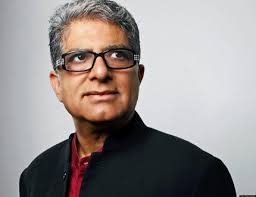
Deepak Chopra: Author, Spiritual Guide, Medical Doctor

Wisdom is bought at a high price - the price of experience.  We all essentially learn the hard way. How often have we heard our elders say that they went to the "school of hard knocks!"  One of my special needs students said the following the other day:  "Life does not get any easier; you just have to learn to laugh harder!"  Pure wisdom, that! The poetry, whether of the Psalms in the Old Testament or the poems in the Tao Te Ching, attempts to capture some wisdom by sheer dint of paradox or seeming contradiction; by setting up polar opposites; by stretching language to its breaking point.

Sometimes when we try too hard we don't achieve the results we want at all.  It's as if the ego gets in its own way and trips itself up.  The ego stretches itself up on tippy toes in a vain effort to see what's going on.  However, on a physical level, as we know, we are only able to maintain our bodies on tippy toes -  in such a stretched mode - for literally several moments as we strain say to look over a high fence.  On tippy toes we simply cannot stand firm. Anyone who runs or jogs will know that such exercise needs to be paced properly.  If the runner or jogger sets out on their chosen route at far too quick a pace. he will not be able to complete it in the proper time or indeed in the proper state of well-being.  Hence, the lapidary piece of wisdom in the above poem: "He who rushes ahead doesn't go far!"  I remember an old teacher I had at school used often say: "The longest way round is often the shortest way home!"  Why?  Well, the longest way round might not have as many obstacles as the shortest way!!
  
Clinical psychologist, Psychotherapist Dr Carl Rogers


I simply love the line: "He who tries to shine dims his own light."  Again, it appears to this reader and meditator that this is all about our ego getting in the way of the wisdom that naturally lives in our True Self (Deepak Chopra) or Real Self (Carl Ransom Rogers), in our Soul (religion/spirituality) or in our Heart of Hearts (traditional phrase meaning inner and true feelings).  It is so obvious when people are boasting of their abilities or attempting to get "one up" on us (one upmanship) or pretending to be something they are not.  Likewise, any person who thinks he can define himself clinically or precisely is simply deluded.  Just as the author puts it, this person "cannot know who he really is."  There is a mystery that lies at the heart of us all and we only gradually get to know that mystery.  Indeed, I believe we cannot really comprehend, apprehend or grasp that mystery in its entirety or fullness.  However, we do get glimpses of our True Self.

Then we come to one of the most corrupt impulses of the ego, namely the drive for power.  Persons who do not know themselves properly, or who have failed, as Carl Jung puts it, to properly integrate their shadow nature, all project their worst fears and hatreds onto others.  Hence we get breakdowns in the various relationships between husbands and wives, managers and staff, leaders and teams and indeed between different states.  When people exercise power over others in this egoic way they actually have failed to empower themselves to simply be their truest selves.  Likewise, if we cling to our work in an effort to gain some identity, we set up a state of dependence on our workaday activity to give us a sense of our true self and such a state of dependence only leads to a false sense of self!

Letting go is the answer, and indeed it is the answer given by all religious and spiritual traditions. What are we asked to let go of?  We are asked to let go of our Ego, of our desires to cling to sensual pleasures, to cling to others, to cling to ideas, to cling to our partners, to cling to our jobs, to cling to our pride, to cling to all false ideas of who we are.  We are asked, in short, to let go of the False Self and embrace our True Self.  This is not easily done, but by constant practice of meditation and other spiritual acts like writing, composing poems or music, sculpting, pottery making and so on and so forth, we gradually chip away at our masks and bit by bit expose our True Self to the light of our consciousness.  Indeed, none of us ever gets there.  Rather like the asymptote we only get there way out at infinity.

Example of two asymptotes: horizontal and vertical


Conclusion:

Once again, perhaps some word, phrase or clause in above poem strikes a chord with you.  If so why not use it as a mantra for a short meditative practice for five or ten minutes.  Namaste, my friends.

Sunday, October 18, 2015

Thoughts on the Tao Te Ching 17

17

When the Master governs, the people
are hardly aware that he exists.
Next best is a leader who is loved.
Next, one who is feared.
The worst is one who is despised.

If you don't trust the people,
you make them untrustworthy.

The Master doesn't talk, he acts.
When his work is done,
the people say, "Amazing:
we did it all, all by ourselves.


Commentary


A. Lincoln: a great Leader
These stanzas of the seventeenth poem are a reflection on good leadership and all that it entails.  Over a 35 year career I have observed many leaders at work in a school setting.  The best leaders amongst them worked away unobserved most of the time and they achieved much. The worst of them were micro-managers seeking to control others.  Managers who were into control and power, or to put it in other words, were obsessed with their own EGO were disliked, caused acrimony among the staff and achieved little.  The above poem is a very perspicacious and wise comment on the style of a good manager where the term "Master" can be substituted easily with the word "manager." 


Conclusion

Once again I invite the reader of this blog to read over the above poem meditatively and to pick out a favourite word or phrase and to use the same as a mantra for a short period of reflection, say five or ten minutes.  Namaste, friends.

Monday, August 31, 2015

Thoughts on the Tao Te Ching 13

Poem 13

Success is as dangerous as failure.
Hope is as hollow as fear.

What does it mean that success is as dangerous as failure?
Whether you go up the ladder or down it,
your position is shaky.
When you stand with your two feet on the ground,
you will always keep your balance.

What does it mean that hope is as hollow as fear?
Hope and fear are both phantoms
that arise from thinking of the self.
When we don't see the self as self,
what do we have to fear?

See the world as your self.
Have faith in the way things are.
Love the world as your self;
then you can care for all things.


Reflections


These poems from the Tao Te Ching are designed to make the reader or indeed listener (as in those ancient times when these lines were written oral cultures abounded, as only the very rich or people of status were able to read) think; to snap the person into a state of wakefulness or awareness.  Koans, which can be in the form of a story, a question, a statement or even a dialogue, were traditionally used in Zen Buddhism to provoke the disciple into a deeper awareness or a keener sense of wakefulness than heretofore.  In this way, the student's progress in Zen practice was tested. To my mind, the poems in the Tao Te Ching share in that purpose, namely to test and to deepen the student's progress in wisdom. The above poem is quite koanic (if this word exists) or koan-like  in this regard. 


Objectivity

All meditative practices allow us to withdraw a considerable distance from our own ego or from our obsession with self, from our egocentricity.  If we can arrive at this stage of personal or spiritual development, we have become more objective about ourselves and are less likely on the one hand to swell up with pride when we are praised by another or on the other hand retreat in failure into gloomy despair when criticized.   In that sense we can meet success and failure in our stride and not be too overcome in either an overly positive or overly negative sense.  Another way of stating these objective sentiments would be by making the paradoxical or koanic statement that "success is a dangerous as failure."  Once again, it's a question of not clinging onto or obsessively desiring those allurements or charms of the ego.  In that sense, success can be dangerous to our discovering real happiness, which lies in discovering the real or true self that is hidden behind all the empty promises of our ego-ridden society.  Failure can be crippling to the ego and reduce it to a state of not being able to do this or that.  We want to keep the ego in a healthy place in our psyche, and we certainly don't want to cripple it.  In fact, when we learn to give it its proper place in the psyche, balanced well astride the super-ego and id, then we can function confidently in life.  We have to learn to be ruthlessly objective and never allow our failures to have any negative effect on our real and true selves.  This takes some work in both personal development and on-going meditative practice to achieve. 

Our Taoist poet tells us also that "hope can be as hollow as fear."  In other words, the poet is telling us that unfounded fear or anxiety can reduce a person to an ineffective and passive on-looker rather than an active participant in society.  Unfounded hope can be mere wishful thinking and lead us into despair.   

Stanza three is pure koan and will only yield up a little of its wisdom after meditating upon it many times.  Therefore, I am offering no explanation here, or attempted explanation even, as I have to humbly, like Socrates, admit my ignorance.  What I will do is meditate and pray on it and leave it to the great Unconscious (or God, or Meaningfulness, or the spirit of life or whatever you wish to call it) to offer up some suggestive answer.

It is also my opinion that the Taoist poet uses the "self" in two differing ways in this poem. Stanza three seems to suggest that when we go beyond the self, or beyond being preoccupied or even concerned with self that it is only then that we have nothing to fear.  Stanza four recommends, in a rather contradictory sense, that we must see all things in the world from the perspective of the self that it is only then that we can really love everything and everyone. This last stanza, then, is in the tradition of Jesus' famous command to his disciples to love their neighbour as themselves.

John Keats: 1795 - 1821


However, as we all know by now, it is in the tradition of Taoist wisdom, as it is in that of Zen Buddhism, to hold the two opposites in a polar tension or union.  Therefore, as readers of this beautiful Taoist poem, we are happy to remain in a state of what the famous ill-fated wonderful Romantic poet John Keats called "negative capability," a term he coined himself for the learnt ability in the human mind to balance opposites and hold them thus "without any irritable reaching after fact and reason." (see Negative Capability)

Conclusion:

One again, by way of conclusion, I invite the reader to read reflectively through the above Taoist lines and let a word or phrase spark a mantra for a five or ten minute meditation.


Sunday, December 14, 2014

Journal of a Soul 70

The Human Web


Our school debating team meets the Lord Mayor of Dublin, Mr Christy Burke.
Identity is never something one constructs alone.  We are so much social creatures that our identity is moulded, shaped and formed within the context of community.  We reach out from our shell of individuality and, too often from a carapace of loneliness, for the supports of relatives, friends, team mates or other groupings to save us the frightening experience of being alone in the universe.  We were simply never made to be alone.  The wise words of the great philosopher and mathematician, Blaise Pascal (1623-1662) come readily to mind: "The eternal silence of these infinite spaces frightens me."  It is a quotation that has been etched on my heart or soul since I first heard it.  When one looks out into the infinity of space in the outer cosmos or into the equally mysterious space in the inner cosmos of the atomic world or even contemplates the seeming eternity of time versus the short duration of our little lives one can surely feel that frightening loneliness and brittleness of spirit that Pascal wrote so memorably about in those quoted words above.

Everywhere one goes one can see this thrust in humankind to reach out its fractal fingers over and over again and network its communications into a community - into a veritable human web.  We experience ourselves being moulded, shaped and formed in relationship with so many others whom we touch and who in turn touch us.  Most especially do we experience this sense of being a human community at Christmastide.  The tunes that emanate from the various shops, the songs that are played on the radio, the seasonal music associated with the Festive Season, the colourful lights sparkling in the frosty air, the buzz of busy shoppers buying gifts for loved ones all conspire to convince us even more that we truly were made to embrace and be embraced, that the first person plural is always so much more important than its singular number.  But then, most of us probably do not need too much reminding of this incontrovertible fact.

The Brittleness of Life


Ardgillan Park, Skerries, June, 2014
And yet we are all equally convinced of the sheer loneliness of certain brittle souls.  Only some few months ago I wrote about the final moments of a former student of mine who decided to end his life at twenty short years of age.  He left no note.  There was no indication, as far as I know that he had been suffering pain of such proportions that the only solution that presented itself to him was shutting off the pain by hanging himself from the branch of a lonely tree not far from our school. Further, the experts tell us that once a suicide has definitively decided on the exit plan that a sense of peace descends upon their lonely soul.  Indeed all this young man's closest friends and family attest to his being in fine form on the evening of his demise.  

As I write my mind is enlivened by other interweaving thoughts and feelings.  A colleague of many years passed away barely 24 hours ago.  He was a larger than life character who was a happy soul who had time for all the young men he had taught over his thirty-five year career. He was also generous and kind to a fault.  Sadly, a son of his had predeceased him in an  act of suicide. Then there are other feelings and thoughts which vie for their attention in my mind: another close friend whose mother is dying from cancer, yet another who is herself recovering from an operation occasioned by the excision of a cancerous tumour. These thoughts and feelings trigger other, if older, sad memories of our fragility.  And yet that fragility is a hallmark of our humanity, a quality that somehow mysteriously magnifies the meaning of every little work of our creative if mortal being.  Shakespeare's genius - indeed his very soul -lives on in his wonderful writings.  Mozart's spirit endures in his wonderful music. And so on.  Humankind reaches out its cultural embrace down the timeless generations and on out into future possibilities beyond the finite and limited individual lifespan.

The web is always ever greater than its individual strands and in a Gestalt or holistic way far greater than the sum of its strands. And so I return inevitably to our starting point above that we are very much part of a human network greater than us, in a real sense a human web.  There is a famous seanfhocal or proverb in our native language - Gaeilge - which runs: Ar scáth a chéile a mhaireann na daoine and which translates "We live in each other's shadow" and to which the following English proverb approximates: "No man is an island." Further, the words of the sermon of the famous Dean of Saint Paul's Cathedral in London, the wonderful poet and divine, John Donne (1572-1631) come to mind here: 

No man is an island entire of itself. Every man is a piece of the continent, a part of the main.  If a clod be washed away by the sea, Europe is the less.  As well as if a promontory were.  As well as if a manor of thy friend or of thine own were.  Any man's death diminishes me because I am involved in mankind.  And therefore never send to know for whom the bell tolls; it tolls for thee. [Meditation XVII from Devotions upon Emergent Occasions, and Several Steps in my Sickness, published in 1624.]

The Temptations of the Ego
Moon reflected in water, Donabate Beach

In a sense here is where Siddhartha Gautama, the Buddha got things so right. In the second noble truth he tells us that suffering is caused by our clinging to things and craving them.  In fact we can also cling to and crave other people by becoming too dependent on them.  This essentially is the weakness of the human Ego.  The Ego in modern English has many meanings. It could mean one’s self-esteem; an inflated sense of self-worth; the conscious-thinking self or in philosophical terms, one’s self. Here, I am using it in a general way as that sense of one's control over one's own life, a sense that could view the self as the centre-point of control of all things that fall within that person's ambit.  Such a person might be arrogant, egocentric and narcissistic. Such indeed are the temptations of the Ego.  In extreme cases egocentrism and narcissism can and do lead to egomania or megalomania that were the hallmarks of dictators like Hitler and Stalin and so on. However, with sound soul-work or good therapy or indeed with mature self-development the Ego can find a balanced place where it can function in harmony with both Superego and Id in the Freudian structural model of the psyche. The Buddhists and Hindus do also use the word Ego as meaning a grandiose sense of one's own importance, a self-importance that must be tamed or even destroyed.  Indeed, the Buddhists have a teaching called Anatta which is a strict one that teaches the doctrine of neither accepting nor denying  the existence of the Ego or Self.  

In all of this we in the West have succumbed to the myth of the grandiose self (Ego) who can control all within its path.  It is also a vain self (Ego) that thinks it can know everything and achieve everything.  It is a power-hungry self (Ego) too that thinks it can control, dominate and subjugate others.  It is a greedy self (Ego) that thinks it can amass wealth after wealth even if this means exploiting others.  It is a lustful self (Ego) that desires the satisfactions of the flesh in all its incarnations.  It is also often a foolish self (Ego) that thinks it can avoid ageing, dying and death.  It is, moreover, a stupid self (Ego) that avoids facing up to painful truths about life.  The reader can add his or her own descriptions of the self (Ego) to this list.

In all of the above the temptations of the Ego-Self are to separation, that the "I" can control, that the "I" can possess, that the "I" can triumph, that the "I" will suffice.  The teachings of all religions and mysticism in general are that the "I" will not suffice, that the "we" of union and unity and oneness only will endure. The path of the Real Self, then,  is to integration not separation.  And so the way out of this separation is through engaging in practices that promote integration, unity, community and communion with one another, even with all of creation, with Mother Earth or Gaia herself. The way out of all the deceptions that the Ego-Self offers us is by engaging in meditation or in any other soul-making activities that recognize the shallowness of the above listed myths of the modern self. In short, no matter who we are, we simply do not get out of life alive. We were made to die and that is the truth of it.  To live is to die.  To live well is to learn to die. To live is to realize that we are a little part of a greater whole. 


Saturday, April 26, 2014

Journal of a Soul 52

The Courage to Leave the Orbit of Little Self or Ego Self

Imbalance: Going it Alone

Fast flowing stream, Marley Park, April, 2014
I finished my last post by saying that going it alone is always dicey.  Why?  Because the Soul or Self is a very fragile craft that can all too easily founder on the rocks of despair rather than taking to the open sea of promise and of life lived fully.  If any of you is a reader of this blog you will have read quite often in these pages that I say that the Self is a work in progress, never complete, but always on the way, as it were.  The development of Soul or Self is one that takes place through the interplay with other Selves (I mean other people essentially here, of course) who guide us and help us in that development.  Our identities, then, not alone have a personal psychological dimension but also a social and interpersonal one.

Balance: Being Lost and Being Found

Over the years I have always been fascinated with literature, and William Blake has been a luminary in my pantheon of poetic heroes.*  Why?  I suppose the simple answer is that not alone did I love the vivid imagery of his poems, but I was always truly moved by his balancing of opposites or polarities, and his ability somehow to sustain that tension all the way.  Hence, we have the title of one of his earlier books of poems, namely Songs of Innocence and Experience.  Notice the balance of opposites here, or the interplay of "antinomies" as William Butler Yeats would call it nearly 200 years later.  John Keats had a similar insight where he writes in his letters about "negative capability," that is where a great thinker is “capable of being in uncertainties, Mysteries, doubts, without any irritable reaching after fact and reason.” A poet, then, has the power to bury self-consciousness, dwell in a state of openness to all experience, and identify with the object contemplated.  Lest I get lost by too many literary allusions and end up roaming the back lanes of my literary past, I will return immediately to my initial point about the balancing of opposites.  While Blake wrote the Songs of Innocence, he also wrote the Songs of Experience.  Therein, he wrote about little boys and girls who were lost, and balanced those poems with ones about those same little boys and girls being found. 

Journeying is quite like that, I suppose, sometimes we get lost, we have to ask directions, consult maps, take help, hitch lifts, find fellow travellers to journey with us to find the right road, even to accompany us part of the way.  Big question, that, the right road, that is.  What is the right road?  What direction should we be travelling in?  Maybe, we can only work that out together.  Education certainly helps us - all the knowledge and wisdom of the ages that are handed on culturally.  

Depression: The way Out  and the Journey Towards Healing
Love: always a sign of hope: Ardgillan Park, April, 2014

These thoughts were also inspired by my reading in one sitting today the autobiography of the Irish playwright, actor and novelist Michael Harding called Staring at Lakes.  As I will review this book over on my other blog, I shall not say too much about it here, save to say that it is a tour de force of deeply personal insight into the highs and lows of one human being's life.  However, that book, in my opinion, shows more of "the little boy lost" than it does "the little boy found," though towards the end  we realise that he is making great strides on the way to either finding himself, or being found, as it were.

To be lost is a dreadful state in which to be as anyone who has ever been so will testify.  However, for the sake of our mental health, none of us can remain lost for too long.  Otherwise, we will end up in "the Slough of Despond" (as the great John Bunyan put it in his Pilgrim's Progress) or the depths of depression, to put it in more contemporary terms. In the above named book, Harding admits he has been a sufferer from depression for most of his life, but really had never admitted it until more recent times, because like a brave soldier he felt obliged to tough his experiences out. There is much despondency in this book, though there is the light of hope at the end where he wishes to start anew.  We feel instinctively that he will find himself, that he is being found in the comforting arms of his family and others, and perhaps by the Source of Life itself,  by what we traditionally term God, if his image of that God has not been totally destroyed by the more negative theology and spirituality harshly promulgated by some reactionary strands in the Catholic Church in Ireland over the years.  And yet, he, a former priest, is a truly spiritual one, truly a real pilgrim on the way to Self-acceptance and Self-healing.

The Fear of Extinction in Death
Portrane Graveyard, July 2013

As I type this post a good friend of mine has just informed me that his mother is dying and that he has to go to her bedside.  That feeling of mortality is very close to the bone for me as my own mother died last July and my two brothers and I waited over twenty hours by her bedside until she breathed her final breath.  It was agony watching her, though we were informed that she could feel no pain.  I am very much with my friend in spirit as he goes through these final hours of his mother's life.  The wound of mortality is the one wound we can never heal.  It is the one great common denominator that makes us human, or rather our consciousness of it does, more to the point.   In short, this awareness of the brevity of life leads to the very heart of what philosophers call existentialism, namely, what the so-called founders of this amorphous and disparate school of thought described as the feeling of angst or anxiety. **

This is the very heart of the existential dilemma, that isthe fear or anxiety of the very nothingness of our existence. This fear, Kierkegaard tells us can never be objective at all, because effectively it is a subjective anxiety that everything that I hold dear, including myself, will in the end, sooner or later, crumble into nothingness. Death takes everything away and, ironically, the very uncertainty of when it will happen only adds to our anxiety or angst.  Such angst is at the very heart of Harding's book.

Transcending and Healing Our Fears

And yet we cannot afford to dwell at such depths of angst or anxiety for too long, because it is essentially a bedfellow of depression, possibly even its author for more susceptible and fragile souls.  Living, I believe, requires us, not so much to overcome in as many ways as possible that anxiety at our essential fragility, but rather to transcend it - paradoxically, by acknowledging its role in the task of living.  Such acknowledgement means seeing death and dying as part of the great cycle of life.  That's what I wrote about in the immediately preceding post to this one.  There is the upside as well as the downside to life, the upswing and the downswing, the rising and the falling, the growth and the decay - essentially, the great wheel of life (or Rotha Mór an tSaoil  as we call this in our native tongue), the great circle, the eternal cycle of things. However, an appreciation of the foregoing requires amazing humility, an objectivity that demands an uprooting of the great tap root of obsession with self, that is, with the ego-self.  Further, it requires great courage by demanding a perspective that entails a moving out from our puniness and littleness in the scheme of things, a moving away from being grossly preoccupied with our pride as crafters and shapers of our little lives.  Preoccupation with the ego-self is a loss of perspective that can lead to the depths of despair.  This moving out into the world of Greater-Self or True Self or Real Self is one of sheer humility before the awesome power of the Universe, one of sheer wonder at its beauty and terror The origins of the word "sublime" and all it denotes and connotes lie in that latter paradoxical contrast of beauty and terror.  And yet, the true voyager beyond the small orbit of the little self often instinctively knows or intuits a safety or safeness of being embraced by a greater more benign power.  Some dare call that an experience of God, the truth which like the Sun, we stare at to our peril.

Notes

* I have written about William Blake on many occasions.  A short essay I wrote about this startlingly original genius, artist and great pilgrim on life's spiritual way can be found here William Blake

**The theme of anxiety was at the very heart of existentialism from its very origins. This is a sense of anguish which can be defined as a sense of dread at the nothingness of human existence. This theme goes back as far as Kierkegaard in modern existentialism though it stretched way back further into ancient philosophy, too. In fact, anxiety as a theme pervades this philosopher’s work. Kierkegaard lived his relatively short life (1813-1855) in Denmark. The meaninglessness of his existence filled him with anxiety and despair and a sense of hopelessness and deep depression. At base his anxiety was a deep despair at the very nothingness of human existence. In the great universal scheme of things we are mere minuscule ants on a minuscule anthill called earth, lost in the infinity of space. How do we cope with the fact that we as thinking and feeling subjects will come to nothing in the end?Let’s hear Kierkegaard’s words: “I stick my finger into existence – it smells of nothing. Where am I? What is this thing called the world? Who is it that has lured me into the thing, and now leaves me here? Who am I? How did I come into the world? Why was I not consulted?” [Quoted Lavine (1984, p. 322)]