Showing posts with label Gift. Show all posts

Saturday, January 10, 2015

Journal of a Soul 71

The Journey Continues

Howth, Christmas Eve, 2014

A New Year has begun.  Another year has been clocked up on that strange weak vehicle of self or soul we call the body.  The calendar cycle has begun once again.  There is a wisdom in the seasons that seems to suggest that everything is cyclical, that progress is an illusion.  The way of wisdom is by the gradual erosion of our superficial beliefs bit by slow bit - like that proverbial drip that wears the stone.  Nothing is constant - all, as the ancient Greek philosopher Heraclitus says, is "in a state of flux," and yet there is a paradoxical cyclical repetition to change. 

Heraclitus in Raphael's School of Athens
The New Year is ushered in by a review of the events - little and great, insignificant and significant, heroic and tragic - of the past twelve months.  It is as if the fires of the last year have all burned themselves down into the ashes of our memory as we look ahead in anticipation and hope to the brighter fires of the year to come. Sometimes one gets the distinct impression that the drudgery of the whole thing begins again.  It's as if our body is growing tired of the whole thing and that the spirit itself is flagging.  When one looks out into the grey skies of winter in this northern hemisphere it feels as if one might be a character in a Kafka novel or a Beckett play - just there on an indifferent stage not understanding what has happened to you in life and that the blessed thing has a habit of just going on and on.  Yes, the cycle begins over and over again. And where lies the meaning?

There are sentences that haunt the mind of this writer - ones indeed of Biblical portent and intensity. These are sentences that come whistling like boys walking past graveyards on a dark shadowy night. "There is nothing new under the sun," says Qoheleth, the writer of the book of Ecclesiastes and he proceeds in Kafkaesque and Beckettian tones, in absurdist or existentialist terms with these rather anachronistically modern lines that are paradoxically over 2000 years old:

A generation goes, and a generation comes,
but the earth remains forever.

The sun rises, and the sun goes down,
and hastens to the place where it rises.

The wind blows to the south
and goes around to the north;
around and around goes the wind,
and on its circuits the wind returns.
All streams run to the sea,
but the sea is not full;
to the place where the streams flow,
there they flow again.


All things are full of weariness;
a man cannot utter it;
the eye is not satisfied with seeing,
nor the ear filled with hearing.

What has been is what will be,
and what has been done is what will be done,
and there is nothing new under the sun.

Is there a thing of which it is said,
“See, this is new”?
It has been already
in the ages before us.


There is no remembrance of former things,
nor will there be any remembrance
of later things yet to be among those who come after.
(Eccles. 1: 2-9)

And so here we go with another year. Where does that leave the writer of this blog? What about the progress on the spiritual way for this pilgrim soul?  I often wonder how far I have come and if any progress has been made at all.   Am I just beginning all over again? It often seems as if the spiritual journey is one of a cyclical nature too.  It feels as if the whole journey is beginning all over again from the start and that any progress that had apparently been achieved has now turned out to be a mere illusion.  With this in mind I can empathize with the young boy who informed me today that he had to get a repeat of his operation of four years ago to replace his VNS device (Vagus Nerve Stimulator) under the skin in his upper chest. This procedure is a modern treatment for trickier cases of epilepsy.  Or still again I can appreciate the predicament of anyone who has had a relapse of one or other disease that plunges them back to the beginning once again.


TS Eliot

And yet,  the words of Thomas Stearns Eliot (1888-1965) lift me, as they always do, with their dearly-bought but deep wisdom:


We shall not cease from exploration 
And the end of all our exploring 
Will be to arrive where we started 
And know the place for the first time. ("Four Quartets")

As any teacher or indeed any maker of poems will tell you a question like "what does this poem or these lines mean?" is a rather inappropriate one to ask of any such work.  Poems are an intricate interweaving of words, feelings, inspiration and sound, and their meaning lies somewhere in the interaction of the reader with that complex phenomenon.  So meaning is a very dynamic experience that cannot be reduced to a mere paraphrase.  

Let's try, though, to tease out some of the connotations and implications for our lives from Eliot's intriguing lines: 

Most of us are searchers and explorers who want to make some sense of our lives.  And moreover, we may never cease from doing so as Eliot suggests.  Oftentimes, and indeed our poet suggests always, we arrive back where we started out and see the place anew.  On one level the place is obviously the same, but now we are seeing it with "new" eyes, with a new optic, from a new or deeper or even different perspective.  Now there are new dimensions to our experience - new depths and/or new heights to it!

Making Sense of Life and the Turn to Meditation

If we don't seek to make some sense of our lives we are somehow consigned to a rather humdrum, boring and meaninglessly repetitious existence.  In short, we are meaning-making creatures and were meant to be.  In so doing, we are in a growing mode, ready to embrace happiness or that state called "flourishing" or "eudaimonia" by Aristotle.

However, searching and exploring can tire the spirit and the body.  I remember many years ago attending a spiritual retreat where each group was asked to come up with a name for their group.  The names suggested were along these lines: Searchers, Explorers, Sunflowers, Wayfarers, Pilgrims, Brothers and Sisters and so on.  The name that showed the least sense of struggle, obviously, was that of Sunflowers.  That particular group explained that they were so aware that they were respondents to sheer gifts and graces that were lavished upon them by God, the Universe or Life itself that they could come up with no other appellation.  This, at first sight, is a rather strange way of responding to life, is it not?  And yet it a legitimate experience of thanksgiving for life's bounty or bounteousness  that quite a number of people experience.  Sunflowers turn towards the sun and are led to blossom under its rays.  There are people who experience living as such a response to what they experience as the sheer giftedness of their being.

In those dry periods when its seems that I am going around in meaningless circles, as so brutally expressed in my opening paragraphs, that I am seemingly in the same old place or predicament, I often find myself turning to meditation.  Meditation for me can be done at three levels, and often I can do it at each of the three levels according to how I feel in any given situation.  At level one we can meditate at a physical level, that is, we can engage in it  solely as an exercise to relax our body.  At level two we can go deeper still and relax our mind - that is, where the mindfulness exercise is one of mental or psychological relaxation.  As a believer in the spiritual realm, I accept and indeed experience meditation as allowing me to experience a sense of being in touch with a deeper ground of my being, namely a divine or spiritual level to my life and to the world.  

It is at this third level that I experience graced moments of contact with a deeper or higher level reaching into my own little world.  This is very hard to describe because quite simply one has to experience it, to be touched by it and moved by it so as to appreciate it in any way at all.  It is at this level, I believe, that the human meditator can become like a sunflower responding to the Sun or Ground of life that some dare call God.  It is at this deeper (or higher depending on one's spatial metaphor) level that in T.S. Eliot's words we recognize or "know the place for the first time."  It is also at this level that one realizes that despite the seeming stagnation, the apparent atrophy and the stupefying stasis, there indeed has been a significant shift at the level of meaning, at the level of being, at the level of the spiritual journey.

And so the spiritual journey goes on.  As any pilgrim will tell you, the road is often twisting and troublesome, sometimes dangerous and impassable and yet one knows one can never turn back.  It is the persevering on that journey that counts.  Paul Tillich, the great German-American theologian and philosopher, called on us to "dare to be!"  He reckoned that this was the call issued to every human being in the task of making life meaningful in a very secular age.  For the wayfarer on the journey to self-knowledge and wisdom, this call can be re-written as "dare to journey onward" or "dare to risk" digging deeper or climbing higher or journeying further in the task of knowing your real self!  That way we will encounter our true and authentic self in all its dimensions.

Monday, May 26, 2014

Journal of a Soul 55

Embracing the Magic of Hope


When I use the word "magic" here, I am in no way using it in its restricted, perhaps more correct, understanding of actions connected with manipulating normal things or forces by paranormal methods.  I am, of course, using it in its broadest sense to suggest everything that evokes wonder, beauty, mystery and love in the human soul.  In a world where destruction is more often than not the hallmark of human interaction, we need the magic of hope more than ever.  One would want to be a strong individual not to grow depressed when one even cursorily views the history of humankind where wars and crimes against humanity so obviously abound.  One would want to be equally courageous in viewing the international news which is virtually filled with accounts of the destruction of humans by other humans: from Afghanistan, Somalia, Nigeria, Pakistan, Egypt, Syria, Iraq, Central African Republic and South Sudan where there are 1000+ deaths per country per year (See Here and Here)  to the destruction of our very own worldly home, namely Mother Earth, our lovely Blue Planet.

Ring-tailed lemur, Dublin Zoo, May 2014
The longer I live the more passionate I am becoming about the need to inspire hope in others.  There are too few great leaders who are doing so today in the political world.  The two most outstanding leaders to my mind, in a more spiritual context, who are attempting to cast the magical spell of hope over a very destructive, greedy and hateful world are such wonderful leaders as Pope Francis I and the Dalai Lama.  Other leaders who impress me from the political world are Aung San Suu Kyi of Myanmar, Desmond Tutu of South Africa and Kofi Annan.  For the life of me, I cannot think of very many more.  President Clinton still impresses me with his commitment to world peace and peace in Northern Ireland, as does the wonderful President Jimmy Carter who is constantly working for peace all around the globe. These are all leaders who inspire hope. Another group of committed "retired" leaders that much encourages the present writer are The Elders and you can read all about their wonderful work for peace here. 

As a teacher, I find that often many of our youngsters are lacking in hope.  In the wake of the downfall of the infamous Celtic Tiger, a growing number of people are mired in negativity that can all to often descend into the lower reaches of desolation and despair. Many pupils who attend our inner city working class school cannot see very much in the way of promise for their future lives. In Ireland as I write, there have been so many cutbacks, so much austerity that the presence of the Labour Party - who are partners in a Coalition Government with a centre-right party called Fine Gael - has been virtually wiped out on town councils all around Ireland.  The Labour Party has been adjudged by the electorate to have so much compromised, or indeed sold out on, their socialist principles that the voters virtually ignored voting for any of their candidates.  A very disillusioned and dejected voting public opted instead for independents and candidates from other parties, most especially Sinn Féin.

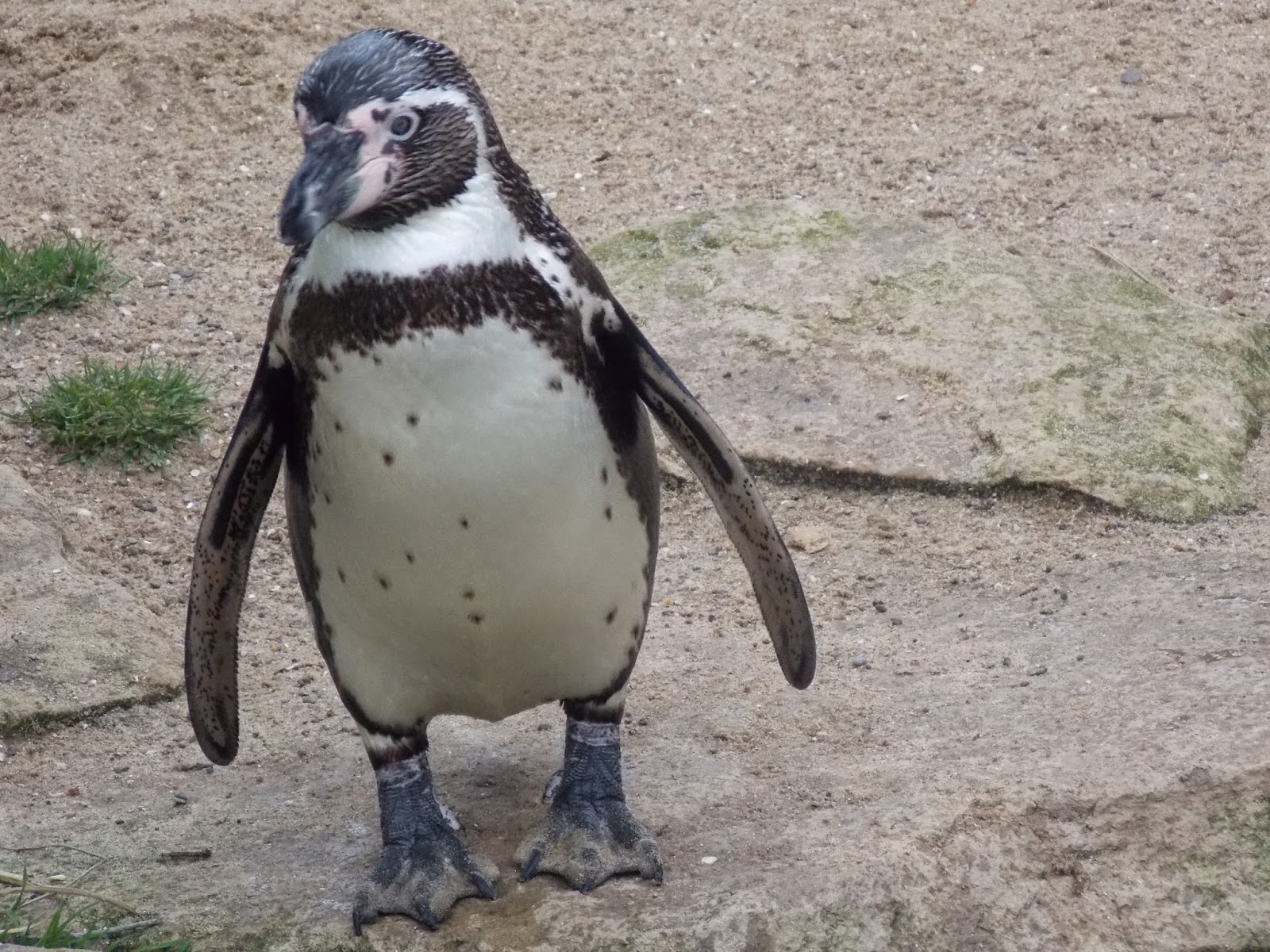
"Pp...pp. pick up a penguin," at Dublin Zoo, May 2014
One boy who comes to me for counselling suffers from a sort of low-grade depression for which he is taking sessions from a qualified psychologist in a local hospital.  I work with him once a week.  He is representative of a growing number of young people who seem to be somewhat bereft of hope.  In our sessions, we constantly talk about choosing life and hope, not despair and death.  Recently a young female contact (I never like the use of the word "friends" for "contacts" on this social network as it is a definite misnomer that can cause some young people an amount of anguish if they are deleted or blocked or even bullied by another so called "friend.") on Facebook put up a rather depressing status including the symbol of the skull: "It's mad knowing the only thing we actually are promised in life, is death I do have meself (sic) freaked to bits thinking about it!" Indeed, I notice that FB has become a sort of diary for many of our young people where they reveal their hearts to an oftentimes disinterested public.  As I say, I have my doubts about how helpful FB can be in mental health matters, but that is a debate for another post.

Attracted to the Light

It is indeed a truism to say that we are attracted to the light and repulsed by the dark. For the most part, we are all intuitively attracted by the light in good people.  Generally, it has been my experience that really good people are innately attractive, e.g., Martin Luther King, Mother Teresa, Pope John XXIII, Pope John-Paul II and in more recent times Pope Francis I.  I have named many others above in my opening paragraph.  I leave it to you, all you good loyal readers out there, to name your own attractive world political and spiritual leaders.  Essentially, such leaders share much with the historical Jesus and the equally historical Siddhartha Gautama (the Buddha), St Francis and all the present day great spiritual leaders (as distinct from Religious Leaders.  I will be contentious here by stating that I believe that Pope Benedict XVI was a Religious Leader while Pope Francis is a Spiritual Leader). I believe that the great contemporary religious writer and theologian Karen Armstrong is also an attractive spiritual leader.  Her books are widely read and she has been universally honoured for them.*

We must radiate the light of hope in our lives, especially if we are in any position of leadership.  Leadership requires those who exercise it to be real, authentic human beings, aware both of their strengths and weaknesses, to be open to encouraging those whom it is both their task and privilege of leading, being so self-assured in themselves that no one on the staff is ever a threat to their sense of authority.  They must be motivators who notice and affirm the innate talents in each and everyone of their colleagues and employees.  This may be a tall order, but after all that is why we put such people into leadership roles and pay them oftentimes extravagant salaries.

If we know that in the end, in a very real and actual way, every individual life is a physical
Chimp with orange, Dublin Zoo, May 2014
failure in the sense that we all end up in the grave, why then should we keep going on?  If, in the end, all the knowledge we have learnt in our individual brains decays into nothing with our bodies, why do we desire to learn?  A very intelligent student asked me that the other day when we attended the presentation of Green Flags for schools that had made serious efforts to cut down on waste of energy and water. We were discussing the dreadful ecological state we have got our lovely Blue Planet into in these more modern times when he asked the question.  If in the end we are all going to perish, given the horrific mess we have made of our planet, why not give up? I replied that one reason we bothered is that we did not ever wish to become victims, that we had a desire, in-built in us, for order and meaning, and that to give up hope was to admit defeat. As we continued our discussion we spoke of humankind being co-creators with the Creator of the Universe, of our being called to build up as many lovely things as we could for the sake of others, for the sake of all humankind and for the sake of all creaturely and inanimate life.

The lovely cuddly red panda at Dublin Zoo, May 2014

When we write a poem, sing a song, compose a new piece of music, protect animals, build a new building, nurse another sick human being or animal, discover a new piece of knowledge to add to the jigsaw of wonder which this life essentially is, we are lighting candles of hope. When we put out our hand to help another, when we join a cause for the betterment of someone or something or even smile in acceptance of another, we are engaged in spreading the light of hope.  When we shake hands, when we hug another, when we truly listen in acceptance, when we are truly compassionate towards all sentient things, as the Dalai Lama is wont to put it, then and only then are we a true and authentic people of hope.  All our most profound religious and spiritual traditions speak of the light of hope conquering the darkness of despair.  It is no wonder that we often turn to their wisdom traditions in times of disillusionment and despair for words of comfort like: "better to light one candle than to scorn the dark," or "every journey, no matter how long, begins with one little step."  Even if you only smiled at someone today, you are engaged in the apostleship of hope.  I have long loved the short saying of the late Medieval Catholic mystic Meister Eckhart that runs: “If the only prayer you said was thank you, that would be enough.”  If each and everyone of us said this prayer as often as we can on a daily basis we would be truly embracing the magic of hope. 


Footnote:

* In May 2008 Armstrong was awarded the Freedom of Worship Award by the Roosevelt Institute, one of four medals presented each year to men and women whose achievements have demonstrated a commitment to the Four Freedoms proclaimed by President Franklin D. Roosevelt in 1941 as essential to democracy: freedom of speech and of worship, freedom from want and from fear. The institute stated that Armstrong had become "a significant voice, seeking mutual understanding in times of turbulence, confrontation and violence among religious groups." It cited "her personal dedication to the ideal that peace can be found in religious understanding, for her teachings on compassion, and her appreciation for the positive sources of spirituality." 

Wednesday, April 3, 2013

Journal of a Soul 11

The Makers of Meaning
A book I am currently reading.


We are makers of meaning.  Without meaning, life is shallow and hollow. Without it, we become heartless and soulless automata.  Eventually, we literally dry up, wilt and die like an uncared for plant.  Immediately here, we have the makings of a good metaphor – living a good life is, in a certain sense, gardening for the soul.  This is a metaphor suggested by Carl Ransom Rogers in his Person-Centred Therapy (PCT).

In a major sense, too, our opening metaphor here, namely gardening for the soul, suggests a firm connection with nature.   And, further, this is one of modern and post-modern humanity’s greatest faults.  Not alone do we lack a real connection or relationship with the earth and its goods, but we destroy them with impunity.  Even worse, the acquisitive and capitalist cultures we are born into allow us to be virtually indifferent to the earth and its bounty.  Sadly, we meet many people who are unaware of the destruction we are doing to the bountiful planet on which we live. 

Maybe at this juncture in the history of humankind, when we are in the midst of the worst economic crisis we have ever witnessed, we are ready for a wake-up call.  Perhaps, greed and rapacity have shown us their worst results – corruption, bankruptcy, selfishness, and a sheer lack of appreciation for things of the spirit or the soul, for values other than those linked to financial profit at all costs.

But, any of us who are idealists, who believe that something else is needed over and above rapacious capitalism for the redemption of humankind, are often left totally disillusioned.  In this side of the developed world – Europe – it would seem to this economically ignorant commentator that the powers that be, namely Germany and France don’t really want to help the rest of Europe in solidarity.  Rather, they prefer to self-righteously preach about unfettered over-spending by smaller countries and lack of regulation, and not a word about their own unfettered over-lending.  There is not much solidarity in squeezing the last penny from some of the poorest nations who in turn are squeezing their own poorest citizens.

This is no political qua political post, dear reader.  It is, perhaps, political qua spiritual, as all spiritual stances have political and financial consequences.  Humankind has lost its way as all spiritual values are being lessened and eroded in the name of the mighty euro or indeed the mighty dollar or whatever the ascendant currency might be. What, then, are these values, the decrease of which, I lament here?  Let me try to list them in no specific order:

  1. Connection with the earth.  Call her Mother Earth or Gaia – see James Lovelock’s notion of Earth as one great organism.  Notice the connection of all simple religions and spiritualities with the Earth as Mother or provider.  In this regard reading the spirituality of the American Native Indians is very enriching.  (Note to self: I must read more here.)
  2. Fostering creativity in all its incarnations: drawing, painting, writing, sculpting, composing music, singing, dancing, acting and so on and so forth.  What do they tell us about humanity?
  3. The moral call – the call to fight for justice on our own doorstep as well as further afield.
  4. Asking questions like: Where does this moral call come from?  Why behave in a just way? Where or who is the source of this moral call?  Is there a source of Good, i.e., God?  The present writer believes this is a very important question to discuss, though he is agnostic about the answer.  He certainly has very few answers.  But in the tradition of Socrates all questions, especially the hard ones must be put.
  5. What is friendship? What is love?  Or again, in reference to the current financial crisis: What is SOLIDARITY? What is the common goal of humanity?  In how far am I my brother’s keeper?
  6. What lessons have we learnt from the current worldwide DEPRESSION?
  7. What, essentially, have the traditions of the great world religions to teach us about our values as humans?


If we as humans are the makers of meaning, and the makers of values, then we had best be up and at it, and not leave the way clear for the empty philosophies of bureaucrats and capitalists, who, in the words of the great Irish litterateur Oscar Wilde, “know the price of everything and the value of nothing.”

Tuesday, June 19, 2012

Journal of a Soul 5

Clump of wood, Isca Marina Beach, June 2012
As I write a monastic silence prevails, and how I love periods of silence.  There is nothing to be heard around me and my little apartment except the twittering of the birds and the occasional noise as a neighbour moves.  The Carthusian Monks or Trappists speak of the Magnum Silencium – the Great Silence.  Whatever about a great silence, a small one - Parvum Silencium - is enough for me.  At this moment in time I am the recipient of a small silence which reigns in my Heart.  For these occasional small silences my Soul lives.  Enter into the sanctuary of your own Soul, a deep voice within tells me.  And yes, this peace of mind is what monks and nuns of old and of new mean when they say they meet their God in the great and small silences of their lives.
Just above, I have said that I am the recipient of the gift of silence.  And gift –“donum” as they call it in Latin – is one of the most powerful words we can use spiritually.  We experience life as a “given” or as a “gift,” as something we have no real control over – either in its coming or in its going, in its growing or in its passing away.  And, it is only when you reflect on your life in the silence of your own Heart or Soul that you know this, or learn in absolute humility to accept the bounty of life over which you have no absolute control, though we often like to fool ourselves with our technologies of all types that we have some.  However, the wonderful Anglican Divine and Poet, John Donne, had an answer to this egotistical hubris of humankind when he stated in one of his sermons that we should not ever ask for whom the bell tolls, for, verily, it tolls for us.  Our mortality is at once, then, our greatest strength and our greatest weakness which takes most of us almost a lifetime to accept.
Indeed, one does not have to be a monk or a nun, a Christian or a Buddhist to know this.  One can be a believer of any hue or none, indeed, to learn to appreciate the sheer gift and bounty that life is. Moreover, you can either learn this lesson positively or negatively, but learn it you will.  As I sit here now in the silence of my little Calabrian sanctuary I am learning it positively by being open to the gift that all life is to me and for me.  There were times when I encountered the gift negatively, that is, in all those times when I experienced loss, when little or indeed big things were taken away from me – the death of my father, the loss of a job, the disappointment in not getting promotion, the dissolution of a relationship, the slow dissipation of strength as I age, the odd bout of ill-health.  All these very negative things subtract much from life and sometimes they can bring us down into the very pits and dungeons of dread and despair. 
Then, thankfully, there are these moments of small silence as I call them, moments of sheer blessedness when one’s Heart almost sings for joy at the sheer giftedness and bounty of life.  As I say, this is where even an atheist can pray.  Spirituality is a most human thing, and in its sheer depths and heights, in it lengths and breadths, there are those who call it divine.  And, I say, “why not call it such, if you so wish?” because once I felt like that, too.  But for this solitary pilgrim, this word “divine” is a metaphor for the heights and depths of humanity at its best.  Religion, uncoupled from the energising power of spirituality, is a frightful thing indeed.  Uncoupled from spirituality, whose fruits are faith (faithfulness), hope (hopefulness) and of course, love (lovingness), religion descends into what its worst critics like Dawkins, Dennett and Hitchens would have it – a veritable and unique source of evil in the world.  Unhitched from spirituality, religion becomes at best a tawdry and bankrupt, if arcane, system of rules, and at worst a corruption of truth in the pursuit of temporal power in the guise of the divine.
One of the local bars/restaurants in Isca Marina
And therein lies the moral of this short tale.  Seek out the silent places and spaces in your own Heart or Soul.  Drink at the wells of your own depths. Seek your own truth by travelling down into the dark passages of your own being.  Acquaint your Self with the shadowy corners of your own Soul and well as with its brighter pastures.  Climb the frightening cliffs of self-knowledge in the hope of gaining some little Self-acceptance.  But in all of this, dear friends, remember to linger often on your journey, and just sit in Silence and let it take you into its loving and sustaining embrace. Truly, you shall not be disappointed.