Showing posts with label Soul. Show all posts

Friday, September 16, 2016

Poems I Journey With 8

Back in the good old days we had to learn many poems off by heart as learning by rote was still in the ascendant in the mid-seventies of the last century. Ireland has given birth to legions of poets, and the author I am celebrating here tonight, one Patrick Kavanagh remarked that at any one time our country could boast of a standing army of some 10,000 poets. W.B. Yeats, Patrick Kavanagh, Thomas Kinsella and Austin Clarke were the four major Irish poets we studied at school. Tonight I want to discuss Patrick Kavanagh's great poem "Stony Grey Soil" which we studied for our Leaving Certificate.

Patrick Kavanagh


Stony Grey Soil
O stony grey soil of Monaghan
The laugh from my love you thieved;
You took the gay child of my passion
And gave me your clod-conceived.

You clogged the feet of my boyhood
And I believed that my stumble
Had the poise and stride of Apollo
And his voice my thick-tongued mumble.

You told me the plough was immortal!
O green-life-conquering plough!
The mandril stained, your coulter blunted
In the smooth lea-field of my brow.

You sang on steaming dunghills
A song of cowards' brood,
You perfumed my clothes with weasel itch,
You fed me on swinish food

You flung a ditch on my vision
Of beauty, love and truth.
O stony grey soil of Monaghan
You burgled my bank of youth!

Lost the long hours of pleasure
All the women that love young men.
O can I still stroke the monster's back
Or write with unpoisoned pen

His name in these lonely verses
Or mention the dark fields where
The first gay flight of my lyric
Got caught in a peasant's prayer.

Mullahinsa, Drummeril, Black Shanco -
Wherever I turn I see
In the stony grey soil of Monaghan
Dead loves that were born for me.

Commentary

Rare colour photo of Patrick Kavanagh
We all at one time or another have a love-hate relationship with the city,  town, village, townland or countryside where we were born.  We are never happy with our progress in life and we often blame our native place for the singular lack of opportunity it offered us as young people.  We also, of course, blame our family of origin which is naturally enough specifically rooted in our birthplace.  When I studied the Irish Gaelic language we were told that the great Irish Gaelic poet Seán Ó Ríordáin had a propensity to compose compound words or "chomhfhocail" as we called them in that language.  Kavanagh uses a similar technique in his poems by using his own compound or hyphenated words, viz., "clod-conceived," "thick-tongued" and "green-life-conquering." I especially liked, as a youngster studying this poem, Kavanagh's use of the literary devices of personification (where his Monaghan farm home is addressed directly as a person) and apostrophe (addressing someone or something that is simply not there in front of one). Also "Stony Grey Soil" is written in a form somewhat akin to that of the ballad as the poem contains stanzas of four lines each even though Kavanagh does not stick rigidly to the rhyming schemes of the traditional ballad.

However, for me the strongest feature of this poem, as of virtually all of Kavanagh's poetry, is the strength or force of his simple and direct imagery. Such strong imagery is evidenced practically in very line and indeed in the very title which occurs as a repeated line that has the effect of a chorus of lament.  A list of images is always easy to make in any poem by our author: "stony-grey soil," "gay child of my passion," "clod-conceived," "clogged," "stumble,"  "stride of Apollo," the named parts of the plough, "lea-field" and so on.  I shall not bore the reader with listing them for the whole poem as he or she can easily do that for themselves.

This poem is steeped in regret for his lost opportunities as a poet and as a human being since as a young man he dedicated himself to the land rather than to his métier as a poet or as a lover or suitor for young women.  The poem then becomes a lament for his predicament, that is, having wasted his youth.  That sentiment is stated very strongly and bitterly in the following lines packed with clear imagery:

O stony grey soil of Monaghan
You burgled my bank of youth!

I also particularly love the traditional format and nature of this poem.  It was long a tradition in Irish Gaelic poems to list off the names of townlands and towns as in the tradition of the "dindshenchus" as is exemplified in the final stanza.

Again, there are references to religion, God, but not the Church as in the following five lines:

Or write with unpoisoned pen
His name in these lonely verses
Or mention the dark fields where
The first gay flight of my lyric
Got caught in a peasant's prayer.

It is the "peasant's prayer" or natural or instinctive spirituality that appeals to Kavanagh. That is at once Pagan Celtic as well as Catholic or Christian.  Then there is the paradox that exists at the very heart of life, namely "dark fields" that might suggest something profoundly ungrounding and unnerving like the "dark night of the soul" and yet it is placed side by side with "the gay flight of his lyric" that somehow was caught up in a peasant's prayer rather than a poet's book of promise.

Finally the line "Dead loves that were born for me" is distinctly depressing and profoundly disturbing.  That the ballad format is used for this poem is also good as it is able to carry the lament and regret from his misspent youth and the lost opportunities he might have had, had he been luckier in life. 

Thursday, March 24, 2016

Thoughts on the Tao Te Ching 55

Stephen Mitchell's translation of Poem 55 runs as follows:


He who is in harmony with the Tao

is like a newborn child.
Its bones are soft, its muscles are weak,
but its grip is powerful.
It doesn't know about the union
of male and female,
yet its penis can stand erect,
so intense is its vital power.
It can scream its head off all day,
yet it never becomes hoarse,
so complete is its harmony.

The Master's power is like this.
He lets all things come and go
effortlessly, without desire.
He never expects results;
thus he is never disappointed.
He is never disappointed;
thus his spirit never grows old.


The city of Prague from the castle walls

 Derek Lin's translation of the same poem runs thus:

Those who hold an abundance of virtue
Are similar to newborn infants
Poisonous insects do not sting them
Wild beasts do not claw them
Birds of prey do not attack them
Their bones are weak, tendons are soft
But their grasp is firm
They do not know of sexual union but can manifest arousal
Due to the optimum of essence
They can cry the whole day and yet not be hoarse
Due to the optimum of harmony
Knowing harmony is said to be constancy
Knowing constancy is said to be clarity
Excessive vitality is said to be inauspicious
Mind overusing energy is said to be aggressive
Things become strong and then grow old
This is called contrary to the Tao
That which is contrary to the Tao will soon perish.

Swan on the river Vltava, Prague, Feb 2016

Commentary

I have often heard it said that as we go further on our path in life in terms of our own personal development that we have to unlearn much of what we have learnt during our early socialisation as children and many of our inculturated opinions so as to eventually reach some level of self-knowledge or individuation.  What I am referring to here are crazy ingrained opinions like "children must be seen not heard," "boys never cry," "men must be strong," "women must be ladylike," "If I haven't a beautiful body I'm not really important," "not to have money is a supreme failure in life," "bad exam results mean failure" and a host of other opinions which can fester into downright prejudices against and hatred of self and others.  And the worst thing about all these ingrained opinions and prejudices is that for a long enough period of our growing as people we are blithely unaware of them.  However, if we are open at all to life, we won't be long about learning lessons in awareness.  After all, life does have a habit of slapping us in the face every now and then as if to say in no uncertain terms: "Wake up! Can't you see what life is doing to you? Do you really think all those things you have gathered around you in life are going to last?  Do you think you can take them to the grave with you? Do you think your thoughts are the only right thoughts? How much of you is ego? Is the price you are paying for all those ego trips really worth it?  Where lies your heart or your soul? Do you not realise that you too will pass as will everything in this world?

Charles Bridge, Prague, February 2016
Solid things after a while begin to seem less solid as we grow older.  Things begin to lose their gloss and sparkle as our body ages.  And yet, are there not things of the soul, goods of the spirit?  Traditional wisdom teaches us that there are.  Things of the soul or goods of the spirit or spiritual values are perhaps, our Taoist poet tells us, whatever is unconsciously pure and natural just like a newly born baby that is totally in harmony with itself.  It is in that natural state of being that approximates, I'd imagine, to what the Hungarian psychologist Mihaly Csikszentmihalyi means by "flow," that is the total absorption of the person in what the person is doing, an actualised being in the now. For an article on the concept of flow see HERE.


Montbretia flowers in my garden, Summer 2007
The natural power of life is seen in the potential power that the infant naturally possesses. In the above poem the author refers to the classic infant grasp reflex.  I have always loved putting my little finger into a young baby's open palm and them to feel that wonderful natural grasp - that wonderful infant tenacity of life, that natural thrust there is in every newborn life to cling on and to survive.  In a sense, what the Tao Te Ching is about, as is the case with all true religions and spiritualities, is finding that natural current of life, tapping into life's Still Point, discovering the Source of our natural power as it were.  As we grow up and become inculturated into whatever society we are born into, we learn to put on the ways of the world; to learn off all the various roles we have to play in life if we are to survive - in other words, we learn to put the ego firmly in the driving seat or into the saddle.  That is part of our survival skills and is very important to do if we are to get on in life.

Montbretia, my garden, Summer, 2007
However, problems emerge when we become besotted with success; when we begin to become enthralled by our own ego; when we begin to believe in the literalness of our own constructed identities; when we begin to believe that any single one or even a combination of some of the masks we are forced to wear is the real us. These obsessive and compulsive parts of ourselves which almost suffocate by times the real us are essentially what Buddhism means by the vices of clinging to and living in dependence upon the apparently real world. Let me liken the real or total self to a diamond with a multitude of faces.  Every face is a face of the diamond and all the faces together conspire to reveal the unique mystery of each individual self.  Spirituality helps us to transcend over-identification with any one face of the diamond, with any one mask of our many workaday masks.  Its the totality of faces/masks/identities and the ability to move with ease from one to another as required and then to deepen our pursuit of the real self through going into the heart or depths of the diamond through meditation and prayer.  There we will encounter the real if elusive self. When one starts out on this spiritual quest for the real self, the "follower of the way" or the "disciple" is drawn into a magical web of discovery that transcends even the self.  However, this writer has only touched on the outer perimeters of this growing reality.  Readers desiring deeper or higher spiritual truths will have to search elsewhere for such insights, into the writings of more powerful and enriching spiritual teachers, those rare souls who have travelled further on the path to self-awareness, awareness of others and an awareness of the abiding presence of the Other, some of us, including this writer, dare call God.

Ireland's Eye from Baldoyle, Summer 2006


Our Taoist author sees the naturalness of the little child, how at-one the little creature is in itself; how united it is in body and soul; how unsplit mind and body are in this natural new little being.  The world is about to work its spell on the little infant and socialise it in its ways and mostly in the ways of the ego and in the ways of its obsessions of humanity.  The new human being will begin to learn the lessons of separation, of how to separate body from mind; body from soul, if you prefer and then be taught the tough lessons of life when the mind ignores the body to the sore cost of both.  Then all the psychologies and all the spiritual paths will kick in for the person who desires to be whole again.

The little baby boy, according to our Taoist writer, experiences arousal in the erection of its manhood and yet it is a sexually unaware arousal insofar as it only experiences the power of life in its member and not the thrust to penetrate its feminine counterpart.  This natural power is felt in his little body, akin, I should imagine, to the generative and receptive powers felt in the female infant's little womb. All this is natural and unselfconsciously natural.

Cycle Path, Baldoyle, 2006
The Tao works by flowing through all the good and natural things of life.  As an erstwhile theologian, I can see parallels here with what classical Catholic Theology referred to as the Natural Law which was concerned with morality mostly and how moral laws can be deduced by human reason by observing nature - in other words, all human values are there already in nature and have only to be deduced or discerned therefrom through the faculty of reasoning. However, that's a shallow enough parallel, but a parallel nonetheless.  Note the Catholic concept would not embrace the vitality associated with either a Pagan or New Age concept of what is natural.

Another traditional Eastern analogy that the writer of this blog likes is that of how the wise person is not like a tree in the storm which can be fractured, broken, even uprooted if the wind is strong enough, but rather like a blade of grass which can bend in the wind and consequently not be harmed.  This is the sense that the above Taoist writer is getting at above when he says in the second stanza that the Master "lets all things come and go," or as I've already said above he learns to "go with the flow."

Finally, in this Holy Week as we fast approach Easter Sunday, read the above verses reflectively again and let their words have an effect on your soul.  Happy reading and peaceful meditating, friends.  Namaste!

Saturday, March 12, 2016

Thoughts on the Tao Te Ching 50

Poem 50


The Master gives himself up
to whatever the moment brings.
He knows that he is going to die,
and he has nothing left to hold on to:
no illusions in his mind,
no resistances in his body.
He doesn't think about his actions;
they flow from the core of his being.
He holds nothing back from life;
therefore he is ready for death,
as a man is ready for sleep
after a good day's work.

Commentary

One of the disputed quotes attributed to one of the mid-twentieth century Prime Ministers of Great Britain, Mr Harold Macmillan, who when asked what was most likely to throw any administration into crisis, is the famous one which goes, "events, dear boy, events!" Whatever about the accuracy or inaccuracy of its attribution, its wisdom is simple and so true.  Things happen either purposely or by chance, crises occur, accidents  take place and so on and so forth, and the wisdom we must learn to our definite cost is that we must weather these incidents with equanimity if we are to survive in this world in any sane sense.  This is the type of wisdom that our Taoist poet is alluding to in this poem above.  Once again, I hasten to point out that what he is recommending is no mere passivity in the face of random or caused occurrences, but rather an attitude of mind, a seemingly imperturbable spirit that will allow us peace of mind and sanity to deal with the human fall-out of those events no matter what the level or depth of their tragedy.

A weak flame tries to pierce the falling dusk: January 2016
Once again, at the heart of all spirituality is the contemplation of death and dying.  It has most rightly been pointed out by our inherited wisdom as a human race - in almost all spiritualities to a greater or lesser extent - that death is not the end of life - in fact, they maintain that it is part of the experience of living and central to life itself.  After all, individuality is but a little part of what life is.  We individuals are but mere specks of life who mostly subscribe to our own mythology of being so much more than we actually are: life is always greater than we small specks of it. However, when those close to us die, we are reminded in no small way what fragile vessels of life we are in actual fact.

In this regard, the Master lives by holding nothing back from life, by retaining nothing within his being that should not be spent on living and thereby adding to the sum total of life in the outer world.  He most naturally goes with the flow of life or the river of being.  As I type these fragile words on this virtual page in computer space, I realise how much more powerfully moving and existentially-loaded is the phrase "river of being" than the reductive, though solidly biological, "river of genes" of Richard Dawkins.  As humans, we are spiritual realities inhering so mysteriously and intricately in our temporary biological bodies. And so, as death and dying are inextricably part of all growth and of all life, the Master lives also by holding nothing back from the inevitability of life, not even his own death.  And so, dear friends, chance readers of these cyphers in virtual space, we could do worse than re-reading and pondering the above poem, which I repeat here for emphasis.  Namaste!


The Master gives himself up
to whatever the moment brings.
He knows that he is going to die,
and he has nothing left to hold on to:
no illusions in his mind,
no resistances in his body.
He doesn't think about his actions;
they flow from the core of his being.
He holds nothing back from life;
therefore he is ready for death,
as a man is ready for sleep
after a good day's work.


Saturday, February 27, 2016

Thoughts on the Tao Te Ching 47

Poem 47


Without opening your door,
you can open your heart to the world.
Without looking out your window,
you can see the essence of the Tao.


The more you know,
the less you understand.

The Master arrives without leaving,
sees the light without looking,
achieves without doing a thing.

Commentary

Windvane on the lungomare in Catanzaro Lido, January 2016
It is becoming increasingly hard  to come up with new insights with respect to the Tao Te Ching and consequently avoid boring the reader unduly by too much repetition.  I have referred to the balance of opposites many times here already.  However, a central pair of polar opposities that springs to mind is that between Inner and Outer. Indeed, this polarity is quite common in early philosophy and theology in general.  The great early Christian scholar St Augustine of Hippo (354 - 430) was one of the scholars within the early Church to highlight its importance.  Augustine was a restless seeker who sought the meaning of life both in the outside material world and also in the inside spiritual world.  According to his own account of his quest for meaning which he delineated in his wonderful classical biography The Confessions he found the former, while sensually stimulating, to be spiritually stultifying:

Late have I loved you, beauty so old and so new: late have I loved you.  And see, you were within and I was in the external world and sought you there, and in my unlovely state I plunged in to those lovely created things which you made.  You were with me, but I was not with you.  The lovely things kept me far from you, though if they did not have their existence in you they had no existence at all. You called and cried out loud and shattered my deafness.  You were radiant and resplendent - you put to flight my blindness.  You were fragrant, and I dew in my breath and now pant after you.  I trusted you, and I feel but hunger and thirst for you.  You touched me, and I am set on fire to attain the peace which is yours.
Admittedly, Augustine went on to condemn the material things of this world, most especially those related to the body as vitiated with evil and to elevate the spiritual realm to a rather esoteric stratosphere.  In other words, I believe he did not manage to hold the two poles in a healthy balance.  However, whatever about our criticisms of Augustinian philosophy and theology, we cannot overlook his insight that a spiritual dimension inheres within us.  In fact, Augustine spoke of his community of fellow friars as being on a shared journey to God and that this same God could be met in their code of practice (moral behaviour), the priciples they subscribed to (the Christian creed) and in their cultic practices (what I mean here by the word "cult" is any particular system of religious practice or worship: religious ceremones like Mass and so forth). He aslo recommended a life of prayer and meditation that followed a process which he called "interiority," namely that it was by a process of "going within" in prayer that one communed with God.

Now back to poem 47.  Our Taoist author is in essence doing exactly as St Augustine recommended above, namely that he suggests that we can be open to the Tao without physically opening our door and going outside.  Even without doing that, we can open our hearts out to the whole world.

Again, the idea of humankind's ignorance is an old epistemological tenet dating back many years.  Socrates encouraged his hearers to continually declare their ignorance as they sought out deeper and wider knowledge.  That knowledge could best be discovered by a process of asking tough questions to elicit ever clearer answers.  Augustine built on Socrates through Plato by recommending what he described as a "docta ignorantia" or "learned ignorance." This is the sense of the second stanza which declares that "the more we know, the less we understand." If one imagines a sphere as being the amount of accumulated knowledge learned by humankind then as knowledge grows the sphere obviously grows and while we have amassed more knowledge and wisdom there is a gowing surface of knowledge over against an ever-expanding universe of unknown knowledge and wisdom.  In that very same sense, it is often said that the more we know, the more we know what we don't know. This is, in effect, the epistemological thrust behind the lines of the second stanza.

Sometimes we need to rest and to cease from all activity to be open to life.  To be busy is a great pastime but it can often lead to mindlessness and drift on the one hand or an obsession with work or with pleasure on the other.  It is in this sense that we must read the lines of our final stanza:

The Master arrives without leaving,
sees the light without looking,
achieves without doing a thing.

Friday, January 1, 2016

Thoughts on the Tao Te Ching 33

Poem 33


Knowing others is intelligence;
knowing yourself is true wisdom.
Mastering others is strength;
mastering yourself is true power.

If you realize that you have enough,
you are truly rich.
If you stay in the center
and embrace death with your whole heart,
you will endure forever.


Commentary

The lifelong task of human beings is surely that of getting to know themselves.  However, that is easier said than done and being "true to oneself" or being "honest to oneself" or being "authentic" or "whole" or "integrated" or "individuated," no matter how one terms full self-knowledge, it is truly a long and painful journey.  That is the essential goal of all conscious life. 

Recent photograph of me

It appears that it is somewhat easier to get to know others, but that is only a superficial perception anyhow.  After all, we really only get to know their social, rather than their "real" selves anyway.  Do we ever master others?  No, indeed.  We possibly might master how to manage our "underlings" or staff or whoever at our places of work, but that is the extent of that.

Our task in life, as we have stated it above, is that of getting to know our true or real selves. This takes courage as we have to stand up to the power and opposition of our egos which are, on the whole, fed with much driving power by society.  Facing down the ego, then, requires much courage!

Greed is one of the basest of desires as we never can get enough of success and possessions and of apparent control of others.  It takes wisdom and the practice of much meditation to arrive at a sense of detachment from others and from the things of this world.  One day we realise that actually we have too much things and that things really don't satisfy our true and real desires.  Even at times the love of others, the we-ness of love itself cannot really satisfy our inner desires for fulfilment.  True detachment and the love that springs from it can be greater than human love.

This is the love that we read about in the Old Testament that is greater than fire and that many waters cannot quench it.  It is a love that stretches beyond death, and we have a hint of eternal life in its expression in that passage.  Likewise, the thoughts of our Taoist poet in the last lines of the above poem are stretching for a similar suggested, if imaginative solution, namely that if we stay in the centre (that is, rooted in the Tao) "and embrace death with (our) whole heart, (we) will endure forever."  In both texts, we have to agree that these are the thoughts of ancient scribes imaginatively reaching towards another world of being - imaginatively reaching to the myth of eternal life.  We remember here that myths are not literal but rather suggest a deeper truth which defies expression.


Thursday, November 19, 2015

Thoughts on the Tao te Ching 24


Poem 24

He who stands on tiptoe
doesn't stand firm.
He who rushes ahead
doesn't go far.
He who tries to shine
dims his own light.
He who defines himself
can't know who he really is.
He who has power over others
can't empower himself.
He who clings to his work
will create nothing that endures.

If you want to accord with the Tao,
just do your job, then let go.

Commentary

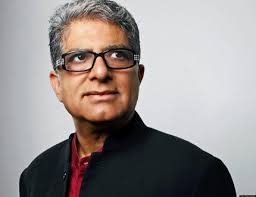
Deepak Chopra: Author, Spiritual Guide, Medical Doctor

Wisdom is bought at a high price - the price of experience.  We all essentially learn the hard way. How often have we heard our elders say that they went to the "school of hard knocks!"  One of my special needs students said the following the other day:  "Life does not get any easier; you just have to learn to laugh harder!"  Pure wisdom, that! The poetry, whether of the Psalms in the Old Testament or the poems in the Tao Te Ching, attempts to capture some wisdom by sheer dint of paradox or seeming contradiction; by setting up polar opposites; by stretching language to its breaking point.

Sometimes when we try too hard we don't achieve the results we want at all.  It's as if the ego gets in its own way and trips itself up.  The ego stretches itself up on tippy toes in a vain effort to see what's going on.  However, on a physical level, as we know, we are only able to maintain our bodies on tippy toes -  in such a stretched mode - for literally several moments as we strain say to look over a high fence.  On tippy toes we simply cannot stand firm. Anyone who runs or jogs will know that such exercise needs to be paced properly.  If the runner or jogger sets out on their chosen route at far too quick a pace. he will not be able to complete it in the proper time or indeed in the proper state of well-being.  Hence, the lapidary piece of wisdom in the above poem: "He who rushes ahead doesn't go far!"  I remember an old teacher I had at school used often say: "The longest way round is often the shortest way home!"  Why?  Well, the longest way round might not have as many obstacles as the shortest way!!
  
Clinical psychologist, Psychotherapist Dr Carl Rogers


I simply love the line: "He who tries to shine dims his own light."  Again, it appears to this reader and meditator that this is all about our ego getting in the way of the wisdom that naturally lives in our True Self (Deepak Chopra) or Real Self (Carl Ransom Rogers), in our Soul (religion/spirituality) or in our Heart of Hearts (traditional phrase meaning inner and true feelings).  It is so obvious when people are boasting of their abilities or attempting to get "one up" on us (one upmanship) or pretending to be something they are not.  Likewise, any person who thinks he can define himself clinically or precisely is simply deluded.  Just as the author puts it, this person "cannot know who he really is."  There is a mystery that lies at the heart of us all and we only gradually get to know that mystery.  Indeed, I believe we cannot really comprehend, apprehend or grasp that mystery in its entirety or fullness.  However, we do get glimpses of our True Self.

Then we come to one of the most corrupt impulses of the ego, namely the drive for power.  Persons who do not know themselves properly, or who have failed, as Carl Jung puts it, to properly integrate their shadow nature, all project their worst fears and hatreds onto others.  Hence we get breakdowns in the various relationships between husbands and wives, managers and staff, leaders and teams and indeed between different states.  When people exercise power over others in this egoic way they actually have failed to empower themselves to simply be their truest selves.  Likewise, if we cling to our work in an effort to gain some identity, we set up a state of dependence on our workaday activity to give us a sense of our true self and such a state of dependence only leads to a false sense of self!

Letting go is the answer, and indeed it is the answer given by all religious and spiritual traditions. What are we asked to let go of?  We are asked to let go of our Ego, of our desires to cling to sensual pleasures, to cling to others, to cling to ideas, to cling to our partners, to cling to our jobs, to cling to our pride, to cling to all false ideas of who we are.  We are asked, in short, to let go of the False Self and embrace our True Self.  This is not easily done, but by constant practice of meditation and other spiritual acts like writing, composing poems or music, sculpting, pottery making and so on and so forth, we gradually chip away at our masks and bit by bit expose our True Self to the light of our consciousness.  Indeed, none of us ever gets there.  Rather like the asymptote we only get there way out at infinity.

Example of two asymptotes: horizontal and vertical


Conclusion:

Once again, perhaps some word, phrase or clause in above poem strikes a chord with you.  If so why not use it as a mantra for a short meditative practice for five or ten minutes.  Namaste, my friends.

Sunday, November 15, 2015

Thoughts on the Tao Te Ching 23

Stanza 23

Express yourself completely,
then keep quiet.
Be like the forces of nature:
when it blows, there is only wind;
when it rains, there is only rain;
when the clouds pass, the sun shines through.

If you open yourself to the Tao,
you are at one with the Tao
and you can embody it completely.
If you open yourself to insight,
you are at one with insight
and you can use it completely.
If you open yourself to loss,
you are at one with loss
and you can accept it completely.

Open yourself to the Tao,
then trust your natural responses;
and everything will fall into place.


The good old worker bee,  I took this photograph in 2010


Commentary

The above poem is essentially about the twin skills of openness and listening.  Both these skills lie at the heart of the practice of meditation.  When we sit to meditate we firstly relax our bodies and de-stress it bit by bit.  Then we concentrate on the rhythm of our breath as it oxygenates our body and expels carbon dioxide through our nostrils - that basic process physiologists and biologists call respiration.  In meditation circles we call the attention to our respiratory apparatus simply "the act of returning to or paying close attention to the breath." This simple act is one of sheer receptivity to the breath that keeps our very body alive in this moment in time.  In holistic practices like that of Focusing, invented by Dr. Eugene Gendlin the person engaged in the process focuses on the "felt sense" of some problem,  Essentially focusing like mindfulness uses those skills used for thousands of years by the different masters and practitioners of meditation in the various religious traditions.  


The sand on Donabate Beach, 2013

In focusing one is literally listening to how we hold certain feelings in our bodies.  I would argue that meditators actually do that very naturally anyway.  It is also my contention that mindfulness is secular meditation and that modern authors who peddle their wares in the form of books, CDs and DVDs on mindfulness stole the clothes of the traditional meditators, but that is a story for a different post than this one.

Another major theme in the above poem is that of self-expression.  Such expression can be done in many creative ways: in art of all kinds, in literature, in poems, in music, in dance, in mime and in sculpture and architecture and so on.  Then, once one has expressed how one feels, the author recommends that we learn to keep quiet.  This is good wisdom as we must for sure express all our emotions, especially negative ones as unexpressed feelings will eat and gnaw away at us forever until they are given expression through one medium or another,  However, there is nothing worst than someone who continually repeats the same old moan and never has the courage to do anything about it.  Such is not what our Taoist writer has in mind.  He (or she) sees the expression of feelings as being therapeutic once expressed.  In this way, the person gets whatever is weighing them down or even lifting them up off their minds.


The second stanza sings the praises of openness which it also sees as essentially healing and therapeutic.  Such openness allows us to feel empathy with our inner self, with others and indeed with the source of all life which some of us dare call God.  Interestingly, the poet recommends that we be open both to negative and positive experiences: On the one hand we can be open to the positive experience of insight and by being so open we become one with it.  On the other hand, we can be open to the negative experience of loss and in so doing becoming one with loss.  Such an openness paradoxically helps us accept that loss and learn to live with it from day to day.  In short, such openness allows the human spirit to heal.

The author invites us in essence to open ourselves to the Tao and in so doing we open ourselves to the healing powers of the universe.  The final stanza works like a chorus and is worth repeating as it is really a summary of the whole poem:

Open yourself to the Tao,
then trust your natural responses;
and everything will fall into place.

In conclusion, some word or phrase or line may suggest itself as a matra for meditation or as a thought to inspire a short period of contemplation.  I wish the reader of these few words peace and happiness in the now of experience.  Namaste, friends!

Saturday, January 10, 2015

Journal of a Soul 71

The Journey Continues

Howth, Christmas Eve, 2014

A New Year has begun.  Another year has been clocked up on that strange weak vehicle of self or soul we call the body.  The calendar cycle has begun once again.  There is a wisdom in the seasons that seems to suggest that everything is cyclical, that progress is an illusion.  The way of wisdom is by the gradual erosion of our superficial beliefs bit by slow bit - like that proverbial drip that wears the stone.  Nothing is constant - all, as the ancient Greek philosopher Heraclitus says, is "in a state of flux," and yet there is a paradoxical cyclical repetition to change. 

Heraclitus in Raphael's School of Athens
The New Year is ushered in by a review of the events - little and great, insignificant and significant, heroic and tragic - of the past twelve months.  It is as if the fires of the last year have all burned themselves down into the ashes of our memory as we look ahead in anticipation and hope to the brighter fires of the year to come. Sometimes one gets the distinct impression that the drudgery of the whole thing begins again.  It's as if our body is growing tired of the whole thing and that the spirit itself is flagging.  When one looks out into the grey skies of winter in this northern hemisphere it feels as if one might be a character in a Kafka novel or a Beckett play - just there on an indifferent stage not understanding what has happened to you in life and that the blessed thing has a habit of just going on and on.  Yes, the cycle begins over and over again. And where lies the meaning?

There are sentences that haunt the mind of this writer - ones indeed of Biblical portent and intensity. These are sentences that come whistling like boys walking past graveyards on a dark shadowy night. "There is nothing new under the sun," says Qoheleth, the writer of the book of Ecclesiastes and he proceeds in Kafkaesque and Beckettian tones, in absurdist or existentialist terms with these rather anachronistically modern lines that are paradoxically over 2000 years old:

A generation goes, and a generation comes,
but the earth remains forever.

The sun rises, and the sun goes down,
and hastens to the place where it rises.

The wind blows to the south
and goes around to the north;
around and around goes the wind,
and on its circuits the wind returns.
All streams run to the sea,
but the sea is not full;
to the place where the streams flow,
there they flow again.


All things are full of weariness;
a man cannot utter it;
the eye is not satisfied with seeing,
nor the ear filled with hearing.

What has been is what will be,
and what has been done is what will be done,
and there is nothing new under the sun.

Is there a thing of which it is said,
“See, this is new”?
It has been already
in the ages before us.


There is no remembrance of former things,
nor will there be any remembrance
of later things yet to be among those who come after.
(Eccles. 1: 2-9)

And so here we go with another year. Where does that leave the writer of this blog? What about the progress on the spiritual way for this pilgrim soul?  I often wonder how far I have come and if any progress has been made at all.   Am I just beginning all over again? It often seems as if the spiritual journey is one of a cyclical nature too.  It feels as if the whole journey is beginning all over again from the start and that any progress that had apparently been achieved has now turned out to be a mere illusion.  With this in mind I can empathize with the young boy who informed me today that he had to get a repeat of his operation of four years ago to replace his VNS device (Vagus Nerve Stimulator) under the skin in his upper chest. This procedure is a modern treatment for trickier cases of epilepsy.  Or still again I can appreciate the predicament of anyone who has had a relapse of one or other disease that plunges them back to the beginning once again.


TS Eliot

And yet,  the words of Thomas Stearns Eliot (1888-1965) lift me, as they always do, with their dearly-bought but deep wisdom:


We shall not cease from exploration 
And the end of all our exploring 
Will be to arrive where we started 
And know the place for the first time. ("Four Quartets")

As any teacher or indeed any maker of poems will tell you a question like "what does this poem or these lines mean?" is a rather inappropriate one to ask of any such work.  Poems are an intricate interweaving of words, feelings, inspiration and sound, and their meaning lies somewhere in the interaction of the reader with that complex phenomenon.  So meaning is a very dynamic experience that cannot be reduced to a mere paraphrase.  

Let's try, though, to tease out some of the connotations and implications for our lives from Eliot's intriguing lines: 

Most of us are searchers and explorers who want to make some sense of our lives.  And moreover, we may never cease from doing so as Eliot suggests.  Oftentimes, and indeed our poet suggests always, we arrive back where we started out and see the place anew.  On one level the place is obviously the same, but now we are seeing it with "new" eyes, with a new optic, from a new or deeper or even different perspective.  Now there are new dimensions to our experience - new depths and/or new heights to it!

Making Sense of Life and the Turn to Meditation

If we don't seek to make some sense of our lives we are somehow consigned to a rather humdrum, boring and meaninglessly repetitious existence.  In short, we are meaning-making creatures and were meant to be.  In so doing, we are in a growing mode, ready to embrace happiness or that state called "flourishing" or "eudaimonia" by Aristotle.

However, searching and exploring can tire the spirit and the body.  I remember many years ago attending a spiritual retreat where each group was asked to come up with a name for their group.  The names suggested were along these lines: Searchers, Explorers, Sunflowers, Wayfarers, Pilgrims, Brothers and Sisters and so on.  The name that showed the least sense of struggle, obviously, was that of Sunflowers.  That particular group explained that they were so aware that they were respondents to sheer gifts and graces that were lavished upon them by God, the Universe or Life itself that they could come up with no other appellation.  This, at first sight, is a rather strange way of responding to life, is it not?  And yet it a legitimate experience of thanksgiving for life's bounty or bounteousness  that quite a number of people experience.  Sunflowers turn towards the sun and are led to blossom under its rays.  There are people who experience living as such a response to what they experience as the sheer giftedness of their being.

In those dry periods when its seems that I am going around in meaningless circles, as so brutally expressed in my opening paragraphs, that I am seemingly in the same old place or predicament, I often find myself turning to meditation.  Meditation for me can be done at three levels, and often I can do it at each of the three levels according to how I feel in any given situation.  At level one we can meditate at a physical level, that is, we can engage in it  solely as an exercise to relax our body.  At level two we can go deeper still and relax our mind - that is, where the mindfulness exercise is one of mental or psychological relaxation.  As a believer in the spiritual realm, I accept and indeed experience meditation as allowing me to experience a sense of being in touch with a deeper ground of my being, namely a divine or spiritual level to my life and to the world.  

It is at this third level that I experience graced moments of contact with a deeper or higher level reaching into my own little world.  This is very hard to describe because quite simply one has to experience it, to be touched by it and moved by it so as to appreciate it in any way at all.  It is at this level, I believe, that the human meditator can become like a sunflower responding to the Sun or Ground of life that some dare call God.  It is at this deeper (or higher depending on one's spatial metaphor) level that in T.S. Eliot's words we recognize or "know the place for the first time."  It is also at this level that one realizes that despite the seeming stagnation, the apparent atrophy and the stupefying stasis, there indeed has been a significant shift at the level of meaning, at the level of being, at the level of the spiritual journey.

And so the spiritual journey goes on.  As any pilgrim will tell you, the road is often twisting and troublesome, sometimes dangerous and impassable and yet one knows one can never turn back.  It is the persevering on that journey that counts.  Paul Tillich, the great German-American theologian and philosopher, called on us to "dare to be!"  He reckoned that this was the call issued to every human being in the task of making life meaningful in a very secular age.  For the wayfarer on the journey to self-knowledge and wisdom, this call can be re-written as "dare to journey onward" or "dare to risk" digging deeper or climbing higher or journeying further in the task of knowing your real self!  That way we will encounter our true and authentic self in all its dimensions.