Showing posts with label Real Self. Show all posts

Wednesday, August 3, 2016

Thoughts on the Tao Te Ching 78

78


Nothing in the world
is as soft and yielding as water.

Yet for dissolving the hard and inflexible,
nothing can surpass it.

The soft overcomes the hard;
the gentle overcomes the rigid.
Everyone knows this is true,
but few can put it into practice.

Therefore the Master remains
serene in the midst of sorrow.
Evil cannot enter his heart.
Because he has given up helping,
he is people's greatest help.

True words seem paradoxical.


Commentary

Let me begin by quoting from an authoritative web page with respect to the importance of water in our lives, indeed in the very life of our little planet: "According to H.H. Mitchell, Journal of Biological Chemistry 158, the brain and heart are composed of 73% water, and the lungs are about 83% water.  The skin contains 64% water, muscles and kidneys are 79% water, and even the bones are watery: 31%.  Each day humans must consume a certain amount of water to survive.  Of course, this varies according to the age and gender, and also by where someone lives.  Generally an adult male needs about 3 litres a day while an adult female needs about 2.2 litres per day.  Some of this water is gotten in food." The quotation is from HERE.  In short, we are literally bound together in this important substance.  Indeed, all literature and all the religions of the world see water as a most potent symbol, not alone of earthly life, but for those who subscribe to belief in God, a potent symbol of the spiritual nature of that life.

Now that we have set the biological, literary and spiritual background to our 78th Taoist poem we can begin our more spiritual reflections.  Once again, this poem is replete in imagery, the use of polar opposites in a healthy tension and, of course, paradox, the use of which is mentioned by name in the last line by our translator. The oppositions we find are the usual ones, which, as we have seen, are repeated rather liberally throughout our text: soft vs hard, yielding vs inflexible, gentle vs rigid, and serenity vs sorrow.  We have discussed this healthy tension of opposites many times in these commentaries.  The beauty of the Tao and all superior spiritualities is that they are somehow able to avoid speaking in terms of the deliberate separation of opposites, that style of religion which espoused a dogmatic and rigid separation of everything into blacks and whites where there are no shades of grey in between let alone the coulours of the rainbow.  That's why the taijitsu or the Yin-Yang is a most potent symbol for Taoists where the black half of the symbol contains a dot of the bright and the bright half of the symbol a dot of the black.  Could any symbol be more potent?

Likewise, the paradoxical two lines near the end of the poem appeal greatly to my sense of growing old and becoming a little wiser through the dint of hard lived experience in life: "Because he has given up helping, he is people's greatest help."  As a young teacher, I used to try and help everyone, that is, rush in with a sort of fire-brigade approach to sorting X, Y and Z problems out, but lived experience has taught me to realise: (i) how little I can do in X situation and that it is better to let another person who may be able to do something handle that issue (ii) that it is better to wait and have patience until a more opportune time presents itself with respect to Y situation and (iii) that it may be better to actually do nothing as in that Z situation things have gone far too far for any helpful intervention on anyone's part.  It is in this sense that I understand the pardoxical lines just quoted.

Oscar Wilde, as I have said here recently, remarked about the pure and simple truth that it is rarely pure and never simple.  That is a rather wise statement as it gives the lie to the black and white version of the truth.  His statement, in that sense, is very Taoist.

As we proceed to age in life, let us become more aware of the dangers of an attitude that sees the world through a very narrow lens.  Let us rather try to view the complex world through a prism that breaks light into all the colours of the rainbow.

Namaste, dear friends, until I get the time for an other reflection in these pages, and have a contented time just being the real you!


Sunday, April 10, 2016

Thoughts on the Tao Te Ching 61

Poem 61


When a country obtains great power,
it becomes like the sea:
all streams run downward into it.
The more powerful it grows,
the greater the need for humility.
Humility means trusting the Tao,
thus never needing to be defensive.

A great nation is like a great man:
When he makes a mistake, he realizes it.
Having realized it, he admits it.
Having admitted it, he corrects it.
He considers those who point out his faults
as his most benevolent teachers.
He thinks of his enemy
as the shadow that he himself casts.

If a nation is centered in the Tao,
if it nourishes its own people
and doesn't meddle in the affairs of others,
it will be a light to all nations in the world.


Commentary

As a frequent traveller I am well used to having my identity checked at passport control or immigration counters as one enters various countries.  In these days of growing terrorist problems worldwide, our identity, and proof of it, was never more important.  Also, if we are users of the Internet, as most of us are now, we also realise that identity theft is a singularly common crime, so must must protect ourselves against that as much as we possibly can.

The beautiful Synogogue in Prague, February, 2016
It seems to me as a Special Needs Teacher and a part-time psychotherapist ans counsellor in a secondary school that one of the most sacred things that I do is to help any individual pupil come to acceptance of his identity (I hasten to add that I teach in an all-boys school, hence my use of male possessive adjective here), to come to realise that the fostering and development of one's own self is the most precious task each of us is charged with as a person. Therefore, coming to an awareness of our real identity is very important for every one of us.

In Ireland, we are celebrating the centenary of the beginnings of our young nation in the Easter Rising/Insurrection of 1916.  There have been many books, journals, magazines and commemorative pamphlets, running into hundreds at this stage, dedicated to this centenary celebrati0n - indeed, our own school has produced two such pamphlets.  To state this in other terms, one could truthfully say that our young nation is engaged in the task of coming to terms with its own identity.  Who are we as a young Irish nation? Where stands the vision of those men who first proclaimed the Irish Republic?  Has their vision of true equality for all "the children of the nation" been actually achieved?  We are, then, at present dealing with this and other questions in our commemorative ceremonies, in the many learned commentaries given, in the books written, in all the various media outlets - written, broadcast and digital - and such activity has been a rewarding exercise for us as a nation as individuals.

Artist at work, Firenze, summer 2002
Our Taoist poem speaks about power and about powerful nations.  Ireland is most certainly not a powerful nation, and yet she has power over her own people, can represent them internationally at the EU and at UN fora.  Power in the hands of evil men can lead to much destruction both of people, animals, the goods of the earth and the work of human hands as we have witnessed in the twentieth century.  Matthew White reports in his Historical Atlas of the Twentieth Century, 2010 that the number of deaths by war and oppression during that period amounted to some 203 million human beings.  One wonders as to what the destruction of animals (mainly horses) and property amounted to - a figure I should prefer not to know as I'm sure it would be mind-bogglingly huge.  As the English Catholic politician and historian Lord Acton famously observed: "Power tends to corrupt and absolute power corrupts absolutely. Great men are almost always bad men."  The statistics quoted confirm that statement.  Power corrupts individuals because of their selfish and worldly-driven and ambitious egos, and it is no wonder then how much more  power actually corrupts whole nations.  The second part of his famous quotation most definitely can be related to such men as Hitler and Stalin and the many hundreds of other despots the world has known since the beginnings of civilization.


Lord Acton, 1834 - 1902
Power, our Taoist poet recommends must always be accompanied by the virtue of humility if it is not to fulfill Lord Acton's famous statement about power quoted in the previous paragraph. Humilty has always been widely viewed as a central virtue in many religions and spiritualities deriving therefrom, and indeed in many philosophic traditions.  It has also often been counterpointed or contrasted with such vices as narcissism, "hubris" and other forms of pride. Humility, needless to say, is related to the adjective "humilis" that can be translated as humble and it is a virtue that became very much abused in Roman Catholic circles over the years where novices in religious orders, and women in particular were called upon to be self-abnegating to such an extent that they might have had a far too low opinion of themselves, perhaps even a low level of self-esteem and consequently very little apreciation for their real selves. However, the Latin word "humilitas" also has a link with the word "humus" which means "earth" or "clay." Hence humility, which obviously entails a certain level of ability to put the ego in its rightful place, also encompasses a sense of being "grounded" and "earthed."  It is this sense of the word that I feel the Taoist poet has in mind in the above quoted lines.

Being grounded and earthed means being able to admit that one does not have all the answers; that the ego has to take its place along with the heart, empathy and compassion as just one motivating factor in our lives; that there is no one right way to live life or any one simple answer to complex problems and that truth is rarely pure and never simple (Oscar Wilde); that everyone makes mistakes and that the admission of them is truly ennobling of the humble person who is always willing to learn.

Individuals as well as nations, then, are called upon by our Taoist poet to be humble, to be earthed, to be grounded, that is to be centered in the Tao.


Friday, March 25, 2016

Thoughts on the Tao Te Ching 56

Poem 56


Those who know don't talk.
Those who talk don't know.


Close your mouth,
block off your senses,
blunt your sharpness,
untie your knots,
soften your glare,
settle your dust.
This is the primal identity.

Be like the Tao.
It can't be approached or withdrawn from,
benefited or harmed,
honored or brought into disgrace.
It gives itself up continually.
That is why it endures.

Commentary

Picture of myself some years back
The line that jumps out at this commentator as he reflectively reads the above poem is the one which runs: "This is the primal identity."  What a wonderfully loaded line.  Using the literal meaning of the word "primal" we could substitute into one meaning of the word the following synonyms for it in this statement, namely "original," "first," "initial" or "early."  A second meaning given for "primal" renders the following synonyms: "basic," "fundamental," "essential," "vital" and "central." Therefore, other meaningful ways of stating our Taoist assertion would be: "This is the real identity," or "This is the true identity" or "This is the essence of identity" or "This is the vital identity."  From the moment of first consciousness we are meaning seekers and meaning makers, and certainly the older we get the more strongly we pursue our rather elusive identity.  It would seem that for us moderns that the search for meaning and the search indeed for ultimate meaning is what often keeps us going in life. The question of personal identity looms large for all of us.  "Who am I?" is a question to which we all seek an answer and one to which we do give an answer insofar as we manage to live any kind of meaningful lives. 

My shadow on Donabate Beach
In the philosophy and practice of psychotherapy, and indeed in that of psychiatry, the question of personal identity is essentially very central.  Listening to the client is an empathetic and affirming way is one sure way of helping him or her to greater self-awareness and greater self-acceptance.  And yet, it is surely a huge question as to what the nature of personal identity is in the first place.  One of the founders of humanistic school of psychotherapy, namely Carl Ransom Rogers stated that the goal of all therapy was the actualization of the Real Self, and this is a very good modern equivalent of what our Taoist poet is getting at in the above poem when he mentions "primal identity."  The task of all meditation practices, and indeed what more secular psychologists and psychotherapists refer to as the practice of mindfulness is in a strong sense one and the same.  They both seek to establish a strong sense of the Real Self or of a real sense of living in the Now of existence. Therefore, the turn to the East - and by this I mean both the actual journeys made by many psychologists, psychiatrists, sociologists, creative writers and musicians and many religious scholars to India and Tibet, as well as the written accounts of their experiences and newly gained knowledge and so on - in the middle of the twentieth century should not surprise us at all.  So many Westerners of note began living in ashrams and studying and meditating under various gurus and masters.  From this there emerged a wonderful blossoming of esoteric scholarship that flowed into the New Age Movement that in turn spawned an almost universal interest in Self-Development, Pop Psychology and Self-Help.  Therefore, mindfulness is merely a secularized account of the meditation practices used in the various religious denominations of Hinduism and Buddhism.

The author as a young lad aged 7.  Is this actually the me I am now?
The second phrase that jumps off the page at this commentator is "settle your dust."  How many times have we heard the old wise saying that we must let the dust settle on this, that or the other problem?  We have other similar phrases like: "Let's let sleeping dogs lie for a while" or "Let's sleep on this problem for a while" or "Don't make important decisions when you are upset in any way!" or "Choose your battles carefully!"  These phrases or sayings are all getting at the same wise advice, namely not to be reactor to this or that situation.  The easiest thing for anyone to do is to "shoot from the hip" as another phrase puts it.  Still another saying offers this piece of wisdom: "Act in haste, repent at leisure!" Meditation is all about slowing down and taking our time, of getting centered in the "Now" of being, of achieving a point of equanimity we may call the Still Point of life, of stilling the body, of becoming aware of what it's really like to inhabit or to live in this body, or even more correctly still, what it's like to be this body here in the now of existence.  I have always loved the statement, also a very wise one, that our minds tend to either live in the past (regrets and remorse and sad memories and so on) or in the future (expectations, ambitions, anxieties and/or fears and so on) while our bodies most definitely live in the present.  That, indeed, is why all meditation or mindfulness practices begin with stilling the body, of becoming aware of the body at first, then becoming aware of our feelings and just letting them go, then becoming aware of our thoughts and letting them so and so on and on, and deeper and deeper into the stillness of the "Real Self" or what our Taoist poet calls the "Primal Self."

Thursday, March 24, 2016

Thoughts on the Tao Te Ching 55

Stephen Mitchell's translation of Poem 55 runs as follows:


He who is in harmony with the Tao

is like a newborn child.
Its bones are soft, its muscles are weak,
but its grip is powerful.
It doesn't know about the union
of male and female,
yet its penis can stand erect,
so intense is its vital power.
It can scream its head off all day,
yet it never becomes hoarse,
so complete is its harmony.

The Master's power is like this.
He lets all things come and go
effortlessly, without desire.
He never expects results;
thus he is never disappointed.
He is never disappointed;
thus his spirit never grows old.


The city of Prague from the castle walls

 Derek Lin's translation of the same poem runs thus:

Those who hold an abundance of virtue
Are similar to newborn infants
Poisonous insects do not sting them
Wild beasts do not claw them
Birds of prey do not attack them
Their bones are weak, tendons are soft
But their grasp is firm
They do not know of sexual union but can manifest arousal
Due to the optimum of essence
They can cry the whole day and yet not be hoarse
Due to the optimum of harmony
Knowing harmony is said to be constancy
Knowing constancy is said to be clarity
Excessive vitality is said to be inauspicious
Mind overusing energy is said to be aggressive
Things become strong and then grow old
This is called contrary to the Tao
That which is contrary to the Tao will soon perish.

Swan on the river Vltava, Prague, Feb 2016

Commentary

I have often heard it said that as we go further on our path in life in terms of our own personal development that we have to unlearn much of what we have learnt during our early socialisation as children and many of our inculturated opinions so as to eventually reach some level of self-knowledge or individuation.  What I am referring to here are crazy ingrained opinions like "children must be seen not heard," "boys never cry," "men must be strong," "women must be ladylike," "If I haven't a beautiful body I'm not really important," "not to have money is a supreme failure in life," "bad exam results mean failure" and a host of other opinions which can fester into downright prejudices against and hatred of self and others.  And the worst thing about all these ingrained opinions and prejudices is that for a long enough period of our growing as people we are blithely unaware of them.  However, if we are open at all to life, we won't be long about learning lessons in awareness.  After all, life does have a habit of slapping us in the face every now and then as if to say in no uncertain terms: "Wake up! Can't you see what life is doing to you? Do you really think all those things you have gathered around you in life are going to last?  Do you think you can take them to the grave with you? Do you think your thoughts are the only right thoughts? How much of you is ego? Is the price you are paying for all those ego trips really worth it?  Where lies your heart or your soul? Do you not realise that you too will pass as will everything in this world?

Charles Bridge, Prague, February 2016
Solid things after a while begin to seem less solid as we grow older.  Things begin to lose their gloss and sparkle as our body ages.  And yet, are there not things of the soul, goods of the spirit?  Traditional wisdom teaches us that there are.  Things of the soul or goods of the spirit or spiritual values are perhaps, our Taoist poet tells us, whatever is unconsciously pure and natural just like a newly born baby that is totally in harmony with itself.  It is in that natural state of being that approximates, I'd imagine, to what the Hungarian psychologist Mihaly Csikszentmihalyi means by "flow," that is the total absorption of the person in what the person is doing, an actualised being in the now. For an article on the concept of flow see HERE.


Montbretia flowers in my garden, Summer 2007
The natural power of life is seen in the potential power that the infant naturally possesses. In the above poem the author refers to the classic infant grasp reflex.  I have always loved putting my little finger into a young baby's open palm and them to feel that wonderful natural grasp - that wonderful infant tenacity of life, that natural thrust there is in every newborn life to cling on and to survive.  In a sense, what the Tao Te Ching is about, as is the case with all true religions and spiritualities, is finding that natural current of life, tapping into life's Still Point, discovering the Source of our natural power as it were.  As we grow up and become inculturated into whatever society we are born into, we learn to put on the ways of the world; to learn off all the various roles we have to play in life if we are to survive - in other words, we learn to put the ego firmly in the driving seat or into the saddle.  That is part of our survival skills and is very important to do if we are to get on in life.

Montbretia, my garden, Summer, 2007
However, problems emerge when we become besotted with success; when we begin to become enthralled by our own ego; when we begin to believe in the literalness of our own constructed identities; when we begin to believe that any single one or even a combination of some of the masks we are forced to wear is the real us. These obsessive and compulsive parts of ourselves which almost suffocate by times the real us are essentially what Buddhism means by the vices of clinging to and living in dependence upon the apparently real world. Let me liken the real or total self to a diamond with a multitude of faces.  Every face is a face of the diamond and all the faces together conspire to reveal the unique mystery of each individual self.  Spirituality helps us to transcend over-identification with any one face of the diamond, with any one mask of our many workaday masks.  Its the totality of faces/masks/identities and the ability to move with ease from one to another as required and then to deepen our pursuit of the real self through going into the heart or depths of the diamond through meditation and prayer.  There we will encounter the real if elusive self. When one starts out on this spiritual quest for the real self, the "follower of the way" or the "disciple" is drawn into a magical web of discovery that transcends even the self.  However, this writer has only touched on the outer perimeters of this growing reality.  Readers desiring deeper or higher spiritual truths will have to search elsewhere for such insights, into the writings of more powerful and enriching spiritual teachers, those rare souls who have travelled further on the path to self-awareness, awareness of others and an awareness of the abiding presence of the Other, some of us, including this writer, dare call God.

Ireland's Eye from Baldoyle, Summer 2006


Our Taoist author sees the naturalness of the little child, how at-one the little creature is in itself; how united it is in body and soul; how unsplit mind and body are in this natural new little being.  The world is about to work its spell on the little infant and socialise it in its ways and mostly in the ways of the ego and in the ways of its obsessions of humanity.  The new human being will begin to learn the lessons of separation, of how to separate body from mind; body from soul, if you prefer and then be taught the tough lessons of life when the mind ignores the body to the sore cost of both.  Then all the psychologies and all the spiritual paths will kick in for the person who desires to be whole again.

The little baby boy, according to our Taoist writer, experiences arousal in the erection of its manhood and yet it is a sexually unaware arousal insofar as it only experiences the power of life in its member and not the thrust to penetrate its feminine counterpart.  This natural power is felt in his little body, akin, I should imagine, to the generative and receptive powers felt in the female infant's little womb. All this is natural and unselfconsciously natural.

Cycle Path, Baldoyle, 2006
The Tao works by flowing through all the good and natural things of life.  As an erstwhile theologian, I can see parallels here with what classical Catholic Theology referred to as the Natural Law which was concerned with morality mostly and how moral laws can be deduced by human reason by observing nature - in other words, all human values are there already in nature and have only to be deduced or discerned therefrom through the faculty of reasoning. However, that's a shallow enough parallel, but a parallel nonetheless.  Note the Catholic concept would not embrace the vitality associated with either a Pagan or New Age concept of what is natural.

Another traditional Eastern analogy that the writer of this blog likes is that of how the wise person is not like a tree in the storm which can be fractured, broken, even uprooted if the wind is strong enough, but rather like a blade of grass which can bend in the wind and consequently not be harmed.  This is the sense that the above Taoist writer is getting at above when he says in the second stanza that the Master "lets all things come and go," or as I've already said above he learns to "go with the flow."

Finally, in this Holy Week as we fast approach Easter Sunday, read the above verses reflectively again and let their words have an effect on your soul.  Happy reading and peaceful meditating, friends.  Namaste!

Friday, January 1, 2016

Thoughts on the Tao Te Ching 33

Poem 33


Knowing others is intelligence;
knowing yourself is true wisdom.
Mastering others is strength;
mastering yourself is true power.

If you realize that you have enough,
you are truly rich.
If you stay in the center
and embrace death with your whole heart,
you will endure forever.


Commentary

The lifelong task of human beings is surely that of getting to know themselves.  However, that is easier said than done and being "true to oneself" or being "honest to oneself" or being "authentic" or "whole" or "integrated" or "individuated," no matter how one terms full self-knowledge, it is truly a long and painful journey.  That is the essential goal of all conscious life. 

Recent photograph of me

It appears that it is somewhat easier to get to know others, but that is only a superficial perception anyhow.  After all, we really only get to know their social, rather than their "real" selves anyway.  Do we ever master others?  No, indeed.  We possibly might master how to manage our "underlings" or staff or whoever at our places of work, but that is the extent of that.

Our task in life, as we have stated it above, is that of getting to know our true or real selves. This takes courage as we have to stand up to the power and opposition of our egos which are, on the whole, fed with much driving power by society.  Facing down the ego, then, requires much courage!

Greed is one of the basest of desires as we never can get enough of success and possessions and of apparent control of others.  It takes wisdom and the practice of much meditation to arrive at a sense of detachment from others and from the things of this world.  One day we realise that actually we have too much things and that things really don't satisfy our true and real desires.  Even at times the love of others, the we-ness of love itself cannot really satisfy our inner desires for fulfilment.  True detachment and the love that springs from it can be greater than human love.

This is the love that we read about in the Old Testament that is greater than fire and that many waters cannot quench it.  It is a love that stretches beyond death, and we have a hint of eternal life in its expression in that passage.  Likewise, the thoughts of our Taoist poet in the last lines of the above poem are stretching for a similar suggested, if imaginative solution, namely that if we stay in the centre (that is, rooted in the Tao) "and embrace death with (our) whole heart, (we) will endure forever."  In both texts, we have to agree that these are the thoughts of ancient scribes imaginatively reaching towards another world of being - imaginatively reaching to the myth of eternal life.  We remember here that myths are not literal but rather suggest a deeper truth which defies expression.


Thursday, November 19, 2015

Thoughts on the Tao te Ching 24


Poem 24

He who stands on tiptoe
doesn't stand firm.
He who rushes ahead
doesn't go far.
He who tries to shine
dims his own light.
He who defines himself
can't know who he really is.
He who has power over others
can't empower himself.
He who clings to his work
will create nothing that endures.

If you want to accord with the Tao,
just do your job, then let go.

Commentary

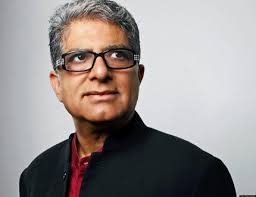
Deepak Chopra: Author, Spiritual Guide, Medical Doctor

Wisdom is bought at a high price - the price of experience.  We all essentially learn the hard way. How often have we heard our elders say that they went to the "school of hard knocks!"  One of my special needs students said the following the other day:  "Life does not get any easier; you just have to learn to laugh harder!"  Pure wisdom, that! The poetry, whether of the Psalms in the Old Testament or the poems in the Tao Te Ching, attempts to capture some wisdom by sheer dint of paradox or seeming contradiction; by setting up polar opposites; by stretching language to its breaking point.

Sometimes when we try too hard we don't achieve the results we want at all.  It's as if the ego gets in its own way and trips itself up.  The ego stretches itself up on tippy toes in a vain effort to see what's going on.  However, on a physical level, as we know, we are only able to maintain our bodies on tippy toes -  in such a stretched mode - for literally several moments as we strain say to look over a high fence.  On tippy toes we simply cannot stand firm. Anyone who runs or jogs will know that such exercise needs to be paced properly.  If the runner or jogger sets out on their chosen route at far too quick a pace. he will not be able to complete it in the proper time or indeed in the proper state of well-being.  Hence, the lapidary piece of wisdom in the above poem: "He who rushes ahead doesn't go far!"  I remember an old teacher I had at school used often say: "The longest way round is often the shortest way home!"  Why?  Well, the longest way round might not have as many obstacles as the shortest way!!
  
Clinical psychologist, Psychotherapist Dr Carl Rogers


I simply love the line: "He who tries to shine dims his own light."  Again, it appears to this reader and meditator that this is all about our ego getting in the way of the wisdom that naturally lives in our True Self (Deepak Chopra) or Real Self (Carl Ransom Rogers), in our Soul (religion/spirituality) or in our Heart of Hearts (traditional phrase meaning inner and true feelings).  It is so obvious when people are boasting of their abilities or attempting to get "one up" on us (one upmanship) or pretending to be something they are not.  Likewise, any person who thinks he can define himself clinically or precisely is simply deluded.  Just as the author puts it, this person "cannot know who he really is."  There is a mystery that lies at the heart of us all and we only gradually get to know that mystery.  Indeed, I believe we cannot really comprehend, apprehend or grasp that mystery in its entirety or fullness.  However, we do get glimpses of our True Self.

Then we come to one of the most corrupt impulses of the ego, namely the drive for power.  Persons who do not know themselves properly, or who have failed, as Carl Jung puts it, to properly integrate their shadow nature, all project their worst fears and hatreds onto others.  Hence we get breakdowns in the various relationships between husbands and wives, managers and staff, leaders and teams and indeed between different states.  When people exercise power over others in this egoic way they actually have failed to empower themselves to simply be their truest selves.  Likewise, if we cling to our work in an effort to gain some identity, we set up a state of dependence on our workaday activity to give us a sense of our true self and such a state of dependence only leads to a false sense of self!

Letting go is the answer, and indeed it is the answer given by all religious and spiritual traditions. What are we asked to let go of?  We are asked to let go of our Ego, of our desires to cling to sensual pleasures, to cling to others, to cling to ideas, to cling to our partners, to cling to our jobs, to cling to our pride, to cling to all false ideas of who we are.  We are asked, in short, to let go of the False Self and embrace our True Self.  This is not easily done, but by constant practice of meditation and other spiritual acts like writing, composing poems or music, sculpting, pottery making and so on and so forth, we gradually chip away at our masks and bit by bit expose our True Self to the light of our consciousness.  Indeed, none of us ever gets there.  Rather like the asymptote we only get there way out at infinity.

Example of two asymptotes: horizontal and vertical


Conclusion:

Once again, perhaps some word, phrase or clause in above poem strikes a chord with you.  If so why not use it as a mantra for a short meditative practice for five or ten minutes.  Namaste, my friends.

Sunday, August 30, 2015

Thoughts on the Tao Te Ching 12

Poem 12

Colours blind the eye.
Sounds deafen the ear.
Flavours numb the taste.
Thoughts weaken the mind.
Desires wither the heart.

The Master observes the world
but trusts his inner vision.
He allows things to come and go.
His heart is open as the sky.


Reflections:

My father used often say that too much of anything is never good for us.  It is a truism worth repeating that moderation is possibly the best key to life in order to open up all its possibilities.  There is something in us that drives us to want more and more and more. That drive is more than likely part of our primordial instinct to survive. We all want success in life and some of us equate that with status, position in society or wealth.  One just has to take a few steps back and observe how obsessive people become about all of these things. Human beings, in building up an identity, accumulate all of the aforementioned and further a lot of our number become driven to acquire more and more.  And yet none of these things in themselves, either singly, or together necessarily brings us happiness.  Something else is needed.  Onto this scene, then, enter the various religions and spiritualities that seek to offer paths to happiness.   


Attachment and Detachment

Once again, let us return to the Second Noble Truth of Buddhism which reflects the message intended by the above Taoist poem.  This truth insists that there is a definite cause to human suffering and, that is, that all our desires and cravings are based on our ignorance of reality. This ignorance causes us to cling to the things of the world like wealth and success and all their appurtenances  as that which is truly valuable and real.  This Second Truth, also known as Samudaya, tells us that we will be hurt proportionately to the intensity of our attachment or clinging to all these things. Craving can be for sensual experiences like love, money, comfort, success, fame, power and all sorts of pleasant feelings.  Or there can be a craving for being/becoming that leads to a craving that life will continue forever, that there will be an eternal life.

The standard rendering of the Second Noble Truth is that dukkha (suffering or stress) is caused by greed or desire.  Apparently, the actual word for this desire is "tanha," but it is more accurately translated as "thirst" or "craving."  This truth is not telling us that we must give up everything we love and then go live an ascetic life in order to find happiness.  The real issue for us here is far more subtle - it is the issue of our attachment to what we desire and it is this attachment that we must learn to control because if we don't it gets us into trouble (stress or suffering). 


Trees: Newbridge House


In commenting on the above Taoist poem in a rhetorical way, we may say that more and more colours won't necessarily make our lives more colourful; more and more sounds won't necessarily add to the harmony; more and more flavours won't necessarily make the food tastier; more and more thoughts won't necessarily make the mind more intellectually profound nor will more and more desires necessarily make the heart grow fonder. 

Inner versus Outer

St Augustine tells us that he searched for God (we may use this term as a metaphor for meaning if you like) everywhere in the world, through the satisfaction of all the senses and his intellect, but finally found him within, in his own inner self or soul.  He described his way of meditating as that of "interiority." Like the Taoist poet he trusted his "inner vision." All of meditation is about going on that inner or interior journey, that journey down to the real or inner self or still point of being below or above (depending on your preferred spatial metaphor) all our agitated and agitating thoughts.


Candles: Vienna Cathedral


Openness

It is so hard to be open about things: to be open to the self, to others, to the world, to life, to the universe or to whatever is its underlying power.  And yet, that openness is the fruit of much meditation and the promise of all great traditions of spiritual practices.  The intention of this poem is that our hearts too will be "as open as the sky."

Conclusion

In these final lines, I will once again invite the reader to peruse the above poem and let any word, phrase or line strike your attention and then to use that as a mantra for a short ten minute meditation.

Namaste, Friends. 


Wednesday, August 26, 2015

Thoughts on the Tao Te Ching 10

Can you coax your mind from its wandering
and keep to the original oneness?
Can you let your body become
supple as a newborn child's?
Can you cleanse your inner vision
until you see nothing but light?
Can you love people and lead them
without imposing your will?
Can you deal with the most vital matters
by letting events take their course?
Can you step back from your own mind
and thus understand all things?

Giving birth and nourishing,
having without possessing,
acting with no expectations,
leading and not trying to control:
This is the supreme virtue.


Commentary/Reflections

One of the central problems experienced by the neophyte meditator is that of all the mental distractions that race through the human mind when one attempts to still it.  This is what the poet means above by his term "the wandering mind." In that field of thought called philosophy of mind, there is an interesting question: Do our thoughts think us or do we think our thoughts?  That question never really engaged me early in my life even though I had heard it discussed in that area of philosophy concerned with the nature of the mind. However, it did hit me very strongly and existentially when I had a major breakdown, or indeed a break-through really, at the age of forty - that is, at the time of the typical midlife crisis brought to a point where Yeats says, "the centre cannot hold."  It was then that I experienced my mind being literally hijacked by my thoughts.  The centre could not hold whatsoever: the hub of control had totally disintegrated and the spokes of identity had shattered and scattered into chaos.  Thoughts ran riot in my mind and there was no controlling them.  The nerve-centre of my identity, or if you like, the core of my self had undergone a meltdown.  


Good mental health essentially means that the person is on the way to establishing an identity that is individuated (Jung), integrated (Storr) or actualized (Maslow et al).  In other words the person is as fully their real or true self as is possible: metaphorically we are a series of spokes (character qualities and traits) centred around a hub called the "Real Self" rotating on a unique path. None of us probably ever reaches the acme point in that process. Spiritually, the parallel term in Eastern philosophy would be "the enlightened mind."  The poem above is as deep as can be and has many layers of meaning as the language struggles to express the spiritual quest of life. Quieting or stilling the mind is a wonderful metaphor for getting under the chaos that our unstilled mind can be.  Spiritual writers speak about the task of achieving a Still Point below that agitated surface of existence.  In the above poem, this task is expressed in the words "original oneness."  Each couplet is another way of expressing the search for this elusive Still Point.


If a true pilgrim of the way or a faithful disciple of enlightenment achieves a position of leadership s/he will be able to "love people and lead them without imposing their will."  In other words, their ego will be firmly under control and integrated into their personality. They will have no need for petty jealousies, for "getting their pound of flesh," for settling old scores, for one-up-man-ship of any kind or for any sort of micro-management.  They will be visionary leaders able to bring their staff with them while allowing everyone the freedom to grow and to succeed on their own terms without interference.  Stepping back and not wishing to control things is central to good spiritual and indeed psychological development. We all learn quite quickly that the only people we can change are ourselves, never ever anyone else.  Some of us only learn that lesson painfully and the ego-ridden person makes that mistake all too often. And so, in light of these comments, the following lines from the above poem are worth repeating and reflecting on here:


Can you deal with the most vital matters
by letting events take their course?
Can you step back from your own mind
and thus understand all things?

Another way of saying this is that the person further on the road to enlightenment is getting ever more detached from the non-essential things of life; is getting nearer to that elusive Still Point of being; that primordial state of being our Taoist poem calls "the original oneness."

Monday, August 17, 2015

Thoughts on the Tao Te Ching 1

Writing any kind of spiritual diary is a very difficult task as one finds one begins to to exhaust the well pretty quickly as it were, and, indeed, the worst results of that is the dreadful experience of repeating oneself to such an extent that one begins to doubt whether one has really progressed any further along the road to spiritual enlightenment.  That is the way I feel about this spiritual journal in the shape of this particular blog. I have often found, that in such periods of aridity and emptiness it is better to go to another well to slake one's spiritual thirst.  Over the next several posts, I am going to visit Lao Tzu's well by way of commentary on that wonderful spiritual work attributed to his hand, namely the Tao Te Ching. Lao Tzu, according to some sources, was a philosopher and poet and founder of the philosophical school called Taoism and author of the spiritual/mystical book just quoted above, and on which I'll attempt to comment here.  Some scholars say that he lived around the 6th century BCE and was a contemporary of Confucius while others reckon that he existed some time during the Warring States period of the 5th or 4th centuries BCE.  Others still, argue that he was a purely legendary figure and that, like the works of other spiritual traditions, there may have been more than just one person involved in the composition of the Tao Te Ching.  While a little bit of background information is always good for us, there is really no need to know much about the author of this spiritual classic as its riches lie purely in the text and its transformative spiritual power on its meditative reader.  Therefore, let us turn now to a meditation on the text itself.

A depiction of Lao Tzu


For my purposes here, I shall be commenting on the following version of the text: Tao Te Ching: An Illustrated Journey, translated by Stephen Mitchell, London: Francis Lincoln Ltd., 1999.

Poem 1:

The tao that can be told
is not the eternal Tao.
The name that can be named
is not the eternal Name.

The unnameable is the eternally real.
Naming is the origin
of all particular things.

Free from desire, you realise the mystery.
Caught in the desire, you see only the manifestations.

Yet mystery and manifestation
arise from the same source.
This source is called darkness.

Darkness within darkness.
The gateway to all understanding. 


If we think about it, even a little, it is very hard to determine what is actually real. What is the real? What is reality?  These are deep philosophical questions that have been dealt with by great philosophical minds over the long history of philosophy.  From Plato's discussion of this question in his story of The Cave in his book The Republic right down through the centuries, through the works of many philosophers, most especially that of René Descartes on the cusp of the modernist period, right down to the recent film The Matrix (1999) where the character Morpheus raises this question with another character named Neo, the burning issue of what reality actually is has besotted us as human beings and obviously still does. Being a spiritual being, as well as a material one, or being a material-spiritual reality and often being quite troubled as to the interrelationship between both, our journey through life is often painful and not a little interesting, intriguing and wonderful at times in consequence.

Our life journey is a meaning-making one, a project in which we are called upon to create our own selves, our very own identity or indeed, often our own reality.  It is up to each one of us to fashion our own meaningful self from a world of myriads of often mind-blowingly different choices. And that is no easy task.  To say the least, it is a life-long undertaking.

And so, we might do worse than turn to some of the spiritual classics like the Tao Te Ching.  the first stanza quoted above resonates with a Buddhist-like sensibility.  What is real may indeed be somewhat nebulous and intangible, always somewhat beyond us and yet somehow we are attracted by its mysterious magnetic pull.  Somehow, the truth or the tao cannot be caught - it is like the wind, in that regard. It certainly cannot be caught in words.  Anyone who has ever attempted to explain what his heart desires is often stuck for words.  In the Jewish tradition, the name of God is so revered that it cannot be spoken aloud and even today some Jews write G-d or G!d when they have to inscribe or write his sacred name.  This is a way of stating that whatever absolute "meaning," "truth" or "reality" may be, it is always unutterable and ineffable and certainly cannot be captured in words. This, I feel, is the sense of the first two lines in our first stanza above, and indeed that of the entire stanza.

I am also struck by the power of the second stanza which also has resonances with Biblical texts as the capacity to name a thing was always traditionally seen as being very much an act of creativity and creation.  To name is to exercise power and control over others and over things.

The third stanza is very Buddhist in its meaning and is basically the second noble truth of Buddhism, namely that our cravings and desires cause us to transform our pains into deep suffering.  We can so easily get so caught up in our weaker and baser desires whether they be material or emotional or ego-based.  When we free ourselves from our desires and the all-too-easy clinging to the crutches of material or emotional supports, this stanza promises us more than a mere taste of mystery.

The fourth stanza brings us to the much disputed area of the relationship between material things "out there," as it were, "in the world" and our perceptions of those things.  The reader of these words will think of the many philosophers who were concerned with these questions over the past two and a half thousand years - Locke, Hume and Berekeley et al to name several.  Reality exists perhaps somewhere between "the world out there" and my experience or perception of it "in here.".  And yet, all of this is so mysterious and wonderful really as it defies our very thinking powers, and any statement of it seems to fall so far short of what we would wish to express.  However, some wonder is the very heart of spirituality really, is it not.  After all, they used to say that philosophy begins in wonder (Socrates said this, according to Plato in Theaethetus).  Surely, the same may be said of spirituality, that it, too, begins in wonder at the mystery of things as we encounter them.

Like all traditions, the Tao Te Ching suggests that much wisdom begins in darkness, and even in "the darkness within darkness."  Resonances here would be the "dark night of the soul" as found within the Roman Catholic Spiritual tradition of St John of the cross.  A scriptural text that comes to mind here, as I finish these reflections, is that from St Paul that here on earth "we see through a glass darkly."(1 Cor 13:12)

Exercise: Now that you have read the above words from the Tao Te Ching you could do worse than meditating upon them for five minutes or so as a way of centering yourself.

Namaste.