Showing posts with label Cycles. Show all posts

Sunday, September 18, 2016

Poems I Journey With 10


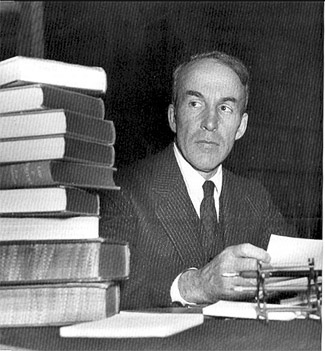
Archibald Macleish
Archibald Macleish (1892-1982) is a major modernist American poet and writer of the twentieth century, and I first discovered him through his critical writings, rather than through his poetry.  I have beside me as I write the first book I bought by him way back in 1978 when I was a mere twenty years of age.  That book is called Poetry and Experience (Harmondsworth: Penguin Books, 1961).  I remember being blown away by how easily he communicated to the reader his understanding of what poetry does and is.  In part one of that book, he discusses in a comprehensive way how poems work through sound, sign, image and metaphor.   In the second section of the book, Macleish treats of how what he has discussed in the first section functions in the works of Emily Dickinson, W.B. Yeats, Arthur Rimbaud and John Keats.  This book, consequently, would be a wonderful introduction to poetry appreciation for anyone wishing to learn more about how to read and enjoy it.

The Old Men in the Leaf Smoke

The old men rake the yards for winter
burning the autumn-fallen leaves.
They have no lives, the one or the other.
The leaves are dead, the old men live
Only a little, light as a leaf,
Left to themselves of all their loves:
Light in the head most often too.


Raking the leaves, raking the leaves,
Raking life and leaf together,
The old men smell of burning leaves,
But which is which they wonder – whether
Anyone tells the leaves and loves –
Anyone left, that is, who lives.

For me, it is the existential thrust of this poem that engages me as a reader.  I have already alluded to the psychiatrist Dr Irvin Yalom's listing humanity's awareness of its mortality as being one of the four great ultimate concerns in every human being's life.  Raking leaves is a perennial occupation for anyone with trees in their garden.  Growing up, it was one task I loved to do when I visited my country cousins and when I spent some three years as a would-be monk.  This poem uses the leaf as a symbol of the mortality of humanity and for the shortness and beauty of life.  I love the way Macleish speaks of "lives" and "loves" and "leaves" as they are, in effect, slight or partial rhymes as these words share the consonants "l," "v" and "s."  Such felicity of language enchants this reader, simple though this use of words is.

Repetition in the poem gives it a song-like sound.  As a country boy, I can almost smell the burning leaves as I have stood beside many a man burning dead vegetation in my time. Another riveting thing about this poem is its apparent simplicity that somehow draws us into the deeper mystery that life is.  It would seem that life is an amorphous mix of things in unity rather than a collection of random things.  When one rakes a garden one rakes many bits and pieces of vegetation and insect life and mud and clay together in a unity, and that unity in plurality suggests a mysticism at work in Macleish's sensitivity.  And this latter mystical sensibility is all too apparent to the perceptive and open reader.  Let's read the second stanza slowly and meditatively with the thoughts and sensitivities of this paragraph in mind:

Raking the leaves, raking the leaves,
Raking life and leaf together,
The old men smell of burning leaves,
But which is which they wonder – whether
Anyone tells the leaves and loves –
Anyone left, that is, who lives.


Mystically and linguistically leaves and lives and loves are all somehow magically one.  We are one with the poet raking them together as we live. On the one hand, then, this is a sad and depressing poem, and yet, on the other, this is a poem that suggests that we are part of the great cycle of nature, and we are ennobled by being part of it, never lessened, as, after all, we are the ones who do the raking.  We are the ones who do the maintenance on the garden.  We, in our turn, will become old men or old women, as the case may be, and we will surely smell of leaves and loves and lives.  Then, the beauty of the poem is that it does not state too much.  It connotes rather than denotes, and that is a wonderful device at the very heart of poetry.  Mystery, mystique, wonder and magic are always beyond capturing in prose.  They are more readily captured but never subdued or crushed in poetry.  That's why the last stanza defies paraphrase, which is surely anathema to anyone with a poetic sensibility.

Saturday, January 10, 2015

Journal of a Soul 71

The Journey Continues

Howth, Christmas Eve, 2014

A New Year has begun.  Another year has been clocked up on that strange weak vehicle of self or soul we call the body.  The calendar cycle has begun once again.  There is a wisdom in the seasons that seems to suggest that everything is cyclical, that progress is an illusion.  The way of wisdom is by the gradual erosion of our superficial beliefs bit by slow bit - like that proverbial drip that wears the stone.  Nothing is constant - all, as the ancient Greek philosopher Heraclitus says, is "in a state of flux," and yet there is a paradoxical cyclical repetition to change. 

Heraclitus in Raphael's School of Athens
The New Year is ushered in by a review of the events - little and great, insignificant and significant, heroic and tragic - of the past twelve months.  It is as if the fires of the last year have all burned themselves down into the ashes of our memory as we look ahead in anticipation and hope to the brighter fires of the year to come. Sometimes one gets the distinct impression that the drudgery of the whole thing begins again.  It's as if our body is growing tired of the whole thing and that the spirit itself is flagging.  When one looks out into the grey skies of winter in this northern hemisphere it feels as if one might be a character in a Kafka novel or a Beckett play - just there on an indifferent stage not understanding what has happened to you in life and that the blessed thing has a habit of just going on and on.  Yes, the cycle begins over and over again. And where lies the meaning?

There are sentences that haunt the mind of this writer - ones indeed of Biblical portent and intensity. These are sentences that come whistling like boys walking past graveyards on a dark shadowy night. "There is nothing new under the sun," says Qoheleth, the writer of the book of Ecclesiastes and he proceeds in Kafkaesque and Beckettian tones, in absurdist or existentialist terms with these rather anachronistically modern lines that are paradoxically over 2000 years old:

A generation goes, and a generation comes,
but the earth remains forever.

The sun rises, and the sun goes down,
and hastens to the place where it rises.

The wind blows to the south
and goes around to the north;
around and around goes the wind,
and on its circuits the wind returns.
All streams run to the sea,
but the sea is not full;
to the place where the streams flow,
there they flow again.


All things are full of weariness;
a man cannot utter it;
the eye is not satisfied with seeing,
nor the ear filled with hearing.

What has been is what will be,
and what has been done is what will be done,
and there is nothing new under the sun.

Is there a thing of which it is said,
“See, this is new”?
It has been already
in the ages before us.


There is no remembrance of former things,
nor will there be any remembrance
of later things yet to be among those who come after.
(Eccles. 1: 2-9)

And so here we go with another year. Where does that leave the writer of this blog? What about the progress on the spiritual way for this pilgrim soul?  I often wonder how far I have come and if any progress has been made at all.   Am I just beginning all over again? It often seems as if the spiritual journey is one of a cyclical nature too.  It feels as if the whole journey is beginning all over again from the start and that any progress that had apparently been achieved has now turned out to be a mere illusion.  With this in mind I can empathize with the young boy who informed me today that he had to get a repeat of his operation of four years ago to replace his VNS device (Vagus Nerve Stimulator) under the skin in his upper chest. This procedure is a modern treatment for trickier cases of epilepsy.  Or still again I can appreciate the predicament of anyone who has had a relapse of one or other disease that plunges them back to the beginning once again.


TS Eliot

And yet,  the words of Thomas Stearns Eliot (1888-1965) lift me, as they always do, with their dearly-bought but deep wisdom:


We shall not cease from exploration 
And the end of all our exploring 
Will be to arrive where we started 
And know the place for the first time. ("Four Quartets")

As any teacher or indeed any maker of poems will tell you a question like "what does this poem or these lines mean?" is a rather inappropriate one to ask of any such work.  Poems are an intricate interweaving of words, feelings, inspiration and sound, and their meaning lies somewhere in the interaction of the reader with that complex phenomenon.  So meaning is a very dynamic experience that cannot be reduced to a mere paraphrase.  

Let's try, though, to tease out some of the connotations and implications for our lives from Eliot's intriguing lines: 

Most of us are searchers and explorers who want to make some sense of our lives.  And moreover, we may never cease from doing so as Eliot suggests.  Oftentimes, and indeed our poet suggests always, we arrive back where we started out and see the place anew.  On one level the place is obviously the same, but now we are seeing it with "new" eyes, with a new optic, from a new or deeper or even different perspective.  Now there are new dimensions to our experience - new depths and/or new heights to it!

Making Sense of Life and the Turn to Meditation

If we don't seek to make some sense of our lives we are somehow consigned to a rather humdrum, boring and meaninglessly repetitious existence.  In short, we are meaning-making creatures and were meant to be.  In so doing, we are in a growing mode, ready to embrace happiness or that state called "flourishing" or "eudaimonia" by Aristotle.

However, searching and exploring can tire the spirit and the body.  I remember many years ago attending a spiritual retreat where each group was asked to come up with a name for their group.  The names suggested were along these lines: Searchers, Explorers, Sunflowers, Wayfarers, Pilgrims, Brothers and Sisters and so on.  The name that showed the least sense of struggle, obviously, was that of Sunflowers.  That particular group explained that they were so aware that they were respondents to sheer gifts and graces that were lavished upon them by God, the Universe or Life itself that they could come up with no other appellation.  This, at first sight, is a rather strange way of responding to life, is it not?  And yet it a legitimate experience of thanksgiving for life's bounty or bounteousness  that quite a number of people experience.  Sunflowers turn towards the sun and are led to blossom under its rays.  There are people who experience living as such a response to what they experience as the sheer giftedness of their being.

In those dry periods when its seems that I am going around in meaningless circles, as so brutally expressed in my opening paragraphs, that I am seemingly in the same old place or predicament, I often find myself turning to meditation.  Meditation for me can be done at three levels, and often I can do it at each of the three levels according to how I feel in any given situation.  At level one we can meditate at a physical level, that is, we can engage in it  solely as an exercise to relax our body.  At level two we can go deeper still and relax our mind - that is, where the mindfulness exercise is one of mental or psychological relaxation.  As a believer in the spiritual realm, I accept and indeed experience meditation as allowing me to experience a sense of being in touch with a deeper ground of my being, namely a divine or spiritual level to my life and to the world.  

It is at this third level that I experience graced moments of contact with a deeper or higher level reaching into my own little world.  This is very hard to describe because quite simply one has to experience it, to be touched by it and moved by it so as to appreciate it in any way at all.  It is at this level, I believe, that the human meditator can become like a sunflower responding to the Sun or Ground of life that some dare call God.  It is at this deeper (or higher depending on one's spatial metaphor) level that in T.S. Eliot's words we recognize or "know the place for the first time."  It is also at this level that one realizes that despite the seeming stagnation, the apparent atrophy and the stupefying stasis, there indeed has been a significant shift at the level of meaning, at the level of being, at the level of the spiritual journey.

And so the spiritual journey goes on.  As any pilgrim will tell you, the road is often twisting and troublesome, sometimes dangerous and impassable and yet one knows one can never turn back.  It is the persevering on that journey that counts.  Paul Tillich, the great German-American theologian and philosopher, called on us to "dare to be!"  He reckoned that this was the call issued to every human being in the task of making life meaningful in a very secular age.  For the wayfarer on the journey to self-knowledge and wisdom, this call can be re-written as "dare to journey onward" or "dare to risk" digging deeper or climbing higher or journeying further in the task of knowing your real self!  That way we will encounter our true and authentic self in all its dimensions.

Monday, June 25, 2012

Journal of a Soul 8

Badolato Marina Beach, June 2012
The fleeting nature of time has long been a topic in philosophy.  Things are so much in flux that the ancient pre-Socratic philosopher Heraclitus declared so insightfully that we cannot step into the same river twice.  Our grand-parents, now long since passed away, used to opine, also rather wisely, “that much water has passed under the bridge” since X, Y or Z happened.  They intuitively had grasped exactly what Heraclitus meant.
As a small boy I used hate travelling with my parents to my father’s home town, called Roscrea, in the County of Tipperary in the Southern midlands of Ireland.  He would inevitably end up in this or that erstwhile neighbour’s house or in this or that local hostelry reminiscing on his youth, on how quickly the years had passed, on where A or B had lived, on whether C or D were still in England or America and how sad it was that E and F were now no more. It used to drive us children mad as we just wanted to be outside playing.  We simply did not wish to be sitting indoors while the older people went back in time in their minds.  And yet we were often bemused that my father could remember decades before the then present time.
As I age it has now become quite interesting that I can now appreciate what made my father misty eyed as he reminisced about the so-called “good old days” which were not that good at all at all.  At 54 years of age I can recall clearly when I was three years old playing with a toy lorry in the lane at the back of our house in Roscrea.  Now that’s 51 years ago or just slightly over five decades in the past.  That time has passed so quickly is at once frightening and somewhat consoling too.  If everything were to stay the same there simply would be no being or becoming at all, no ageing and consequently no death.  Indeed, if everything were to remain the same would there even be birth?  Without change there would be no life at all.  Then, paradoxically, one could say that without death there would be no life at all. 
To be is to become; to become is to grow old; to grow old is to die.  St Augustine once defined time as “the measure of change.”  For a fourth century intellectual that was not a bad definition of time at all.  To grow is to change.  To live is to grow and change, and indeed, eventually to die.
Modernity has a lot going for it.  Health of humans and indeed animals has improved remarkably in the last, say, one hundred years.  People are now living longer; women into their late eighties and men into their late seventies and early eighties.  I’m taking these figures from my own experience here in Ireland, and have not checked them out, but they are roughly accurate.  Modernity has brought comfort with it also, with so many pieces of modern technology to help us in our every daily task.  And so living has become less of a struggle.  We are also so much better educated.  Added to that, we can practically travel anywhere we want in the modern world, again with greater ease and with so much less cost than one hundred years ago.  Within reason we have more control over our lives than our forefathers.  And yet, this control over our lives has a downside to it.
Modernity, and indeed post-modernity if that is the way to describe our time in the early 21st century, have hoodwinked us into believing almost the impossible at times.  We, in the Northern hemisphere certainly, believe that we are entitled to all the benefits that a modern state can give; believe almost at times that the world (or State) owes us a living; believe that we can conquer the impossible; live longer and ever longer; look to our selfish rights without adequately considering our due responsibilities.  And this is where we have lost some of the extraordinary advantages of less modern times.
Another view of Badolato Beach
Those advantages were more of a “soul-making nature.”  John Keats, the great poet of the English Romantic period, who lived to be barely 25 years of age used to call this world the “vale of soul-making.”  The poor man died very young from Tuberculosis.  Even travelling to the wonderfully warm climes of Rome failed to stop the inevitable.  In other words, from our sufferings we can learn.  Now, here I am not necessarily talking about suffering and dying per se, or about learning their profound if bitter lessons.  No, I am referring to the fact that we can learn to slow down; learn to take stock of life; learn to prioritize things in our lives; learn to listen to our own Heart or Soul; learn to listen to the Heart or Soul of an Other; learn to be in tune with the rhythms of life; learn really to be at one with the natural sequences of the seasons.
And so to finish this post, I have learned to slow down firstly the hard way by enduring a bad mental breakdown occasioned by too much stress when I was forty.  But I knew that I had to do more.  I then began to do many creative soul-making things like Meditation, taking more time out, learning to say NO, learning to do new things, to holiday more, to write more, to reflect more, to go to more personal development conferences, to get to know positive people and to spend more time with such people, to cultivate friendships because truly relationships are like plants, they will wither and die if not cared for.  Even in the concrete jungles of modern cities each of us can at least cultivate a small garden on our balconies.  I have seen many of them in the biggest and most alienating of cities.  I have also been privileged to have been welcomed into the smallest and most homely and soul-full of homes in the biggest of cities.  In other words, with practice we can learn to grow our own Souls with care.  We can also learn in the most alien of places to put down roots of Self.  By doing so we will become attuned once again, like our forebears to the rhythms and cycles of the seasons where it is just as natural for the ripe fruit to drop from the bough as it is just as natural for the seed to die and give forth the life of a new young shoot.  Being in tune with the rhythms and cycles of the seasons, with the circular nature of time, readies us to face our own necessary part in those same cycles and rhythms, of which our dying and death are just such a little part.