Showing posts with label Mysticism. Show all posts

Thursday, April 2, 2020

Coronavirus Diary 1


The Control Myth & Coronavirus:

We like to be in control of our lives, and, of course, we learn soon enough that while there is a lot we can control, there is also much that lies beyond our power.  Events like personal illness and that of our friends and family; the chance occurrence of natural disasters; the incidence of accidents on road, rail, water, and air; and much else are examples of this.  Then a novel virus called SARS-CoV-2 that causes the disease COVID-19 seems to spell the end to all we hold dear like our valued freedom to go about our daily business unhindered.  Civilisation of all varieties, especially that of the rich Northern hemisphere, seems to be grinding to a halt, stymied by a microscopic nucleic acid, that to my mind looks like a beautifully coloured sphere with projecting spikes rather like a maritime mine from World War II.  Incredibly it latches its spikes into host human cells, gains access and multiplies almost totally unhindered in the bodies of the immuno-compromised.  Those are the unlucky ones with underlying diseases.  Others of the population vary from presenting with serious flu-like symptoms to being totally asymptomatic.  No wonder, then, that when modern computers and laptops came on the scene hackers were able to develop sequences of code aptly named viruses that could corrupt many programs developed by the smartest brains.  And my goodness, I’d imagine that as a so-called civilized people we have spent more on defending our technologies from viruses than on defending our own human bodies from microbe attacks.  After all, greed is practically the sole consideration of unethical capitalism.  I often wonder whether ethical capitalism exists at all?


The mystics of all religious and spiritual traditions have been gently reminding humankind for millennia now to “wake up,” “become aware” and stop living in the delusional world of limitless progress.  Their message has been smothered by the unruly din of accelerating progress-driven more by financial gain than the good of society.  Thankfully, there are some bright lights in the billionaire entrepreneurial world like Bill Gates who these days spends much of his time and money in philanthropic pursuits.  He is among the few, and, of course, it was he, who in a famous TED talk in 2015 warned the Western World that we had more to fear from a global viral pandemic than from any nuclear war.  In the place of weapons obliterating us from the outside, we would instead, especially the weakest amongst us, be slowly and painfully fragmented from the inside by a virus that attacks our very own bodies at a cellular level.

In short, the Western capitalist system has been delivered a severe body blow, knocked to the canvas by an invisible invader.  For a short while at least it will require hospitalization.  It will no doubt recover, but at the cost of thousands, if not millions, of lives. But the question remains as to whether it will get up and enter the fighting ring of human civilization and culture as a wiser and less greedy exploiter of the earth’s resources and, indeed, of the millions of poor souls in the less fortunate Southern hemisphere.  We can but hope that lessons will have been learned. Sic transit Gloria mundi.  (“Thus, the glory of the world passes away”)

Tuesday, October 18, 2016

Poems I Journey With 28

T.S. Eliot said in “Burnt Norton,” the first poem in the sequence of poems called “Four Quartets,” that “human kind cannot bear very much reality.” Reality here, I contend, can be interpreted as all that wears us down as human beings as we try to negotiate our way through life, as we try to cope with its many highs and lows and make some meaning of our own journey through it. Again, I repeat this great poet’s words merely to highlight our need for some form of escapism from time to time: a good holiday, an inspiring read, celebrations of all kinds, concerts, drama, plays, music recitals, and all the cultural conventions and traditions that attempt to help human kind cope with the “jagged edges of existence” or “reality” as T.S. Eliot puts it in the above quoted poem.

Here, I’d like to return to two poems from the pen of our great national Nobel Laureate for Literature, W.B. Yeats and reproduce here for the readers of these musings two lovely refreshing poems that quite soothe my drooping spirits in these stressful days after a traffic accident.

Poem 1: The Lake Isle of Innisfree (1888):

Lake Isle of Innisfree

I will arise and go now, and go to Innisfree,
And a small cabin build there, of clay and wattles made;
Nine bean rows will I have there, a hive for the honey bee,
And live alone in the bee loud glade.

And I shall have some peace there, for peace comes dropping slow,
Dropping from the veils of the morning to where the cricket sings;
There midnight's all a glimmer, and noon a purple glow,
And evening full of the linnet's wings.

I will arise and go now, for always night and day
I hear lake water lapping with low sounds by the shore;
While I stand on the roadway, or on the pavements grey,
I hear it in the deep heart's core.

Poem 2: The Song of Wandering Aengus


The Song of Wandering Aengus

I went out to the hazel wood,
Because a fire was in my head,
And cut and peeled a hazel wand,
And hooked a berry to a thread;
And when white moths were on the wing,
And moth-like stars were flickering out,
I dropped the berry in a stream
And caught a little silver trout.

When I had laid it on the floor
I went to blow the fire a-flame,
But something rustled on the floor,
And someone called me by my name:
It had become a glimmering girl
With apple blossom in her hair
Who called me by my name and ran
And faded through the brightening air.

Though I am old with wandering
Through hollow lands and hilly lands,
I will find out where she has gone,
And kiss her lips and take her hands;
And walk among long dappled grass,
And pluck till time and times are done,
The silver apples of the moon,
The golden apples of the sun.

Source: The Wind Among the Reeds (1899)

Briefest of Commentaries

Yeats was born in 1865 and so he was only 23 when he wrote “Lake Isle of Innisfree” while he was 34 when he wrote the second poem. Eleven years is a long time in anyone’s life, and the second poem is obviously a far more mature and far deeper poem than the first. However, they are both written against the background of the nourishing and sustaining power of nature for us humans. In short, a good walk out in nature can heal many a broken heart and lift many a depressed spirit. These poems help me cope with life then at this first level, that is, at the level of the balm, the comfort and the healing that nature can offer us if we are open to her charms.

As Yeats grew older he became much more interested in what we in Ireland call the “Celtic Twilight” period, namely that Romantic turning back not alone to nature, but also to mythology and the strong links that mythology had with nature as it developed.  Also Yeats as a poet became far more enchanted with anything to do with mystery, mystique and, indeed the mystical. To commune with nature was to commune with the sustaining power behind that universe – the pagan Celtic gods as represented in that wonderful body of Gaelic Celtic mythology that he himself did much to preserve and to promulgate.

The “fire” that was in his head is a very potent line because it shows the passion for nature that is in Aengus’s mind and indeed in that of the poet himself. Again, Aengus cuts and peels a “hazel wand” and we are immediately enchanted with a magical act that brings us into a more mystical world to which we can escape from the harsh reality around us.  Everything around Aengus is magical and mystical and shot through with the powers of the gods of nature. There are moths on the wing there while the very heavens contain the mystical “moth-like stars” and the repetition of words serves to enchant us further as this is indeed the song of a wanderer through nature with all its healing attributes – indeed it yields up a “silver trout” to feed us on our journey.

Then we are invited into Aengus’s company as he lights a fire on the forest or wood floor, and then some mysterious person calls Aengus, or indeed us the reader, by our name. For sure, we are now in the mythical and mystical woods of the Celtic imagination, of the Celtic Twilight.  Indeed, we are so enchanted that we want to stay there with Aengus.  Like a fairy presence, this female voice changes into a beautiful girl who enchants Aengus and us the readers:

It had become a glimmering girl
With apple blossom in her hair
Who called me by my name and ran
And faded through the brightening air.

Reading the final verse, this commentator writing these few reflections feels old like Aengus in the poem: “old with wandering” or old and worn out from looking for meaning in an often sad and painful world.  But this final verse is full of promise and hope; full of beauty and truth; full of wisdom and inspiration, for we truly can live in an enchanted world when we read those wonderful final lines of this second poem:

I will find out where she has gone,
And kiss her lips and take her hands;
And walk among long dappled grass,
And pluck till time and times are done,
The silver apples of the moon,

The golden apples of the sun.

Wednesday, September 28, 2016

Poems I Journey With 16

Elizabeth Barrett Browning
Elizabeth Barrett Browning (1806 – 1861) was one of the most prominent English poets of the Victorian era, popular in Britain and the United States during her lifetime. She was vehemently anti-slavery even though her father had earned much of his wealth from that much maligned, exploitative and cruel industry. She had married her husband Robert Browning in secret and went with him to live in Florence, having been disinherited by her father. Emily Dickinson was an avid fan of Barrett Browning and the latter’s work greatly influenced the American poet who admired her as a woman of achievement. Her popularity in the United States and Britain was further advanced by her stands against social injustice, including slavery in the United States, injustice toward Italian citizens by foreign rulers, and child labour.

Here, let me offer the reader of this blog two poems from Barrett Browning’s pen, “A Musical Instrument” published posthumously and her most frequently anthologized poem “How do I Love Thee?” Both poems speak eloquently for themselves and are rather ethereal and mystical in tone and sentiment. Barrett Browning was extremely spiritual and religious and a gifted linguist and scholar, all self-taught.  She knew Greek, Latin and Hebrew and translated many pieces from the early Fathers of the Church into English and read the Hebrew Bible. All her life she was sickly, but her delicate physical condition did not prevent either her intellectual or spiritual insights and visions.

A Musical Instrument

I.
WHAT was he doing, the great god Pan,
Down in the reeds by the river?
Spreading ruin and scattering ban,
Splashing and paddling with hoofs of a goat,
And breaking the golden lilies afloat
With the dragon-fly on the river.

II.
He tore out a reed, the great god Pan,
From the deep cool bed of the river:
The limpid water turbidly ran,
And the broken lilies a-dying lay,
And the dragon-fly had fled away,
Ere he brought it out of the river.

III.
High on the shore sate the great god Pan,
While turbidly flowed the river;
And hacked and hewed as a great god can,
With his hard bleak steel at the patient reed,
Till there was not a sign of a leaf indeed
To prove it fresh from the river.

IV.
He cut it short, did the great god Pan,
(How tall it stood in the river!)
Then drew the pith, like the heart of a man,
Steadily from the outside ring,
And notched the poor dry empty thing
In holes, as he sate by the river.

V.
This is the way,' laughed the great god Pan,
Laughed while he sate by the river,)
The only way, since gods began
To make sweet music, they could succeed.'
Then, dropping his mouth to a hole in the reed,
He blew in power by the river.

VI.
Sweet, sweet, sweet, O Pan!
Piercing sweet by the river!
Blinding sweet, O great god Pan!
The sun on the hill forgot to die,
And the lilies revived, and the dragon-fly
Came back to dream on the river.

VII.
Yet half a beast is the great god Pan,
To laugh as he sits by the river,
Making a poet out of a man:
The true gods sigh for the cost and pain, —
For the reed which grows nevermore again
As a reed with the reeds in the river.
Elizabeth's husband Robert Browning and their son Robert Junior, called Pen

How Do I Love Thee?
How do I love thee? Let me count the ways.
I love thee to the depth and breadth and height
My soul can reach, when feeling out of sight
For the ends of being and ideal grace.
I love thee to the level of every day's
Most quiet need, by sun and candle-light.
I love thee freely, as men strive for right.
I love thee purely, as they turn from praise.
I love thee with the passion put to use
In my old griefs, and with my childhood's faith.
I love thee with a love I seemed to lose
With my lost saints. I love thee with the breath,
Smiles, tears, of all my life; and, if God choose,
I shall but love thee better after death.

Sonnet XLIII
from Sonnets from the Portuguese, 1845 (published 1850)

Sunday, September 25, 2016

Poems I Journey With 14

Emily Dickinson
After Gerard Manley Hopkins, I turn most often to the wonderful and wondrous rhythms of the poems of Emily Dickinson, another spiritual and mystical poet who also loved her periods of isolation and aloneness and even ascetic living like the Victorian Jesuit priest and convert. Dickinson was born in 1830 (fourteen years before Hopkins was born) and died at the age of 56 in 1886 when Hopkins was 42.  While their lives overlapped then for some 42 years in terms of linear time neither would obviously have been aware of the writings of the other given their personal and indeed the social circumstances of the day and indeed the fact that neither sought publication of their work.  But, I personally get a lot of spiritual sustenance from the poems of both great poets. Both were also most unusual is that they both broke away from the then conservative conventions of what poetry was deemed to be. While both are spiritual and mystical poets their work is correspondingly completely "sui generis," unique and authentic to the very syllable of their output.  As her poems are so short I will offer three short favourite poems from Dickinson's pen here below:

1. Hope is a thing with feathers

Hope is a thing with feathers—
That perches in the soul—
And sings the tune without the words—
And never stops—at all—

And sweetest—in the Gale—is heard—
And sore must be the storm—
That could abash the little Bird
That kept so many warm—

I've heard it in the chillest land—
And on the strangest Sea—
Yet, never, in Extremity,
It asked a crumb—of Me.

2.  Heaven

"Heaven"—is what I cannot reach!
The Apple on the Tree—
Provided it do hopeless—hang—
That—"Heaven" is—to Me!

The Color, on the Cruising Cloud—
The interdicted Land—
Behind the Hill—the House behind—
There—Paradise—is found!

Her teasing Purples—Afternoons—
The credulous—decoy—
Enamored—of the Conjuror—
That spurned us—Yesterday! 


A somewhat younger Emily Dickinson


3. My cocoon tightens, colors tease

MY cocoon tightens, colors tease, 
I 'm feeling for the air; 
A dim capacity for wings 
Degrades the dress I wear. 

A power of butterfly must be 
The aptitude to fly, 
Meadows of majesty concedes 
And easy sweeps of sky. 

So I must baffle at the hint 
And cipher at the sign, 
And make much blunder, if at last 
I take the clew divine. 

The Briefest of Commentaries:
I love Emily Dickinson's poems because they invariably give me a spiritual lift and a deep insight into the depths that simple things can have. I also like her unique writing style with dashes, which is completely unique to her and revolutionary, indeed, at the time she was writing.  She is simply unique, "sui generis" and so authentic. Who could not be moved by the image of a little bird?  It is at once so fragile and yet can fly to such heights and gain an overall view of things we humans are not privy to. Then the equating of hope - a complete abstraction - with that little physical image of a bird is simply mindblowingly powerful.  That equation or juxtaposition of two utterly different "objects" is so wonderful and wondrous that it strikes us immediately as being insightful. Hope, which we all need to keep going, is often as fragile as a little bird which we often doubt will be able to weather the storms of life. Where does that little bird of hope perch? Yes, in the very cage of our souls!  It sings a tune without words, the delicate and fragile tune of hope.  And that strange little fragile creature, that brittle bird of hope, never asked a single crumb of sustenance from its jailer, that is, ME and YOU and US!!

The second poem is about Heaven. However, no mystic will ever offer a cheap or cheapened image of that place or state or whatever we call Heaven.  Dickinson presents that reality as somewhat unattainable like the apple on the highest bough while we are mere children playing about the trunk of that great tree. There are hints also of Moses not being granted his wish to the Promised Land which has traditionally also been linked with whatever Heaven is, may be or could be. In fact, I like this poem also, and have placed it under the poem on Hope as Dickinson talks about the reaching of the apple being absolutely hopeless.  In that regard let me repeat its opening stanza for our contemplation here:

"Heaven"—is what I cannot reach!
The Apple on the Tree—
Provided it do hopeless—hang—
That—"Heaven" is—to Me!

The third poem reminds me of the sage advice, or at least the wise comment of Anais Nin (1903 - 1977) that the day will come for all of us "when the risk to remain tight in the bud is more painful than the risk it takes to blossom."  These words resonate with those of the entire poem and especially those of the first stanza. The growth of the little seed in the bud to full flower and blossom parallels the formation of the butterfly from egg to larva (caterpillar) to pupa (chrysalis) to adult butterfly:

MY cocoon tightens, colors tease, 
I 'm feeling for the air; 
A dim capacity for wings 
Degrades the dress I wear. 

Sunday, September 18, 2016

Poems I Journey With 10


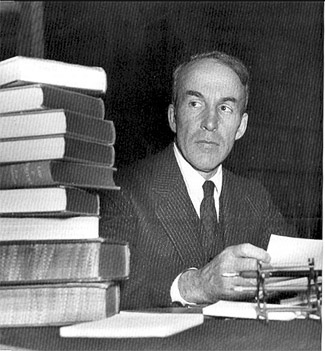
Archibald Macleish
Archibald Macleish (1892-1982) is a major modernist American poet and writer of the twentieth century, and I first discovered him through his critical writings, rather than through his poetry.  I have beside me as I write the first book I bought by him way back in 1978 when I was a mere twenty years of age.  That book is called Poetry and Experience (Harmondsworth: Penguin Books, 1961).  I remember being blown away by how easily he communicated to the reader his understanding of what poetry does and is.  In part one of that book, he discusses in a comprehensive way how poems work through sound, sign, image and metaphor.   In the second section of the book, Macleish treats of how what he has discussed in the first section functions in the works of Emily Dickinson, W.B. Yeats, Arthur Rimbaud and John Keats.  This book, consequently, would be a wonderful introduction to poetry appreciation for anyone wishing to learn more about how to read and enjoy it.

The Old Men in the Leaf Smoke

The old men rake the yards for winter
burning the autumn-fallen leaves.
They have no lives, the one or the other.
The leaves are dead, the old men live
Only a little, light as a leaf,
Left to themselves of all their loves:
Light in the head most often too.


Raking the leaves, raking the leaves,
Raking life and leaf together,
The old men smell of burning leaves,
But which is which they wonder – whether
Anyone tells the leaves and loves –
Anyone left, that is, who lives.

For me, it is the existential thrust of this poem that engages me as a reader.  I have already alluded to the psychiatrist Dr Irvin Yalom's listing humanity's awareness of its mortality as being one of the four great ultimate concerns in every human being's life.  Raking leaves is a perennial occupation for anyone with trees in their garden.  Growing up, it was one task I loved to do when I visited my country cousins and when I spent some three years as a would-be monk.  This poem uses the leaf as a symbol of the mortality of humanity and for the shortness and beauty of life.  I love the way Macleish speaks of "lives" and "loves" and "leaves" as they are, in effect, slight or partial rhymes as these words share the consonants "l," "v" and "s."  Such felicity of language enchants this reader, simple though this use of words is.

Repetition in the poem gives it a song-like sound.  As a country boy, I can almost smell the burning leaves as I have stood beside many a man burning dead vegetation in my time. Another riveting thing about this poem is its apparent simplicity that somehow draws us into the deeper mystery that life is.  It would seem that life is an amorphous mix of things in unity rather than a collection of random things.  When one rakes a garden one rakes many bits and pieces of vegetation and insect life and mud and clay together in a unity, and that unity in plurality suggests a mysticism at work in Macleish's sensitivity.  And this latter mystical sensibility is all too apparent to the perceptive and open reader.  Let's read the second stanza slowly and meditatively with the thoughts and sensitivities of this paragraph in mind:

Raking the leaves, raking the leaves,
Raking life and leaf together,
The old men smell of burning leaves,
But which is which they wonder – whether
Anyone tells the leaves and loves –
Anyone left, that is, who lives.


Mystically and linguistically leaves and lives and loves are all somehow magically one.  We are one with the poet raking them together as we live. On the one hand, then, this is a sad and depressing poem, and yet, on the other, this is a poem that suggests that we are part of the great cycle of nature, and we are ennobled by being part of it, never lessened, as, after all, we are the ones who do the raking.  We are the ones who do the maintenance on the garden.  We, in our turn, will become old men or old women, as the case may be, and we will surely smell of leaves and loves and lives.  Then, the beauty of the poem is that it does not state too much.  It connotes rather than denotes, and that is a wonderful device at the very heart of poetry.  Mystery, mystique, wonder and magic are always beyond capturing in prose.  They are more readily captured but never subdued or crushed in poetry.  That's why the last stanza defies paraphrase, which is surely anathema to anyone with a poetic sensibility.

Friday, May 20, 2016

Thoughts on the Tao Te Ching 63

Poem 63


Act without doing;
work without effort.

Think of the small as large
and the few as many.
Confront the difficult
while it is still easy;
accomplish the great task
by a series of small acts.

The Master never reaches for the great;
thus she achieves greatness.
When she runs into a difficulty,
she stops and gives herself to it.
She doesn't cling to her own comfort;
thus problems are no problem for her.

Our graduating Sixth Years:  May they learn to go with the flow and stay in the zone!! 


Commentary

Once again, our Taoist poet and philosopher uses the balance of polar opposites to put across both the mystery and complexity of life on the one hand and the depth or height of spiritual wisdom on the other.  In a certain sense, we can appreciate the above poem if we let go of our rigidity, especially the rigidity associated with linear logic.  We have to learn to think outside the box, to go beyond the rigid linearity associated with intellectual knowledge or logic and allow the reasons of the heart to attract us to action.  As Pascal tells us, "le coeur a ses raisons que la raison ne connait point" - "the heart has its reasons which reason itself can never comprehend."  In this sense, it may be said that we can "act without doing."  In a similar way we can "work without effort."  Moreover, we can stand things on their head by treating the large as small and vice versa.  In a way, what our poet is suggesting is that there is as much a universe in the atom as there is in the expanse of space.  Lines from the "Auguries of Innocence" by the wonderful pre-Romantic poet William Blake come to my mind:

To see a World in a Grain of Sand 
And a Heaven in a Wild Flower 
Hold Infinity in the palm of your hand 
And Eternity in an hour

Trees in Newbridge House, Summer 2014


Yet again, another associated thought that comes to mind is that of the psychological concept of flow as proposed by the Hungarian psychologist Mihály Csikszentmihályi.  Flow is a central concept in positive psychology, and it is also known as the zone.  Children can far more readily enter this zone than we adults because they are closer to their hearts and to their intuition that we adults are.  We adults are far more likely to be locked in the world of logic and intellect.  Flow or the zone is the mental state or that state of being where the person doing some action or activity is fully immersed in his/her experience of the moment, and is fully energized and well focused on the task at hand.  Flow is characterized by complete absorption in what is being experienced.  

It is, then, in this sense, that we can agree with our Taoist poet that we should confront the difficult while it is easy and achieve great tasks by doing small ones.  By not intending to reach for greatness the Master achieves it effortlessly.  Moreover, when she runs into difficulty she does not struggle with it or face it head on in pointless opposition - oh, no.  In fact she surrenders herself to it and swims with its tide.  And finally, like any true Taoist or Buddhist, or even Christ-like believer she never clings to her own comforts.

In this way, she never encounters problems.  As the philosopher Gabriel Marcel and the theologian Eugene Joly aver she rather embraces the total mystery of life.

Namaste, my friends.


Wednesday, February 17, 2016

Thoughts on the Tao Te Ching 45

Poem 45


True perfection seems imperfect,
yet it is perfectly itself.
True fullness seems empty,
yet it is fully present.

True straightness seems crooked.
True wisdom seems foolish.
True art seems artless.

The Master allows things to happen.
She shapes events as they come.
She steps out of the way
and lets the Tao speak for itself.

Commentary

Howth Harbour, 2003
Once again, we are in the misty realms of the mystical where nothing appears clear - at least clear in the conceptual or cortical or logical sense Once again, to continue by way of a refrain, we are in the country of poetry which nicely parallels the world of the mystical. Another related, and indeed cognate word to mystical is undoubtedly that of "mystery." Both derive from the Greek root "musterion" and the Latin word "misterium" through "mistere" of Old French to mean something akin to hidden meaning or truth, or a deeper religious feeling or some sort of esoteric experience of union with that meaning or truth behind whatever reality is. Maybe, indeed, it is that reality in se? Moreover, it suggests a strong, though hidden, presence of the source of all truth, namely God or some other such esoteric principle, with the person doing the experiencing. 

Further, let me point out here, at the risk of repeating myself somewhat ad nauseam, that there is more to human intelligence than the logical, the cortical or the narrowly mathematical.  There are many other aspects to the human intelligence as the great contemporary psychologist Howard Gardner so powerfully pointed out to us in his book Frames of Mind (1983) namely Musical, Visual, Verbal, Logical, Bodily, Interpersonal, Intrapersonal,  Naturalistic and Existential.  There are other scholars who would add some others to this list. Be that as it may, these nine intelligences are essentially highly useful and intuitively obvious models of Intelligence, and obviously they do overlap and mutually co-operate in the workings of our human brains/minds.  In the main, as a schema or suggested structure for the complexity that is the human intelligence, they are useful in many fields of endeavour, especially in education and mental health areas to name but two.  What I am about here, to state my argument as vividly and as clearly as possible, is to emphasise that argumental clarity is a trait of logical and mathematical intelligence pre-eminently, and that it is not necessarily a strong trait in other aspects of intelligence as in Art or Music or Bodily or indeed Existential Intelligence.  In short, it is only at our peril that we look for a logical clarity in spiritual or mystical or indeed in existential writing.

"Of the writing of books there is no end!" Own library
Once again, to sustain my old refrain, poetry lends itself well to the expression of mystical theology, mystical experience, religious or siritual writing in a most important way. Poetry places all its powers at the disposal of the spiritual or mystical writer: simile, metaphor, paradox, imagery of all types, symbolism and so on, along with much subtlety of connotation.  Yet again, setting up pairs of polar oposites is to the fore in the above poem: perfection vs imperfection, fullness vs emptiness, presence vs absence, straightness vs crookedness, wisdom vs foolishness, expression vs concealment, openness vs closedness or closure, masculine vs feminine and so on.    

Perfection is essentially a hard word really, a relentlessly condemnatory and judgemental one at that, I believe. Somehow, unrealistic and obsessional teachers and professors have used it over the years as a cruel weapon in education to beat their pupils and students relentlessly with and in so doing massage their own egos. To my mind, they were simply that, that is to say, simply unrealistic, obsessional, cruel and egotistical.  A friend of mine, whose father was a professor and scholar of note at one of our foremost colleges described him as a "grammar fascist" in his ruthless pursuit of perfection in his chsosen language of study.  It is educationally sound to strive for a certain perfection as a goal but never to be obsessional in its pursuit as it can be so dismissive of seemingly lesser achievements, achievements which may require greater effort on the part of strugglers than the effort expended by the experts in the discipline in question. After all, does not life teach us that imperfection is often the order of the day?  Things fail and structures crumble as indeed do the creators and makers of those things.  As a young boy, I was often quite upset when this or that toy broke.  And then, I learned to live with the inevitable breaking down of things.  A deeper and more bitter lesson yet had to be learnt by me as a young boy, and that was that people as well as things broke, faded and died.  This is life, I learned to my then consternation. Perfection is always ahead of us, often never, if ever, here in the now. Living in the now often requires that we be satisfied at times with accepting what we cannot improve or change despite our greatest efforts, and that some individual things and some situations in which we find ourselves in life may just well be such as the old saying has it, that is, that they represent life's being simply "as good as it gets!" 

And yet perfection may include within it an element of the imperfect.  After all, how can one describe light without shade, black without white, good without bad, kindness without cruelty and so on?  Those polar opposites may just well be in that healthy tension suggested by many philosophers and creative writers?

As one of our great Irish writers, Oscar Wilde, once so pithily put it "the truth is never pure and rarely simple."  Indeed, Wilde did not write his words flippantly (as we often infer from his more humorous works) as he had suffered much in his quite short life and much of his thoughts and indeed his great humour were tempered with the most bitter of experiences of a life that had as many lows and well as it had highs. 

In a sense, existentially we are called upon, in the words of Jean-Paul Sartre to shape our own destinies by modelling the best self (or our best identity project) we can from the talents at our disposal within the orbit of our own little lives.  In that same sense, we are condemned to be free within the limits and constraints of our own private and public worlds.  However, we are but mere dots on a bigger blob of earth that is in turn a mere dot within a bigger blob that is a mere dot within another bigger blob and so on ad infinitum.  In that sense, the Tao or the Wisdom behind the universe or God or the Great Spirit or even what some call the Indifferent Energy behind the universe, or whatever is at the base of reality, shapes much that is beyond our puny control.  We are definitely mere "flies to wanton boys," as Shakespeare once so timelessly put it, in this particular context outlined. And yet, our task is at least to make the best stab we can at making even a little splash in our tiny pond of life.  To this end, all cultures call us, and all religions, too, which are, of course, mere aspects of those same cultures.  Maybe, indeed, the cultural must, of necessity, always and ever be greater than mere individuality, that most wonderful and elusive myth of all.