Showing posts with label Creativity. Show all posts

Saturday, September 10, 2016

Poems I Journey With 4

W.B.Yeats, surely one of the greatest poets of all time who wrote in the English language, offers me so much artistic, literary, and dare I say it, spiritual sustenance, that my volumes of his poems are always well thumbed.  Therefore, let me offer the reader another of my favourites from his pen, here.  It is called, aptly enough, "The Long-Legged Fly."  There is something at once beautiful and somewhat gauche about the title as "long-legged" applied to any species suggests a certain ungainliness and a definite awkwardness in the first place. And yet the poem suggests a certain transcendent grace that builds its myth upon lowly nature; a certain extraordinary beauty that transcends the ordinary quotidian experience of life.


Long-Legged Fly

That civilization may not sink,
Its great battle lost,
Quiet the dog, tether the pony
To a distant post;
Our master Caesar is in the tent
Where the maps are spread,
His eyes fixed upon nothing,
A hand upon his head.
Like a long-legged fly upon the stream
His mind moves upon silence. 

That the topless towers be burnt
And men recall that face,
Move most gently if move you must
In this lonely place.
She thinks, part woman, three parts child,
That nobody looks:
Her feet practise a tinker shuffle,
Picked up upon a street.
Like a long-legged fly upon the stream
Her mind moves upon silence. 

That girls at puberty may find
The first Adam in their thought,
Shut the door of the Pope's chapel,
Keep those children out.
There on the scaffolding resides
Michael Angelo.
With no more sound than the mice make
His hand moves to and fro.
Like a long-legged fly upon the stream
His mind moves upon silence. 

Commentary

Something as beautiful as this poem simple defies commentary, and in so doing I am, in a sense being somewhat sacrilegious in attempting, as it were, to nail down the "sacred" experience of these well-crafted lines in more mundane words.  Despite that caveat, I shall try to express here, at least what this poem means to me, one solitary reader.  I love the scientific, very unpoetical term, a word, naturally enough, avoided by Yeats, namely "dolichopodidae" that describes that most cosmopolitan of fly families, namely that of the "two-legged flies." Apparently there are about 7,000 species of these flies at a conservative count.

When I read a poem I don't necessarily go in search for an exact meaning, for such an intention, to my mind, is sacrilegious.  In other words, I search for connotations more than denotations.  I have learnt to let a poem suggest meanings, obviously not outlandish and impossible ones, but rather more possible ones and as many of them as is reasonable.  In a sense, obviously, we will never know exactly what was in  the poet's mind when he wrote the poem, but we can make an educated guess anyway.

The refrain which marks the ending of each stanza is an amazingly powerful chorus that suggests the power of human reflection, awareness, concentration, meditation or contemplation from whose seeds all of civilization emerged.  It suggests that through this self-reflective power civilization emerges and is greater than the individual parts that go to make it up. Civilization and all its cultures transcend the individual.

Western monasticism and Eastern practices of Buddhism have always rated silence highly because silence is, as it were, the seedbed of creativity and wisdom.  Silence is also the seedbed of genius.  In the first stanza we meet the great Julius Caesar sitting in his tent looking into the distance, obviously pondering, with his eyes "fixed upon nothing."  In silence, he is obviously contemplating what he and his troops have as a goal.  The Romans were great conquerors, great men of action and one of the great builders of Western civilization.  Caesar needs to enter the realm of silence to garner inspiration for his conquests, to tap into his vision of future possibilities:

Like a long-legged fly upon the stream
His mind moves upon silence. 

In the second stanza we encounter the great Helen of Troy. Obviously, her beauty is directly conjured up in our minds by the lines:

That the topless towers be burnt
And men recall that face,
Move most gently if move you must
In this lonely place.

These lines remind us of the lines from Christopher Marlowe's play, Doctor Faustus, especially these lines put in Faustus's mouth by the playwright:

Was this the face that launch'd a thousand ships,
And burnt the topless towers of Ilium -
Sweet Helen, make me immortal with a kiss.

Helen is the very essence of beauty, a beauty so natural and so rhythmic that she captures its quintessence in the gorgeous peasant girl that dances so lithely in the streets. Through her, Yeats seems to be arguing that all beauty is made possible as she is its symbol or emblem in Greek civilization.  The Greeks, obviously, with the Romans were the two great builders of Western civilization. In this sense, we may say that the first stanza is essentially about politics/military affairs, which lie at the physical foundations of civilization, while the second stanza is about aesthetics and the innocence of pure alluring beauty which is also another source of the creative spark that set civilization alight.  One could also maintain that this second stanza highlights or underscores the power of creativity in the realm of mythology.  

In the last stanza, Yeats contemplates the spark of genius that inspired one of the greatest artists of the Renaissance period, one Michel Angelo, whom he calls Michael Angelo here in this poem.  It is, as it were, the "Arts" stanza as it describes the painting of the Sistine Chapel.   To put it rather bluntly the poet's wish "That girls at puberty may find the first Adam in their thoughts" suggests that the power of Michel Angelo's depiction of the naked male form may entice them to have children.

Once again, genius thrives in silence and peace:

With no more sound than the mice make
His hand moves to and fro.

Each of the three characters, one in each stanza, viz., Julius Caesar, Helen of Troy and Michel Angelo achieve transcendence, or an elevation to a higher plane, or a going beyond this physical world just as the long-legged fly defies gravity as it walks across the water.  Let us note here that the imagery in the last two lines, which function like a chorus from a song, is simply beautiful and so gently put because the long-legged fly can move across the surface of the water effortlessly, without disturbing it in the same way, as it were, that the genius of Caesar, Helen or Michel Angelo can move creatively from one idea to the next.

Michel Angelo, like Helen and Caesar, is inspired by a vision beyond him, some transcendent pull, as it were.  Aristotle called such a pull, a "telos."*


*telos (from the Greek τέλος for "end", "purpose", or "goal") is an end or purpose, in a fairly constrained sense used by philosophers such as Aristotle. It is the root of the term "teleology," roughly the study of purposiveness, or the study of objects with a view to their aims, purposes, or intentions.  See WIKI here.


Monday, May 26, 2014

Journal of a Soul 55

Embracing the Magic of Hope


When I use the word "magic" here, I am in no way using it in its restricted, perhaps more correct, understanding of actions connected with manipulating normal things or forces by paranormal methods.  I am, of course, using it in its broadest sense to suggest everything that evokes wonder, beauty, mystery and love in the human soul.  In a world where destruction is more often than not the hallmark of human interaction, we need the magic of hope more than ever.  One would want to be a strong individual not to grow depressed when one even cursorily views the history of humankind where wars and crimes against humanity so obviously abound.  One would want to be equally courageous in viewing the international news which is virtually filled with accounts of the destruction of humans by other humans: from Afghanistan, Somalia, Nigeria, Pakistan, Egypt, Syria, Iraq, Central African Republic and South Sudan where there are 1000+ deaths per country per year (See Here and Here)  to the destruction of our very own worldly home, namely Mother Earth, our lovely Blue Planet.

Ring-tailed lemur, Dublin Zoo, May 2014
The longer I live the more passionate I am becoming about the need to inspire hope in others.  There are too few great leaders who are doing so today in the political world.  The two most outstanding leaders to my mind, in a more spiritual context, who are attempting to cast the magical spell of hope over a very destructive, greedy and hateful world are such wonderful leaders as Pope Francis I and the Dalai Lama.  Other leaders who impress me from the political world are Aung San Suu Kyi of Myanmar, Desmond Tutu of South Africa and Kofi Annan.  For the life of me, I cannot think of very many more.  President Clinton still impresses me with his commitment to world peace and peace in Northern Ireland, as does the wonderful President Jimmy Carter who is constantly working for peace all around the globe. These are all leaders who inspire hope. Another group of committed "retired" leaders that much encourages the present writer are The Elders and you can read all about their wonderful work for peace here

As a teacher, I find that often many of our youngsters are lacking in hope.  In the wake of the downfall of the infamous Celtic Tiger, a growing number of people are mired in negativity that can all to often descend into the lower reaches of desolation and despair. Many pupils who attend our inner city working class school cannot see very much in the way of promise for their future lives. In Ireland as I write, there have been so many cutbacks, so much austerity that the presence of the Labour Party - who are partners in a Coalition Government with a centre-right party called Fine Gael - has been virtually wiped out on town councils all around Ireland.  The Labour Party has been adjudged by the electorate to have so much compromised, or indeed sold out on, their socialist principles that the voters virtually ignored voting for any of their candidates.  A very disillusioned and dejected voting public opted instead for independents and candidates from other parties, most especially Sinn Féin.

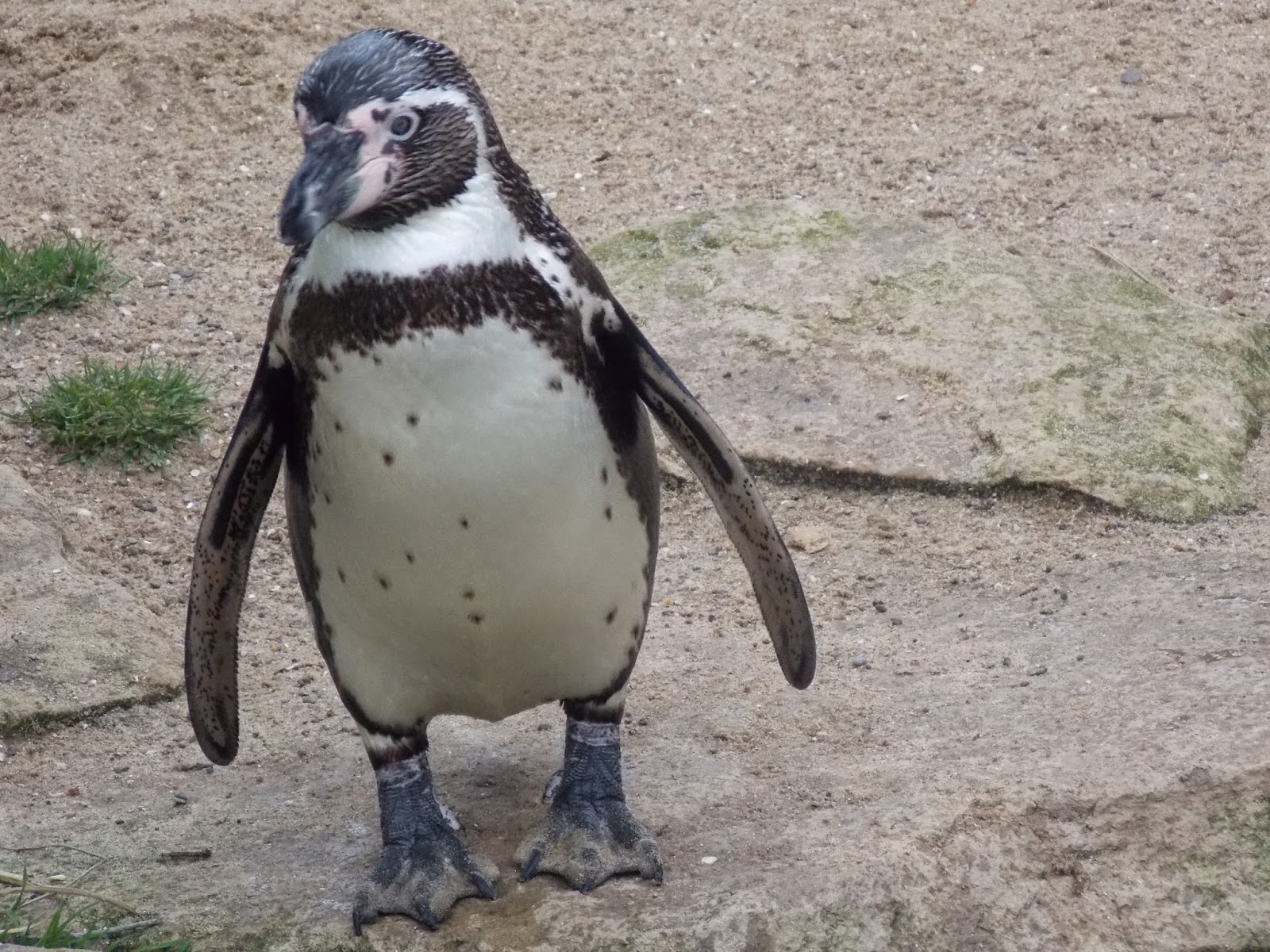
"Pp...pp. pick up a penguin," at Dublin Zoo, May 2014
One boy who comes to me for counselling suffers from a sort of low-grade depression for which he is taking sessions from a qualified psychologist in a local hospital.  I work with him once a week.  He is representative of a growing number of young people who seem to be somewhat bereft of hope.  In our sessions, we constantly talk about choosing life and hope, not despair and death.  Recently a young female contact (I never like the use of the word "friends" for "contacts" on this social network as it is a definite misnomer that can cause some young people an amount of anguish if they are deleted or blocked or even bullied by another so called "friend.") on Facebook put up a rather depressing status including the symbol of the skull: "It's mad knowing the only thing we actually are promised in life, is death I do have meself (sic) freaked to bits thinking about it!" Indeed, I notice that FB has become a sort of diary for many of our young people where they reveal their hearts to an oftentimes disinterested public.  As I say, I have my doubts about how helpful FB can be in mental health matters, but that is a debate for another post.

Attracted to the Light

It is indeed a truism to say that we are attracted to the light and repulsed by the dark. For the most part, we are all intuitively attracted by the light in good people.  Generally, it has been my experience that really good people are innately attractive, e.g., Martin Luther King, Mother Teresa, Pope John XXIII, Pope John-Paul II and in more recent times Pope Francis I.  I have named many others above in my opening paragraph.  I leave it to you, all you good loyal readers out there, to name your own attractive world political and spiritual leaders.  Essentially, such leaders share much with the historical Jesus and the equally historical Siddhartha Gautama (the Buddha), St Francis and all the present day great spiritual leaders (as distinct from Religious Leaders.  I will be contentious here by stating that I believe that Pope Benedict XVI was a Religious Leader while Pope Francis is a Spiritual Leader). I believe that the great contemporary religious writer and theologian Karen Armstrong is also an attractive spiritual leader.  Her books are widely read and she has been universally honoured for them.*

We must radiate the light of hope in our lives, especially if we are in any position of leadership.  Leadership requires those who exercise it to be real, authentic human beings, aware both of their strengths and weaknesses, to be open to encouraging those whom it is both their task and privilege of leading, being so self-assured in themselves that no one on the staff is ever a threat to their sense of authority.  They must be motivators who notice and affirm the innate talents in each and everyone of their colleagues and employees.  This may be a tall order, but after all that is why we put such people into leadership roles and pay them oftentimes extravagant salaries.

If we know that in the end, in a very real and actual way, every individual life is a physical
Chimp with orange, Dublin Zoo, May 2014
failure in the sense that we all end up in the grave, why then should we keep going on?  If, in the end, all the knowledge we have learnt in our individual brains decays into nothing with our bodies, why do we desire to learn?  A very intelligent student asked me that the other day when we attended the presentation of Green Flags for schools that had made serious efforts to cut down on waste of energy and water. We were discussing the dreadful ecological state we have got our lovely Blue Planet into in these more modern times when he asked the question.  If in the end we are all going to perish, given the horrific mess we have made of our planet, why not give up? I replied that one reason we bothered is that we did not ever wish to become victims, that we had a desire, in-built in us, for order and meaning, and that to give up hope was to admit defeat. As we continued our discussion we spoke of humankind being co-creators with the Creator of the Universe, of our being called to build up as many lovely things as we could for the sake of others, for the sake of all humankind and for the sake of all creaturely and inanimate life.

The lovely cuddly red panda at Dublin Zoo, May 2014

When we write a poem, sing a song, compose a new piece of music, protect animals, build a new building, nurse another sick human being or animal, discover a new piece of knowledge to add to the jigsaw of wonder which this life essentially is, we are lighting candles of hope. When we put out our hand to help another, when we join a cause for the betterment of someone or something or even smile in acceptance of another, we are engaged in spreading the light of hope.  When we shake hands, when we hug another, when we truly listen in acceptance, when we are truly compassionate towards all sentient things, as the Dalai Lama is wont to put it, then and only then are we a true and authentic people of hope.  All our most profound religious and spiritual traditions speak of the light of hope conquering the darkness of despair.  It is no wonder that we often turn to their wisdom traditions in times of disillusionment and despair for words of comfort like: "better to light one candle than to scorn the dark," or "every journey, no matter how long, begins with one little step."  Even if you only smiled at someone today, you are engaged in the apostleship of hope.  I have long loved the short saying of the late Medieval Catholic mystic Meister Eckhart that runs: “If the only prayer you said was thank you, that would be enough.”  If each and everyone of us said this prayer as often as we can on a daily basis we would be truly embracing the magic of hope. 


Footnote:

* In May 2008 Armstrong was awarded the Freedom of Worship Award by the Roosevelt Institute, one of four medals presented each year to men and women whose achievements have demonstrated a commitment to the Four Freedoms proclaimed by President Franklin D. Roosevelt in 1941 as essential to democracy: freedom of speech and of worship, freedom from want and from fear. The institute stated that Armstrong had become "a significant voice, seeking mutual understanding in times of turbulence, confrontation and violence among religious groups." It cited "her personal dedication to the ideal that peace can be found in religious understanding, for her teachings on compassion, and her appreciation for the positive sources of spirituality." 

Thursday, February 20, 2014

Journal of a Soul 44

And What or Who Keeps you Going?

That is a good question indeed.  Especially when some people give up on life, while others apparently, no matter how tough life is for them, manage somehow to "keep on keeping on." In case you don't know the provenance of those last several words, they come from a song of Bob Dylan called Tangled Up In Blue.  That song is one of my favourites from the pen of Bob Dylan as it has haunting lyrics which show the deep inner longing of a drifter for love, companionship or meaning in his life.  Interestingly, Dylan mixes past, present and future tenses in this song with consummate ease, with an readiness of transition that is magical. Indeed he changes person, too, from verse to verse, even changing the "I" of the first verse to "he" and "she" in his later concerts.  But that only adds to the magic, wonder and beauty of this wonderful song.  Lest I lose my path in this post, I had better curb my musical passions here, and point out that the phrase "keep on keeping on" is an important one for me that shows the strength, persistence and determination of the traveller or wayfarer in life. Now let me turn my attention to the question posed in the title of this post.  What, indeed, you may ask, keeps me going?  Let me attempt to list those reasons in no particular order.

1. My Job.  

I remember Pat Kenny, one of our foremost broadcasters here in Ireland, remarking that he was lucky as his hobby became his profession.  He was luckier still as he is currently the best paid broadcaster in the country at 66 years of age.  While few of us can boast the contentment Kenny talks about, some of us do get immeasurable satisfaction from our work.  At the moment, I count myself one of those lucky souls.  Not that my job was always that rewarding.  It's just that I was lucky to realize that m  y job was driving me crazy at 48 and I decided to change track.  In all of that, self-awareness is of utmost importance. There is simply no sense in staying in a job that is soul-destroying.  So I retrained as a Resource and Special Education teacher and left the main stream classroom to begin working with autistic boys, mainly those with Asperger's Syndrome in the area of Social Skills and Communications.  I also do learning support in Mathematics for the school at large.  This is all extremely rewarding work as I can see the results of my labour on a daily basis.  I suppose the big thing in this work on a personal level is simply being needed.  That is why being unemployed leads to such depression in the lives of those afflicted with that dreadful problem.

2. My Creative Outlets

Creativity can never be underestimated as it is literally the food of the soul if I may use a metaphor.  Ever since I can remember I have been a writer, and over the years I have had many bits and pieces published here and there.  In these more recent days I have been engaged in blogging.  This latter has been a soul-saver for me as it allows me to instantly publish online the ideas and, more correctly and importantly, my concerns online.  I also write poems in two languages, English obviously, and then, also, in my native tongue, Gaeilge or Gaelic or as it is more commonly called Irish.  By writing, I am engaged in getting to know myself better, and consequently becoming more contented.  If one reads and writes poems as I do, then you will appreciate that poetry does not really sell, that getting published is difficult to say the least.  However, I remind myself often, as one poet wisely counselled me once, that it is more important that a person writes a poem than that many people read it.  If only a few others read it, in a writing group or in some community setting, then that is the reward.

Other creative outlets are reading, listening to music, travelling and going out with friends. Lest this become like a boring list of my hobbies as would appear on a CV, let me proceed onto the next point.

3. My Spirituality or Religion 

In more recent times, religion has become a somewhat sullied word, while spirituality has become a more positive one.  In my young day, I remember the good things about religion: (i) the sense of wonder evoked by what seemed to me as a child to be very colourful and dignified services, (ii) the sense of a mystery or something divine beyond me, (iii) the beauty of the Latin language and of the hymns and (iv) the sense of the unity within the community. I have long ceased to be a practising Catholic, but I can still tap into some of those old feelings when I attend funerals, baptisms, and Christmas and Easter services.  

However, secularization has long since consigned the role of religion in Ireland to the periphery of life.  As well as a more secularized society, there were indeed intrinsic and endemic problems within the Catholic Church itself.  Those problems in short were the corruption of power and the abuse of that power through allowing child abuse by clerics to go unchecked.  One of the most crippling aspects of any organised religion is the abuse of power. It happens in all and every religion, and let none of us forget that.  Such happens in every human organization: there will always be people who hunger for power and control over others, and they will use every doctrine under the sun to hang onto that power so that they can use it and abuse it.  In every human organization, be it church, state, government, medicine, law, or any other one, those who hunger for power will manage to get their way into the top echelons.  It is only now - in the last ten or so years - that we here in Ireland are properly watching and checking all professions. It is a truism that needs repeating that no organization can monitor or check itself Here I recall that old Latin quotation attributed to Juvenal:  "Quis custodiet ipsos custodes?" "Who will guard the guards?" A question still worth asking 2000 years later.

Like the Dalai Lama, the smile on Pope Francis' face says it all!!
Religion, uncoupled from spirituality, is a mere power structure that aims at controlling people, at least in certain people's hands.  That's why the election of Pope Francis was/is one of the more prophetic things that have happened in the Roman Catholic Church in the past 50 years.  For me, as for many Catholics, Francis is on a par with another prophetic Pope, namely John XXIII who inspired and opened the historic and prophetic Vatican II.   It was not by chance that Jorge Mario Bergoglio chose Francis as his name as pontiff, as St Francis was the apostle of the poor and unfortunate, with a deep commitment to ecology.  It is more than apparent by his actions that Pope Francis is a highly spiritual man who loves ministering to the poor, and all his actions speak of one with a deep conviction and commitment to Christian principles.  In short, he is Christlike, not church-like!  And there lies the difference between him and  his immediate predecessor. Here is an interesting post written by an unusual but firmly believing (non-Catholic) Christian on why he admires Pope Francis:  Boeskool.com.  His comments are really worth reading and I have signed up to be a member of his blog: they boil down to the fact that Pope Francis is Jesus-like, that is he is more interested in spirituality and in acting like Jesus than in the power structures of the Church.  He is an old man of 77, but his spirituality allows him to walk, smile, talk, and obviously think and feel like a far younger man,  Maybe, just maybe, this man can turn the tide for the Roman Catholic Church, but he must be meeting some opposition within its power structures.  Unfortunately, that is why the bigger Churches are losing so many members: they are too petrified literally - "petrified" means stone-like, unmoved and unmoving.  That is where and how power corrupts, and boy does it corrupt no matter where frail human beings belong.  Finally, it is no wonder to this writer at least that Pope Francis is a Jesuit, one of the foremost orders in the Roman Catholic Church who truly believe in discerning the signs of the times, in discerning their own relationship with Christ and with humanity as a whole.

Spirituality for this writer is all about connection or connectedness with all of creation, which obviously includes other humans.  It is about union with whatever power or spirit runs through the heart of this universe and keeps it "together."  It has involved me in community work, in helping others through the Society of St Vincent de Paul and so on.  It inspires me to meditate and do yoga practices with others.  It also inspires me to read spiritual classics from all traditions.  That's what I love about these modern times where pluralism is more important than uniformity.  I remember a scholar once informing me that unity never means uniformity, and I have never forgotten that piece of wisdom.  (Interestingly Pope Francis realizes that as he says that even atheists can get into heaven if they live moral lives. Mind you, he's only repeating the teachings of Vatican II here!) No matter what religion one belongs to, even none, everyone has a spiritual sense.  I will write later in these posts about the spirituality of atheism, and indeed this topic has been written about by a few scholars in more recent years.

And what is it all about?

I will finish this rather meandering post with this question as it was one put to me when I was only 22 and a young teacher beginning my career.  I was so innocent and "green about the gills" back then that it is almost embarrassing to remember the way I was.  However, such is life and such is the cost of experience.  Anyway, one morning a man called Ger Smith asked me that question.  I was too young and too busy to take the man seriously, far too caught up in my own little world.  It was only some three years later when I had learnt that Ger had died from a congenital heart condition that none of us his colleagues ever knew about at the time., that I realized the import of Ger's question both for him and indeed for all thinking and feeling beings.  If you like, that question, along with legions of others over the years, opened up a giant unknown world to me, a world of infinite questions seeking answers or at least seeking better forms of questions as Rev Dr. Patrick Wallace used to put it back in the day.  Really good and deep questions open us up to mystery and never confusion.  And mystery, as they say, is an ocean we dive into, and never ever a wall against which we bash our cognitive heads. And so to Ger, RIP, I owe a debt of gratitude for opening up the vistas of mystery to me all those years ago.  I do hope that someone somewhere holds you in their heart.

Wednesday, April 3, 2013

Journal of a Soul 11

The Makers of Meaning
A book I am currently reading.


We are makers of meaning.  Without meaning, life is shallow and hollow. Without it, we become heartless and soulless automata.  Eventually, we literally dry up, wilt and die like an uncared for plant.  Immediately here, we have the makings of a good metaphor – living a good life is, in a certain sense, gardening for the soul.  This is a metaphor suggested by Carl Ransom Rogers in his Person-Centred Therapy (PCT).

In a major sense, too, our opening metaphor here, namely gardening for the soul, suggests a firm connection with nature.   And, further, this is one of modern and post-modern humanity’s greatest faults.  Not alone do we lack a real connection or relationship with the earth and its goods, but we destroy them with impunity.  Even worse, the acquisitive and capitalist cultures we are born into allow us to be virtually indifferent to the earth and its bounty.  Sadly, we meet many people who are unaware of the destruction we are doing to the bountiful planet on which we live. 

Maybe at this juncture in the history of humankind, when we are in the midst of the worst economic crisis we have ever witnessed, we are ready for a wake-up call.  Perhaps, greed and rapacity have shown us their worst results – corruption, bankruptcy, selfishness, and a sheer lack of appreciation for things of the spirit or the soul, for values other than those linked to financial profit at all costs.

But, any of us who are idealists, who believe that something else is needed over and above rapacious capitalism for the redemption of humankind, are often left totally disillusioned.  In this side of the developed world – Europe – it would seem to this economically ignorant commentator that the powers that be, namely Germany and France don’t really want to help the rest of Europe in solidarity.  Rather, they prefer to self-righteously preach about unfettered over-spending by smaller countries and lack of regulation, and not a word about their own unfettered over-lending.  There is not much solidarity in squeezing the last penny from some of the poorest nations who in turn are squeezing their own poorest citizens.

This is no political qua political post, dear reader.  It is, perhaps, political qua spiritual, as all spiritual stances have political and financial consequences.  Humankind has lost its way as all spiritual values are being lessened and eroded in the name of the mighty euro or indeed the mighty dollar or whatever the ascendant currency might be. What, then, are these values, the decrease of which, I lament here?  Let me try to list them in no specific order:

  1. Connection with the earth.  Call her Mother Earth or Gaia – see James Lovelock’s notion of Earth as one great organism.  Notice the connection of all simple religions and spiritualities with the Earth as Mother or provider.  In this regard reading the spirituality of the American Native Indians is very enriching.  (Note to self: I must read more here.)
  2. Fostering creativity in all its incarnations: drawing, painting, writing, sculpting, composing music, singing, dancing, acting and so on and so forth.  What do they tell us about humanity?
  3. The moral call – the call to fight for justice on our own doorstep as well as further afield.
  4. Asking questions like: Where does this moral call come from?  Why behave in a just way? Where or who is the source of this moral call?  Is there a source of Good, i.e., God?  The present writer believes this is a very important question to discuss, though he is agnostic about the answer.  He certainly has very few answers.  But in the tradition of Socrates all questions, especially the hard ones must be put.
  5. What is friendship? What is love?  Or again, in reference to the current financial crisis: What is SOLIDARITY? What is the common goal of humanity?  In how far am I my brother’s keeper?
  6. What lessons have we learnt from the current worldwide DEPRESSION?
  7. What, essentially, have the traditions of the great world religions to teach us about our values as humans?


If we as humans are the makers of meaning, and the makers of values, then we had best be up and at it, and not leave the way clear for the empty philosophies of bureaucrats and capitalists, who, in the words of the great Irish litterateur Oscar Wilde, “know the price of everything and the value of nothing.”

Monday, June 25, 2012

Journal of a Soul 8

Badolato Marina Beach, June 2012
The fleeting nature of time has long been a topic in philosophy.  Things are so much in flux that the ancient pre-Socratic philosopher Heraclitus declared so insightfully that we cannot step into the same river twice.  Our grand-parents, now long since passed away, used to opine, also rather wisely, “that much water has passed under the bridge” since X, Y or Z happened.  They intuitively had grasped exactly what Heraclitus meant.
As a small boy I used hate travelling with my parents to my father’s home town, called Roscrea, in the County of Tipperary in the Southern midlands of Ireland.  He would inevitably end up in this or that erstwhile neighbour’s house or in this or that local hostelry reminiscing on his youth, on how quickly the years had passed, on where A or B had lived, on whether C or D were still in England or America and how sad it was that E and F were now no more. It used to drive us children mad as we just wanted to be outside playing.  We simply did not wish to be sitting indoors while the older people went back in time in their minds.  And yet we were often bemused that my father could remember decades before the then present time.
As I age it has now become quite interesting that I can now appreciate what made my father misty eyed as he reminisced about the so-called “good old days” which were not that good at all at all.  At 54 years of age I can recall clearly when I was three years old playing with a toy lorry in the lane at the back of our house in Roscrea.  Now that’s 51 years ago or just slightly over five decades in the past.  That time has passed so quickly is at once frightening and somewhat consoling too.  If everything were to stay the same there simply would be no being or becoming at all, no ageing and consequently no death.  Indeed, if everything were to remain the same would there even be birth?  Without change there would be no life at all.  Then, paradoxically, one could say that without death there would be no life at all. 
To be is to become; to become is to grow old; to grow old is to die.  St Augustine once defined time as “the measure of change.”  For a fourth century intellectual that was not a bad definition of time at all.  To grow is to change.  To live is to grow and change, and indeed, eventually to die.
Modernity has a lot going for it.  Health of humans and indeed animals has improved remarkably in the last, say, one hundred years.  People are now living longer; women into their late eighties and men into their late seventies and early eighties.  I’m taking these figures from my own experience here in Ireland, and have not checked them out, but they are roughly accurate.  Modernity has brought comfort with it also, with so many pieces of modern technology to help us in our every daily task.  And so living has become less of a struggle.  We are also so much better educated.  Added to that, we can practically travel anywhere we want in the modern world, again with greater ease and with so much less cost than one hundred years ago.  Within reason we have more control over our lives than our forefathers.  And yet, this control over our lives has a downside to it.
Modernity, and indeed post-modernity if that is the way to describe our time in the early 21st century, have hoodwinked us into believing almost the impossible at times.  We, in the Northern hemisphere certainly, believe that we are entitled to all the benefits that a modern state can give; believe almost at times that the world (or State) owes us a living; believe that we can conquer the impossible; live longer and ever longer; look to our selfish rights without adequately considering our due responsibilities.  And this is where we have lost some of the extraordinary advantages of less modern times.
Another view of Badolato Beach
Those advantages were more of a “soul-making nature.”  John Keats, the great poet of the English Romantic period, who lived to be barely 25 years of age used to call this world the “vale of soul-making.”  The poor man died very young from Tuberculosis.  Even travelling to the wonderfully warm climes of Rome failed to stop the inevitable.  In other words, from our sufferings we can learn.  Now, here I am not necessarily talking about suffering and dying per se, or about learning their profound if bitter lessons.  No, I am referring to the fact that we can learn to slow down; learn to take stock of life; learn to prioritize things in our lives; learn to listen to our own Heart or Soul; learn to listen to the Heart or Soul of an Other; learn to be in tune with the rhythms of life; learn really to be at one with the natural sequences of the seasons.
And so to finish this post, I have learned to slow down firstly the hard way by enduring a bad mental breakdown occasioned by too much stress when I was forty.  But I knew that I had to do more.  I then began to do many creative soul-making things like Meditation, taking more time out, learning to say NO, learning to do new things, to holiday more, to write more, to reflect more, to go to more personal development conferences, to get to know positive people and to spend more time with such people, to cultivate friendships because truly relationships are like plants, they will wither and die if not cared for.  Even in the concrete jungles of modern cities each of us can at least cultivate a small garden on our balconies.  I have seen many of them in the biggest and most alienating of cities.  I have also been privileged to have been welcomed into the smallest and most homely and soul-full of homes in the biggest of cities.  In other words, with practice we can learn to grow our own Souls with care.  We can also learn in the most alien of places to put down roots of Self.  By doing so we will become attuned once again, like our forebears to the rhythms and cycles of the seasons where it is just as natural for the ripe fruit to drop from the bough as it is just as natural for the seed to die and give forth the life of a new young shoot.  Being in tune with the rhythms and cycles of the seasons, with the circular nature of time, readies us to face our own necessary part in those same cycles and rhythms, of which our dying and death are just such a little part.