Showing posts with label Prayer. Show all posts

Friday, March 18, 2016

Thoughts on the Tao Te Ching 51

Poem 51

Every being in the universe
is an expression of the Tao.
It springs into existence,
unconscious, perfect, free,
takes on a physical body,
lets circumstances complete it.
That is why every being
spontaneously honors the Tao.

The Tao gives birth to all beings,
nourishes them, maintains them,
cares for them, comforts them, protects them,
takes them back to itself,
creating without possessing,
acting without expecting,
guiding without interfering.
That is why love of the Tao
is in the very nature of things.


Commentary

Dublin Bay from Clontarf, January, 2016

If spirituality is about anything, it is about the desire in each of us to be one with our own self, with others and with the significant Other, some of us dare call God.  In short, it is about forging connections. In a sense, spirituality is like a source of power into which we may connect ourselves in order to be enlivened or to come truly alive.  There is a plethora of definitions of spirituality given by all the various religions, but the one I have given here is the most general one I can give - one that embraces the multitude of other definitions.  The great contemporary Catholic Christian Meditator, Fr. Richard Rohr and Master of Contemplation describes himself in the following words on his own web page as "a globally recognized ecumenical teacher, bearing witness to the universal awakening within Christian mysticism and the Perennial Tradition.  He is a Franciscan priest of the New Mexico Province and founder of the Center for Action and Contemplation (CAC) in Albuquerque, New Mexico...." (see HERE ).  This "universal awakening" is essentially about being aware or mindful that everything is part of the jigsaw of life, that everything connects and interconnects.  In other words, everything in the world, including most essentially us humans, connects or links together in one great spiritual or mystical union.  One of Fr. Richard's books is called succinctly Everything Belongs: The Gift of Contemplative Prayer (2003, New York: The Crossroad Publishing Company).  For the meditator or contemplator, everything connects up with us and we with them, that is, true spirituality is about working at our growing awareness of that connectedness and interconnectedness.

Boat on the River Vltava Prague, February 2016
Everything connects, or in the words of Fr.Rohr, "everything belongs," that is nothing is superfluous or left out of the equation of life.  Literally, everything is included, even pain and suffering.  This is the type of spirituality that is behind the above Taoist poem. In this sense, therefore, "Every being in the universe// is an expression of the Tao."   As one reads, ponders and meditates upon the words of this poem, one soon comes to appreciate the underlying nature of reality, that is, that essentially everything connects, that everything in the universe is part of a greater plan, part of a greater unity that lies beyond actual individual things, that a deeper connection, "a golden thread of connection," if you like (this blogger's phrase), exists between all things.  Every line in the above poem is about all things, including us humans, being buoyed up and kept in deep connection by an underlying unity that can either be called the Tao or God or the Meaning of Life or the Goal (Telos) of life.  No wonder, then, that everything is sustained by the Tao or by God and, therefore, love of this Tao or God is the most natural thing in the world: "That is why love of the Tao // is in the very nature of things."  Therefore, with our Taoist poet, we may pray or meditate or contemplate as a result of reading the following lines once again:


The Tao gives birth to all beings,
nourishes them, maintains them,
cares for them, comforts them, protects them,
takes them back to itself,
creating without possessing,
acting without expecting,
guiding without interfering.
That is why love of the Tao
is in the very nature of things.

Namaste, friends!

Sunday, February 28, 2016

Thoughts on the Tao Te Ching 48

Poem 48


In pursuit of knowledge,
every day something is added.
In the practice of the Tao,
every day something is dropped.

Less and less do you need to force things,

until finally you arrive at non-action.
When nothing is done,
nothing is left undone.

True mastery can be gained
by letting things go their own way.
It can't be gained by interfering.


Commentary

Pair of swans, Bull Island, January 2016
Once again, this current poem rehearses all the old themes.  However, that need not distract us, as such is the way all religious writings work, and indeed all great literature works. Themes will be repeated, but almost always in different ways, in different contexts and with different words.  T.S. Eliot underlined that same point with respect to the themes he returned to often in his own oeuvre. 

The Taoist oppositional tension is returned to in Poem 48 above, but this time the opposition is that between addition and subtraction.  Indeed, as a teacher of basic mathematics at secondary school level here in Ireland, I am aware that philosophically these are two inextricably related operations and that subtraction can be looked upon as adding a negative number.  This, in my opinion,  is a good example of how inextricable opposites are in actuality, and that to vere to either extreme is to do some damage to the actual reality of the healthy tension or balance of opposition.  Those of you who have some knowledge of mathematics will know that another example of oppositional operations are those of multiplication and division where division can be seen as the operation of multiplication by a fraction.  Now, to return to poem 48 above, our author is talking about adding to knowledge bit by inexhaustible bit and so on ad infinitum, and yet, he or she sees that, in a way, a lot of unnecessary and weighty information will have to be dropped or subtracted. Indeed, there is much to be learnt here by twenty first century humankind who perdure in a world in which we are literally awash with information.  Indeed, we might quite plausibly push our metaphor further by saying that we are constantly being hit by a tsunami of information on a daily basis in that same world.  One only has to google a topic or a question on that topic to know that one can get literally hundreds and thousands, or more even, of possible answers. Scholars tell us that we are in an era of information overload, and that what is needed is interpretation or analysis skills of that data.  We may be awash with information but we are literally bereft of secure ground on which to anchor our ship of interpretation, and we are often equipped with poor critical and analytical skills to engage profitably and critically with the data.

Unity, Bull Island, January, 2016
A parent remarked to me recently that her second son "carries the weight of the world on his shoulders" while her eldest does not "sweat the small stuff" at all.  Undoubtedly, what the younger lad needs to do is to "let go" or to "subtract" or "take away" or to "get rid of" the small stuff.  This is what our Taoist poem is about above, that is, the subtraction of all that weight from our shoulders, all that heavy unnecessary knowledge.  Knowledge must lead us to the truth, that is, in any deep and reasonable understanding of epistemology, knowledge must not drown us in a sea of confusion, but rather philosophically enlighten our paths to the truth.  This is what we are about in counselling and in psychotherapy.  As a part-time counsellor in my own school, this is one way in which I see my role.  In fact, I will be working with the second boy I have adverted to in the opening sentence of this present paragraph.  That is to say, one of the things I will try to elucidate for the young man is his path to self-discovery by enabling his to throw off some of that weight - how to enable him to subtract or take away some of the load he is carrying.  Admittedly, these weights may not be burdens of knowledge, but they most certainly will be burdens of negative thoughts which are themselves negative information. My task will be to enable the young man to get a handle on what is brdening him, to equip him with the tools to let go of the load he is carrying.  Indeed, in that task, I am a mere channel through which the client is enabled to unburden himself of his load.

Avoiding Passivity

Most people who engage with spirituality, or who involve themselves in meditation practices, or what is more popularly called practices of mindfulness these days, are aware of the criticism levelled at such practitioners that they are passive actors in a world that requires a greater active involvement.  Again, paradoxically, stillness of soul and centeredness of being lead to a more directed and profitable engagement with the world. Such so-called passivity is exactly what was condemned by the Roman Catholic Church as the heresy of quietism which elevated contemplation over actual mental engagement or meditation on scriptural or other spiritual texts or even oral prayer.  When I studied the history of mystical theology and spirituality many decades ago we learnt that this practice of quietism was condemned by Pope Innocent XI in 1687. This quietist heresy (or that heresy which led the mind into sheer passivity, according to officialdom) was seen to consist of wrongly elevating "contemplation" over "meditation," intellectual stillness over vocal prayer, and interior passivity over pious action.  Once again, such concerns are merely fuelled by considerations of control and power (closely linked to the ego, no doubt) rather than with, on the one hand, the paradoxical powerfulness of silence, meditation and contemplation and, on the other, the directedness of still-pointedness and focus in meditation or mindfulness.

Once again, by way of concluding these few words, I should like to invite the reader to peruse the above poem again and to let whatever word or phrase offer itself to you as a mantra for a five minute period of still-pointed or focussed meditation or mindfulness.


Saturday, February 27, 2016

Thoughts on the Tao Te Ching 47

Poem 47


Without opening your door,
you can open your heart to the world.
Without looking out your window,
you can see the essence of the Tao.


The more you know,
the less you understand.

The Master arrives without leaving,
sees the light without looking,
achieves without doing a thing.

Commentary

Windvane on the lungomare in Catanzaro Lido, January 2016
It is becoming increasingly hard  to come up with new insights with respect to the Tao Te Ching and consequently avoid boring the reader unduly by too much repetition.  I have referred to the balance of opposites many times here already.  However, a central pair of polar opposities that springs to mind is that between Inner and Outer. Indeed, this polarity is quite common in early philosophy and theology in general.  The great early Christian scholar St Augustine of Hippo (354 - 430) was one of the scholars within the early Church to highlight its importance.  Augustine was a restless seeker who sought the meaning of life both in the outside material world and also in the inside spiritual world.  According to his own account of his quest for meaning which he delineated in his wonderful classical biography The Confessions he found the former, while sensually stimulating, to be spiritually stultifying:

Late have I loved you, beauty so old and so new: late have I loved you.  And see, you were within and I was in the external world and sought you there, and in my unlovely state I plunged in to those lovely created things which you made.  You were with me, but I was not with you.  The lovely things kept me far from you, though if they did not have their existence in you they had no existence at all. You called and cried out loud and shattered my deafness.  You were radiant and resplendent - you put to flight my blindness.  You were fragrant, and I dew in my breath and now pant after you.  I trusted you, and I feel but hunger and thirst for you.  You touched me, and I am set on fire to attain the peace which is yours.
Admittedly, Augustine went on to condemn the material things of this world, most especially those related to the body as vitiated with evil and to elevate the spiritual realm to a rather esoteric stratosphere.  In other words, I believe he did not manage to hold the two poles in a healthy balance.  However, whatever about our criticisms of Augustinian philosophy and theology, we cannot overlook his insight that a spiritual dimension inheres within us.  In fact, Augustine spoke of his community of fellow friars as being on a shared journey to God and that this same God could be met in their code of practice (moral behaviour), the priciples they subscribed to (the Christian creed) and in their cultic practices (what I mean here by the word "cult" is any particular system of religious practice or worship: religious ceremones like Mass and so forth). He aslo recommended a life of prayer and meditation that followed a process which he called "interiority," namely that it was by a process of "going within" in prayer that one communed with God.

Now back to poem 47.  Our Taoist author is in essence doing exactly as St Augustine recommended above, namely that he suggests that we can be open to the Tao without physically opening our door and going outside.  Even without doing that, we can open our hearts out to the whole world.

Again, the idea of humankind's ignorance is an old epistemological tenet dating back many years.  Socrates encouraged his hearers to continually declare their ignorance as they sought out deeper and wider knowledge.  That knowledge could best be discovered by a process of asking tough questions to elicit ever clearer answers.  Augustine built on Socrates through Plato by recommending what he described as a "docta ignorantia" or "learned ignorance." This is the sense of the second stanza which declares that "the more we know, the less we understand." If one imagines a sphere as being the amount of accumulated knowledge learned by humankind then as knowledge grows the sphere obviously grows and while we have amassed more knowledge and wisdom there is a gowing surface of knowledge over against an ever-expanding universe of unknown knowledge and wisdom.  In that very same sense, it is often said that the more we know, the more we know what we don't know. This is, in effect, the epistemological thrust behind the lines of the second stanza.

Sometimes we need to rest and to cease from all activity to be open to life.  To be busy is a great pastime but it can often lead to mindlessness and drift on the one hand or an obsession with work or with pleasure on the other.  It is in this sense that we must read the lines of our final stanza:

The Master arrives without leaving,
sees the light without looking,
achieves without doing a thing.

Friday, February 19, 2016

Thoughts on the Tao Te Ching 46

Poem 46

When a country is in harmony with the Tao,
the factories make trucks and tractors.
When a country goes counter to the Tao,
warheads are stockpiled outside the cities.


There is no greater illusion than fear,
no greater wrong than preparing to defend yourself,
no greater misfortune than having an enemy.
Whoever can see through all fear will always be safe.


Commentary

Stained glass window, St Vitus Cathedral, Prague, 2016
Our translator Stephen Mitchell is using his translator's licence in his above rendition of poem 46. To illustrate how one translator's version differs from another's, I give here immediately that of Derek Lin which is available at the link given after it.  It runs thus:


When the world has the Tao
Fast horses are retired to till the soil
When the world lacks the Tao
Warhorses give birth on the battlefield.
There is no crime greater than greed
No disaster greater than discontentment
No fault greater than avarice
Thus the satisfaction of contentment
is the lasting satisfaction
Mitchell speaks of the stockpiling of nuclear weapons and Lin that of horses being prepared for battle.  He also chooses to use contemporary or modern images of prosperity and war, that is, tractors and nuclear warheads while his fellow translator chooses the more historic images of agricultural workhorses and warhorses to put across the same message, namely that harmony with the Tao leads both to individual, social, national and international peace and harmony.

Ancient means of war: Prague Castle, February 2016
Evil stalks our world when we as individuals are not "at home " or are not comfortable with ourselves as persons; when we are always envious of others, and when our hearts are shackled, if not shattered, by negative feelings.  If, as individuals, we find it hard to live with ourselves, how can we ever find it easy to live in some peaceful acceptance with others?Whatever happens in our hearts at this micro or personal and social level must surely be magnified if a whole people or nation are not "at home" or comfortable with their identity as a people.  It is no wonder, then, that when crises arise, these opposing nations can see no peaceful solution to their conflicted sense of their own identity and that of the hated other and take recourse to war.  

Therefore, if more and more people are in harmony with themselves they will live in consequent harmony with others.  This micro, personal and social situation will then be replicated further at national and international level.  Hence, the more people practise mindfulness, meditation and prayer as individuals and as small groups there will be a knock-on effect on the world.  When people are "in harmony with the Tao" prosperity comes about.  One could say that peace and prosperity "break out," instead of its direct opposite, namely the inevitability of fighting and war.  Material prosperity follows inevitably on the heels of spiritual prosperity, if one may express the idea thus.

Hitler, and indeed all other dictators whether of the right or left, knew all too well how to manipulate people by playing to their baser instincts like fears, anxieties, memories of old rivalries; by re-opening old wounds; by inspiring the negative feelings of greed and avarice, discontentment, jealousy and envy and thereby fomenting racism, hatred, murder, mayhem and war.

However, to see through all fear is a very difficult thing to do.  The Tao Te Ching is suggesting a path for us to follow, a way of practising reflection and mindfulness, a way of meditating on life, a way of positive action in the world that springs naturally from such practice.  Once, when the great Irish poet, W.B. Yeats was asked how a person becomes a good writer, he replied that he or she must practise continually their craft.  If we are to become mindful people we must also follow the advice given by Yeats, namely to practise the craft of meditating as often and as regularly as possible.  Nothing less is required.

Namaste, friends.

Sunday, January 31, 2016

Thoughts on the Tao Te Ching 42

Poem 42


The Tao gives birth to One.
One gives birth to Two.

Two gives birth to Three.
Three gives birth to all things.


All things have their backs to the female

and stand facing the male.
When male and female combine,
all things achieve harmony.

Ordinary men hate solitude.
But the Master makes use of it,
embracing his aloneness, realizing
he is one with the whole universe.

Commentary

Flowers, Ardgillen Park, Skerries, Easter, 2014
Numerology made up a significant part of ancient religions. One, Two and Three are well known sacred numbers.  One represents unity or wholeness. Two is especially symbolic for Taoists:  followers of Taoism believe in the complementary and opposing forces of Ying and Yang. Threes, triads and triangles were always important in both ancient and modern religions, too. The 'Three Pure Ones' are the highest ranking gods in the Taoist trinity, they are The Grand Pure One, The Jade Pure One and The Supreme Pure One.  It is in the sense of the symbolism of numbers that three is seen as generative of all life.  These reflections may give some insight into stanza one above.

I have mentioned many times in these commentaries that the Tao is very much based on the balance of opposites, on the tension between obvious polarities, e.g., light vs dark, day vs night, white vs black, fire vs water, expanding vs contracting, height vs depth and so on and so forth.  Another polarity is undoubtedly male vs female. In Taoist philosophy this balance of polar opposites is called Yin (dark, feminine, open to life and possibility) and Yang (bright, masculine, defensive, protective and, therefore, somewhat closed).  Basically, this healthy tension of opposites describes how contrary forces are actually complementary or interconnected or interdependent in the natural world and in our experiences of that world. Indeed, they are so mutually bound up with one another that they seem to give rise to one another. This basic duality is a major trait of classical Chinese science and philosophy. Further, it is central to the understanding and practice of traditional Chinese medicine and a major principle of the practice of different forms of Chinese martial arts and physical exercise of all types.


Mountains over Delphi, March 2008

Chinese philosophy argues that everything has both yin and yang aspects (for instance shadow cannot exist without light.) Either of the two major aspects may manifest more strongly in a particular object depending on the criterion used as a basis for our observation. The yin-yang (as shown in the taijitu symbol shown herewith) shows a balance between two opposites with a portion of the opposite element in each section. A basic rule regarding the relationship between yin and yang is that the YANG (masculine) protects the YIN (feminine) and the YIN nurtures the YANG and that together they form a complete whole.  Everyone has a max of yin and yang qualities. Men are essentially more YANG - in body, temperament and behaviour while women are essentially more YIN.  Again, each of us has some of the other energy, and in each of us our yang protects our yin. 


Solitude is a much misunderstood condition or experience.  Religious and spiritual folk of all denominations and none understand what solitude is.  Indeed, so do all creative people whether they belong to the Sciences or the Arts.  In solitude the "creative juices" or "inspiring muses" work effectively.  If the present author does not get at least a couple of hours of solitude daily he will be out of sorts and will become grumpy.  It is a special time for me to "re-charge my batteries" and re-empower myself to do my daily work as a Resource Teacher responsible for the education of some ten autistic adolescent boys.  I love the job, and thrive on it, but if I do not get my two hour daily dose of time alone in solitude, I am useless both to myself and to all with whom I work.  Real solitude has nothing to do with loneliness or being alone in the sense of being abandoned by others.  Loneliness is all about absence of others and the feeling of absolute loss of their presence in your life.  On the other hand, solitude is all about presence - about being present to oneself in a deep way, about even being present to others though they are not with you as you simply do not miss them as they are their in your heart.  This is where the spirituality of solitude comes in: I am here sitting alone, and yet I feel the presence of all the people who mean much to me in my life. In the stillness of my heart and in the solitude of my soul I truly feel their presence in my life.  Now, with these thoughts and feelings in my mind, I am re-reading the final stanza of the above poem: You see the Master, or any meditator who is serious about his periods of stillness embraces his aloneness or solitude and realises that he is truly one with everything and everybody in the universe.  In other words, meditation and mysticism in all spiritual traditions calls us into a realisation that we are merely just one little insignificant part of a more significant whole. 

Tuesday, December 22, 2015

Thoughts on the Tao Te Ching 26

Poem 26


The heavy is the root of the light.
The unmoved is the source of all movement.

Thus the Master travels all day
without leaving home.
However splendid the views,
she stays serenely in herself.

Why should the lord of the country
flit about like a fool?
If you let yourself be blown to and fro,
you lose touch with your root.
If you let restlessness move you,
you lose touch with who you are.


Rocks on Donabate Beach


Commentary


As we have outlined many times before in these pages, spiritual writers like to proceed by way of pardox, by setting up contradictions to make the reader or aspiring disciple think, ponder, meditate and contemplate.  Spirituality engages all faculties, not just that of the intellect.  It takes into account all the dimensions of the human being - intellect, heart, feelings, the unconscious, the non-rational and the irrational at times.  The last two lines make me ponder and wonder and they are worth re-quoting even at this close juncture to their former mention:


If you let restlessness move you,
you lose touch with who you are

These lines in the third stanza of the 26th poem brings the early philosopher and theologian St Augustine of Hippo to my mind.  Augustine (354 - 430 A.D.) often described himself as a restless seeker more so than a systematic and profound thinker.  He tells us in his Confessions that he restlessly sought out the truth (or the Good or God) behind the so-called world of the senses.  He declared that he had sought God everywhere, in his many travels around the then known world and in his relationships - some of them failures in worldly terms - and studies.  He tells us that he finally found God in the stillness of his own heart - within himself rather than in the world without. Those Augustinian thoughts seem to contradict outright what the Taoist poet is getting at. Once again, the contradiction is only apparent at one level.  I constantly refer to the predilection of spiritual writers with the healthy tension of opposites.  We have it here, both in Augustine and the Taoist poet. Augustine realised finally that truth or the Good or God could really only be found within his inner self, or heart or soul. So restlessness led Augustine to find rest for his weary soul within his own soul or heart through prayer of meditation, a process of contemplation or meditation he called "interiority" or the "interior way."  In this sense, he is actually in agreement with the Taoist author.

Icon of St Augustine of Hippo


In ways, even if we do not travel in a physical sense, we can travel in our inner selves or minds.  If we are seekers of peace, we shall certainly only find it within ourselves after much meditation and facing and integrating our own individual shadow as Carl Gustav Jung recommends. 

If we are overwhelmed by the weather, it is often good to recall that it is the inner weather of our minds that is the most important thing in anyone's life.  Then, no matter where we go, we will not need to complain about the outer weather.  A good traveller is one who is "at home" in his or her own mind, comfortable with themselves, happy with the lives with which they have been gifted.  In this sense, then, a good traveller never gets homesick.  Let us now add to the above paradoxes by suggesting that a person who stays at home because of some anxiety or depression or other mental problem can be a very restless traveller in his/her own mind.  In fact, they simply are not "at home" with themselves - and this is a very painful mental disequilibrium.

Once again, I invite any reader of the above lines to read over the above Taoist poem and let a word, phrase or line vibrate like a mantra in their minds for at least five minutes of peace and restfulness. 

Monday, May 26, 2014

Journal of a Soul 55

Embracing the Magic of Hope


When I use the word "magic" here, I am in no way using it in its restricted, perhaps more correct, understanding of actions connected with manipulating normal things or forces by paranormal methods.  I am, of course, using it in its broadest sense to suggest everything that evokes wonder, beauty, mystery and love in the human soul.  In a world where destruction is more often than not the hallmark of human interaction, we need the magic of hope more than ever.  One would want to be a strong individual not to grow depressed when one even cursorily views the history of humankind where wars and crimes against humanity so obviously abound.  One would want to be equally courageous in viewing the international news which is virtually filled with accounts of the destruction of humans by other humans: from Afghanistan, Somalia, Nigeria, Pakistan, Egypt, Syria, Iraq, Central African Republic and South Sudan where there are 1000+ deaths per country per year (See Here and Here)  to the destruction of our very own worldly home, namely Mother Earth, our lovely Blue Planet.

Ring-tailed lemur, Dublin Zoo, May 2014
The longer I live the more passionate I am becoming about the need to inspire hope in others.  There are too few great leaders who are doing so today in the political world.  The two most outstanding leaders to my mind, in a more spiritual context, who are attempting to cast the magical spell of hope over a very destructive, greedy and hateful world are such wonderful leaders as Pope Francis I and the Dalai Lama.  Other leaders who impress me from the political world are Aung San Suu Kyi of Myanmar, Desmond Tutu of South Africa and Kofi Annan.  For the life of me, I cannot think of very many more.  President Clinton still impresses me with his commitment to world peace and peace in Northern Ireland, as does the wonderful President Jimmy Carter who is constantly working for peace all around the globe. These are all leaders who inspire hope. Another group of committed "retired" leaders that much encourages the present writer are The Elders and you can read all about their wonderful work for peace here

As a teacher, I find that often many of our youngsters are lacking in hope.  In the wake of the downfall of the infamous Celtic Tiger, a growing number of people are mired in negativity that can all to often descend into the lower reaches of desolation and despair. Many pupils who attend our inner city working class school cannot see very much in the way of promise for their future lives. In Ireland as I write, there have been so many cutbacks, so much austerity that the presence of the Labour Party - who are partners in a Coalition Government with a centre-right party called Fine Gael - has been virtually wiped out on town councils all around Ireland.  The Labour Party has been adjudged by the electorate to have so much compromised, or indeed sold out on, their socialist principles that the voters virtually ignored voting for any of their candidates.  A very disillusioned and dejected voting public opted instead for independents and candidates from other parties, most especially Sinn Féin.

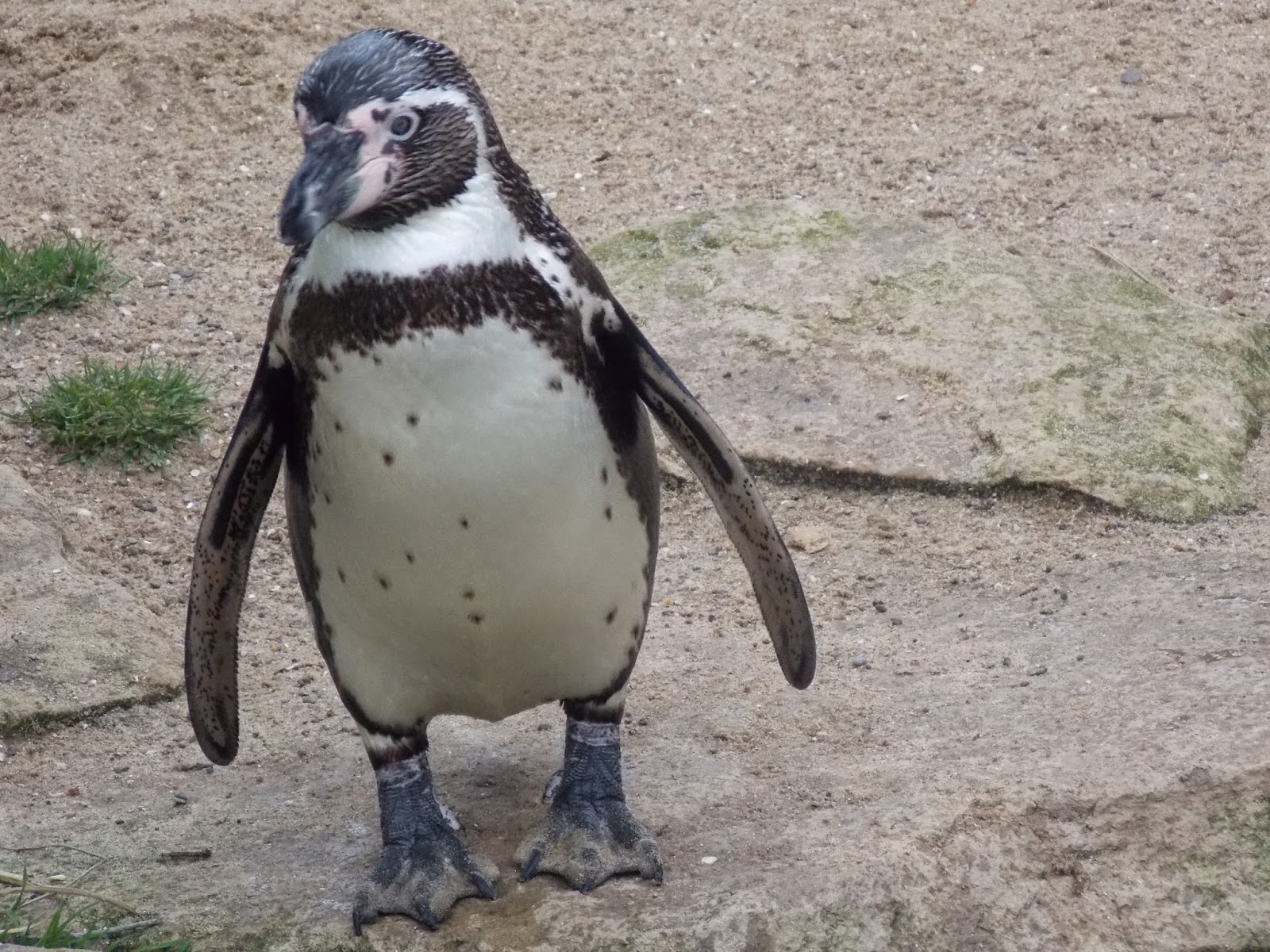
"Pp...pp. pick up a penguin," at Dublin Zoo, May 2014
One boy who comes to me for counselling suffers from a sort of low-grade depression for which he is taking sessions from a qualified psychologist in a local hospital.  I work with him once a week.  He is representative of a growing number of young people who seem to be somewhat bereft of hope.  In our sessions, we constantly talk about choosing life and hope, not despair and death.  Recently a young female contact (I never like the use of the word "friends" for "contacts" on this social network as it is a definite misnomer that can cause some young people an amount of anguish if they are deleted or blocked or even bullied by another so called "friend.") on Facebook put up a rather depressing status including the symbol of the skull: "It's mad knowing the only thing we actually are promised in life, is death I do have meself (sic) freaked to bits thinking about it!" Indeed, I notice that FB has become a sort of diary for many of our young people where they reveal their hearts to an oftentimes disinterested public.  As I say, I have my doubts about how helpful FB can be in mental health matters, but that is a debate for another post.

Attracted to the Light

It is indeed a truism to say that we are attracted to the light and repulsed by the dark. For the most part, we are all intuitively attracted by the light in good people.  Generally, it has been my experience that really good people are innately attractive, e.g., Martin Luther King, Mother Teresa, Pope John XXIII, Pope John-Paul II and in more recent times Pope Francis I.  I have named many others above in my opening paragraph.  I leave it to you, all you good loyal readers out there, to name your own attractive world political and spiritual leaders.  Essentially, such leaders share much with the historical Jesus and the equally historical Siddhartha Gautama (the Buddha), St Francis and all the present day great spiritual leaders (as distinct from Religious Leaders.  I will be contentious here by stating that I believe that Pope Benedict XVI was a Religious Leader while Pope Francis is a Spiritual Leader). I believe that the great contemporary religious writer and theologian Karen Armstrong is also an attractive spiritual leader.  Her books are widely read and she has been universally honoured for them.*

We must radiate the light of hope in our lives, especially if we are in any position of leadership.  Leadership requires those who exercise it to be real, authentic human beings, aware both of their strengths and weaknesses, to be open to encouraging those whom it is both their task and privilege of leading, being so self-assured in themselves that no one on the staff is ever a threat to their sense of authority.  They must be motivators who notice and affirm the innate talents in each and everyone of their colleagues and employees.  This may be a tall order, but after all that is why we put such people into leadership roles and pay them oftentimes extravagant salaries.

If we know that in the end, in a very real and actual way, every individual life is a physical
Chimp with orange, Dublin Zoo, May 2014
failure in the sense that we all end up in the grave, why then should we keep going on?  If, in the end, all the knowledge we have learnt in our individual brains decays into nothing with our bodies, why do we desire to learn?  A very intelligent student asked me that the other day when we attended the presentation of Green Flags for schools that had made serious efforts to cut down on waste of energy and water. We were discussing the dreadful ecological state we have got our lovely Blue Planet into in these more modern times when he asked the question.  If in the end we are all going to perish, given the horrific mess we have made of our planet, why not give up? I replied that one reason we bothered is that we did not ever wish to become victims, that we had a desire, in-built in us, for order and meaning, and that to give up hope was to admit defeat. As we continued our discussion we spoke of humankind being co-creators with the Creator of the Universe, of our being called to build up as many lovely things as we could for the sake of others, for the sake of all humankind and for the sake of all creaturely and inanimate life.

The lovely cuddly red panda at Dublin Zoo, May 2014

When we write a poem, sing a song, compose a new piece of music, protect animals, build a new building, nurse another sick human being or animal, discover a new piece of knowledge to add to the jigsaw of wonder which this life essentially is, we are lighting candles of hope. When we put out our hand to help another, when we join a cause for the betterment of someone or something or even smile in acceptance of another, we are engaged in spreading the light of hope.  When we shake hands, when we hug another, when we truly listen in acceptance, when we are truly compassionate towards all sentient things, as the Dalai Lama is wont to put it, then and only then are we a true and authentic people of hope.  All our most profound religious and spiritual traditions speak of the light of hope conquering the darkness of despair.  It is no wonder that we often turn to their wisdom traditions in times of disillusionment and despair for words of comfort like: "better to light one candle than to scorn the dark," or "every journey, no matter how long, begins with one little step."  Even if you only smiled at someone today, you are engaged in the apostleship of hope.  I have long loved the short saying of the late Medieval Catholic mystic Meister Eckhart that runs: “If the only prayer you said was thank you, that would be enough.”  If each and everyone of us said this prayer as often as we can on a daily basis we would be truly embracing the magic of hope. 


Footnote:

* In May 2008 Armstrong was awarded the Freedom of Worship Award by the Roosevelt Institute, one of four medals presented each year to men and women whose achievements have demonstrated a commitment to the Four Freedoms proclaimed by President Franklin D. Roosevelt in 1941 as essential to democracy: freedom of speech and of worship, freedom from want and from fear. The institute stated that Armstrong had become "a significant voice, seeking mutual understanding in times of turbulence, confrontation and violence among religious groups." It cited "her personal dedication to the ideal that peace can be found in religious understanding, for her teachings on compassion, and her appreciation for the positive sources of spirituality." 

Saturday, July 20, 2013

Journal of a Soul 28

My Eulogy for My Mother, Mary Quinlan, 1917 - 2013

Preamble

This short eulogy fits in here in this blog because it is very much written from the soul.  My brothers and I sat by her bedside from 05:30 until 00:05, that is for her last eighteen hours and thirty five minutes of earthly existence. She seemed to have "given up the ghost" when her breathing stopped at 22:05 on Monday 15th July. However, when the Doctor in attendance arrived she declared, having examined her, that she could not pronounce her dead as her heart was still strongly beating. In the end, she was declared dead at 00:05 on Tuesday16th July.  A deeply devout Catholic friend declared that he was in no way surprised at this, adding that my mother obviously wished to die on the Feast of Our Lady of Mount Carmel.  Now, as you will read in the tribute below, my mother had spent some15 years leading the Rosary in her local church which at that stage had been run by Carmelite priests - O. Carm.  If one is a Catholic believer one would call thing providence; if an agnostic, a coincidence, or a New Age believer a God-incidence.  Be that as it may, here follows my eulogy for my mother in full, together with a poem I wrote for her:

Mother’s Eulogy


1  Words of thanks must come first.  On behalf of the Quinlan family and the extended larger Brophy family I would like to take this opportunity to say a heart-felt “thank you” to all the medical, nursing, caring and ancillary staff in St Mary’s Hospital, Phoenix Park.  Anyone with any connection to that wonderful “home from home” will know the excellent standards of care and attention available there.  Mary was in four or five different wards during her long stay there, but her last port of call was Beibhinn Ward in Teach Cara where she spent three happy and content years.  To the wonderful staff of Beibhinn, thank you for your care and love for our mother – it was simply second to none.

2.  I would also like to thank Fr Gerry for his gentle, sensitive and prayerful handling of the whole funeral service.  Thanks, as well, to the choir for the lovely fitting music.


3.  I would also like to invite everyone, back to Parnell’s Club, now called The Chanel for a light meal.  My mother would have wished that her life would be fittingly celebrated with old memories and fun shared over a meal!

4.  Mary had a long and happy life of 96 years and three months.  While not an English scholar at all she liked to say that she was born on Shakespeare’s birthday, the 23 rd of April.  In her case the year was 1917.  If Mary’s life were a book it would contain three chapters:


5.  The First chapter would be entitled: “The Crumlin Years: Hard Work and Music.”  My mother was the second eldest of 12 siblings, and as the eldest girl she performed the role of mother to many of her younger brothers and sisters.  In those days much responsibility fell to the eldest girl in any family, more so in one so large.  A committed and diligent work regime was instilled into her from her earliest years, and caring was the core of her very existence from the beginning – this was never to change.  She was a wonderful home-keeper, organiser, cook, carer, dress-maker, knitter – all the usual skills and competencies associated with the traditional Irish woman of that era.  In hindsight she would have been imbued with all these values and skills by her own mother, Phoebe St Ledger, who was a convert from the Church of Ireland.  The Brophy home was a happy and caring home where Irish traditional Irish music was part of its very fabric with all the notables of traditional music, like Seamus Ennis visiting there because her father was a well-regarded exponent of the uilleann pipes and a marvellous reed maker.  I remember her telling me that when she was very young she and her siblings would follow my grandfather in line around the fields as he played the bag and chanter of his uilleann pipes.  This is chapter one, and it ends in 1954, I think, when all her siblings were reared and married and she herself married my father Thomas Quinlan.

6.  And so chapter 2 may be called “Roscrea and Dublin.”  In 1954 at the age of 36/7 she moved to Roscrea, the hometown of my father where we were all born.  Crises were never far away, but in her case they were all grist to the mill.  The first house was burned down, I believe, but luckily the alarm was raised and no harm done.  Then in the early sixties my father Tom got polio in the then countrywide polio epidemic. Luckily he came through that with just the loss of the use of one arm and was happily able to work for the rest of his life.  However, Mary never lamented any misfortune ever as troubles were simply something you dealt with, and never ever given into.  My father’s convalescence and his new work necessitated a move back to Dublin in 1964.  All these years, which were hard at times, were in general happy ones for her and her family.  Typical of her, she found herself a job to supplement the family income as the housekeeper for an old gentleman in Ballsbridge, which she continued with until she was a young 70.  Hard work was always part of her nature. Having retired, she became a daily mass-goer in this Church which became the hub of her daily existence as she proudly led the rosary here every morning for the last fifteen or so years of her active life, and during this time was a loyal member of the over-fifties group.

7.  Chapter 3 may be termed “The Long Good Bye.”  At 84, while still active, she had a mild stroke which unfortunately was the beginnings of dementia which she would live with for the last 12 and half years, with 11 or so of those spent in the care of the wonderful staff of St Mary’s hospital.  The first several years had their funny moments with Mary thinking the other patients were her brothers and sisters – indeed she called them by their names – and used to tuck them in at night before she went to bed herself.  However, dementia is no kind friend, and it diminishes the memory bit by inevitable bit, but thankfully she was always very happy in her surroundings and was constantly smiling, an ability she retained to the very end when speech was no longer possible.  She was able to smile for us before her passing.


8.  Her two most prominent characteristics were her gentleness and her total non-judgement of others.

9.  I’ll finish with a poem which may sum her up better than these above  more prosaic words:

A Poem for Mother

Your love was the shade of a tree on a scorching day,
A summer shower refreshing our parched clay,
A strong hand that lifted child from harm’s way,
Your face a sun that warmed our every day.

And yet not much was said
For all was done and every child was fed
And every plant was nurtured to its flower
As years rolled by beyond our power.

And now there are no words that we can say,
No rhymes to capture life’s decay,
The fall of leaf, the burden of dismay,
And yet there is a solace in the season’s turn:

Ripe fruit must fall to earth
To bring new life to birth

And so inevitable it must be,
The parting wave, the final smile, the stinging tear,
The mystery of the turn in every year.

And now we dwell in the comfort of your great love,
Your long life’s work, no task left undone –
Let us celebrate its length of years
And the joys that far outnumbered all our tears.

RIP, Mary and may the light of the heavens shine upon you!